Monday, June 23, 2014

The Dangers of Genetically Engineered Food

As a lead-in to Father Matthew’s essay on organic farming, Christianity, the body and soul, and other related themes that is planned for posting on Wednesday, here is some of the latest news on genetically engineered ‘food’.

A handy picture showing some of the dangers, etc. (mash the source path below for larger view):


How Oregon is fighting against GE food:


Vermont is the first State to require labeling of GE food:

Countries around the world are also banning GE crops, or thinking of doing so:


The deadly poisons associated with growing GE crops:


How GE crops harm livestock, and the tactics used by ‘corporate neighbors’ like Syngenta to silence their opponents:

Lastly, a more sustainable approach to farming:

Friday, June 20, 2014

Welcoming Summer - 2014

‘The Waving of the Corn’

By Sidney Lanier (Georgia poet, 1842 - 1881)

 Ploughman, whose gnarly hand yet kindly wheeled
Thy plough to ring this solitary tree
 With clover, whose round plat, reserved a-field,
In cool green radius twice my length may be —
 Scanting the corn thy furrows else might yield,
To pleasure August, bees, fair thoughts, and me,
   That here come oft together — daily I,
   Stretched prone in summer's mortal ecstasy,
Do stir with thanks to thee, as stirs this morn
            With waving of the corn.

 Unseen, the farmer's boy from round the hill
Whistles a snatch that seeks his soul unsought,
 And fills some time with tune, howbeit shrill;
The cricket tells straight on his simple thought —
 Nay, 'tis the cricket's way of being still;
The peddler bee drones in, and gossips naught;
   Far down the wood, a one-desiring dove
   Times me the beating of the heart of love:
And these be all the sounds that mix, each morn,
            With waving of the corn.

 From here to where the louder passions dwell,
Green leagues of hilly separation roll:
 Trade ends where yon far clover ridges swell.
Ye terrible Towns, ne'er claim the trembling soul
 That, craftless all to buy or hoard or sell,
From out your deadly complex quarrel stole
   To company with large amiable trees,
   Suck honey summer with unjealous bees,
And take Time's strokes as softly as this morn
            Takes waving of the corn.

____ West Chester, Pa., 1876.

Source:  http://www.gutenberg.org/cache/epub/579/pg579.html, posted July 1996, accessed 20 June 2014

Wednesday, June 18, 2014

Southern Piety and the Saints

One thing Southerners have always valued is reverence for the past: piety towards the forefathers of one’s own blood and other heroes of the fatherland, towards other righteous men and women of past cultures, for inherited traditions, and so on.  Memory is still a brooding presence amongst us.

How much more, then, ought veneration for the saints of the Church have a place in Southern life!  For if we are quick to honor those whose lives displayed only pagan virtues (like the ancient Greek and Roman statesmen, philosophers, and warriors), it is all the more fitting to honor the saints who have purified themselves completely of sin in this life, living perfectly the commandments the Lord gave us in the Holy Gospels, and who now dwell in the undimmed, unhidden Light of the Most Holy Trinity.

But what is meant by a ‘saint’?  Let us try to clarify a little.

Father Ambrose Young in a sermon for All Saints Sunday says,

 . . .

In Protestantism, generally, it is believed that anyone who has accepted Christ as Lord and Savior is already saved and is a saint, because the early Christians were always referred to in the Book of Acts and the Epistles as saints. This, however, betrays a lack of knowledge of the first Christians and their times. Those initial believers gave themselves over so completely and fully to Christ that their lives were absolutely, magnificently, and completely changed. They were “living saints”—something very different from people that came later or who call themselves Christians today, yet continue to life in a sinful lifestyle, with bad habits, negative outlooks, and vices, no matter how small. Those early Christian were indeed saints. They turned completely away from themselves and turned in the direction of Christ God exclusively. Christians today are not in the same category at all.

And then there is the Roman Catholic understanding of sainthood, which has generally evolved and changed over the centuries, reflecting different streams of thought in Western culture and civilization as society has developed or gone downhill. At the present time and for about a generation, most of the men and women in Catholicism who are beatified or canonized by the Pope—for example Mother Teresa of Calcutta—were elevated to the honors of their Church because of their fine social work and outreach. Of course there’s nothing at all wrong with social work and outreach, if one has been called to do that. Also, many Catholic saints are the founders of religious orders for men and women—in other words, very talented organizers and leaders–, and this is also a good thing. But all of this differs from the standards the Holy Fathers of Orthodoxy—both ancient and today—who have always upheld for sainthood in the Eastern Orthodox Church.

Of course in both Catholicism and Orthodoxy a saint is primarily someone who is now in heaven. But it is the qualifications for sainthood in each Church that differs in some ways. Basically, for us Orthodox, sainthood means that an individual attained a very high level of holiness in this lifetime, and holiness, in this context, means sharing in the very holiness of the Lord God Almighty Himself. Also, holiness is a special gift or, to use the correct Greek term, “charisma”, which God Himself gives to a man or a woman who has prepared and opened his soul, his mind, and his heart unconditionally and fully to God.

Of course all of us are called by God to be saints—that is, to be holy, sanctified. This is, in fact, the purpose, and the main purpose of our life here on earth. You see, our main purpose is not to be good businessmen—though there’s nothing wrong with that—or good teachers, or good priests, or good writers, or good anything else. Our primary destiny is to live with God in most intimate union, forever, and ever, and ever, beginning in this life.

The Holy Trinity gives all of us, each and every one, exactly the amount of grace that we need to become saints even while we live here on earth. He does not give saints like St. Nektarios or St. John of San Francisco a different grace or more grace than He gives us. It’s the same for all. The difference is how we make use of that grace, whether or not we make use of it to come to holiness in our lives, or whether we waste it.

 . . .

Each and every one among all these saints has his or her own calling and characteristics: they all fought the “good fight for the faith” (1 Tim. 6: 12 and 2 Tim. 4: 7). All of them applied in their lives the scriptural virtues of “justice, piety, fidelity, love, fortitude, and gentleness” (1 Tim. 6: 11).

Furthermore, we Orthodox believe that “the ultimate goal of the saint is to imitate God and live the life of deification (theosis)…turning and looking always towards God, thus achieving total unity with Him through the Holy Spirit.

These, then, are the specific things we remember and think upon on this, the Sunday of All Saints, thanking God for this great “cloud of witnesses” that has been, are, and will be brought forth by the outpouring of the Holy Spirit, which began on Pentecost. Let us not have it rest there.

We should also, today, be thinking that we, too, are called to complete union with Christ God and perfection or deification in the Holy Trinity. Let that be our prayer, our hope, and our sworn goal on this Sunday.

 . . .

Source: http://www.pravmir.com/all-saints-suday/#ixzz351quDWOY, posted 19 June 2011, accessed 18 June 2014

Prof Alexey Osipov takes us deeper into the differences of how the various churches approach the saints.

 . . .

But there is a different way, which shows apparently, what Catholicism is and where it leads one to. This is also a method of comparative investigation, but investigation of the spiritual sphere of life, demonstrated in the life of saints. Here the whole deception (as it is called in the ascetic language) of the Catholic spirituality gets revealed, the deception fraught with very grave consequences for an ascetic who chose this way. You know, sometimes I give public lectures, attended by different people. Frequently they ask me the question: "What is the difference of Catholicism from Orthodoxy? What is its fault? Is it not just a different way to Christ?" Many times I saw it is enough to give a few examples from the life of catholic mystics for the inquirers to say: "Thank you, now it is clear. It's enough."

Indeed, any Local Orthodox Church or non-Orthodox church can be judged by her saints. Tell me who your saints are and I will tell what your church is. Any church calls as saints only those who realized in their life the Christian ideal, as this Church understands it. That is why canonization of a certain saint is not only testimony of the Church about this Christian, who according to her judgment is worthy of the glory and suggested by her as an example to follow. It is at the same time a testimony of the Church about herself. By the saints we can best of all judge about the true or imaginary sanctity of the Church.

I am going to give you a few examples to illustrate the idea of sanctity in the Catholic church.

One of the great Catholic saints is Francis of Assisi (13th century). . . .

The goal of life set by Francis is also very indicative: "I laboured and want to labour further…, for it brings honour" (St. Francis of Assisi. - M., Izd.Frantsiskantsev, 1995. - P.145). Francis wishes to suffer for the others and atone their sins (P.20). And at the end of his life he frankly said: "I do not know any transgression of mine that I have not atoned by confession and repentance" (M.V.Lodyzhensky. - p.129). All this testifies for his not seeing his sins, i.e. his total spiritual blindness.

For comparison I'll describe to you a moment from life of St. Sisoi the Great (5th century). "Just before his death, surrounded by the brethren, when Sisoi looked like talking with invisible ones, to the question "Father, tell us, whom are you talking with?" he said: "The angels have come to take me, but I pray to them that they let me stay here for a short time for repentance". Knowing that Sisoi was perfect in virtues the brethren objected to him: "Father, you have no need in repentance", and Sisoi answered like this: "Verily, I do not know, if I have at least started the cause of my repentance" (Lodyzhensky. - p.133). This deep understanding, sight of one's imperfection is the main distinctive trait of all true saints.

 . . .

Mystical experience of one of the pillars of the Catholic mystics, founder of the Jesuits Order Ignatius Loyola (16th century) was also based on the methodical development of imagination.

His book "Spiritual exercise", which has enormous authority with the Catholics, calls a Christian to imagining and contemplating the Holy Trinity, Christ, Mother of God, angels, etc. All this fundamentally contradicts the foundations of the spiritual feats of the saints of the Ecumenical Church, for it leads the faithful to the total spiritual and mental disorder.

An authoritative collection of ascetic writings of the ancient Church "The Dobrotolubie" ("The Philokalia") strictly forbids this kind of "spiritual exercise". Here are a few quotations from it.

Saint Nilus of Sinai (5th century) warns: "Do not desire to see sensually Angels or Virtues, or Christ, otherwise you'll go mad taking a wolf for the shepherd and bowing to demon-enemies" (St.Nilus of Sinai. 153 Chapters on Prayer. Ch.115 // The Dobrotolubie: In 5 volumes. V.2. 2nd edition. - M., 1884. - p. 237).

St. Simeon the New Theologian (11th century) reasoning about those who "imagine heavenly blessings, angel hosts and abodes of saints" in prayer definitely says "this is a sign of prelest" (spiritual deceit). "Going this way even those who see light with their bodily eyes, smell fragrance with their nose, hear voices with their ears and the like get seduced (St. Simeon the New Theologian. On three forms of prayer // The Dobrotolubie. V.5. M., 1990. p.463-464).

St. Gregory the Sinaite (14th century) reminds: "Never accept things when you see something sensual or spiritual, inside or outside, even if it has an image of Christ or an angel or a certain saint… The one who accepts it easily gets seduced… God does not resent one being attentive to himself, if one fearing to get seduced does not accept what He gives,… but rather praises him as a wise one" (St. Gregory the Sinaite. Hesyhast instruction // same. - p.224).

So the landowner, whom St. Ignatius Brianchaninov described in his work, was quite right, when he seeing a catholic book "On the Imitation of Christ" by Thomas a Kempis (15th century) snatched it out of her hands and said: "Stop playing a romance with God". The above examples do not leave any doubts in the truth of these words. Unfortunately, the Catholic church has lost the art to distinguish the spiritual from the sensual, and sanctity from reveries, and thus also Christianity from paganism.

That's what I wanted to say about Catholicism.

To make it clear with Protestantism it is enough to have a look at its dogmatics. To see its essence I'll limit myself to the main doctrine of Protestantism: "Man gets saved only by faith and not by deeds, that is why sin is not counted to the believer for sin". Here is the main question where the Protestants got confused. They start to build the house of salvation from the 10th floor having forgotten (if they remembered it at all) the teaching of the ancient Church what kind of faith saves man. Not the faith that 2000 years ago Christ came and did everything for us?!

What is the difference in understanding the faith in the Orthodoxy and the Protestantism? The Orthodoxy says that man is saved by faith, but sin is counted to the believer for sin. What sort of faith is it? - Not a mental one, but the state acquired trough correct Christian life, thanks to which one gets assured that only Christ can save him from bondage and poignant passions. How can one achieve this faith-state? Through compulsion to observe the Gospel commandments and sincere repentance. St. Simeon the New Theologian says: "Through strict observance of Christ's commandments man learns his infirmity", that is one discovers his inability to extirpate passions without God's help. For man alone it is impossible, but together with God everything is possible. Correct Christian life reveals to man, first, his passions-illnesses, second, that God is near each of us, and finally, that at any instance He is ready to come to the rescue and save us from sin. But He saves us not without us, not without our efforts and struggle. Act of faith is necessary to make us able to accept Christ, for they show us that we cannot heal ourselves without God. Only when I am drowning I realize I need a Saviour, when there is nobody on the bank, and only when I feel I am drowning in the poignant passions, I turn to Christ. And He comes and helps. This is where the living saving faith starts. The Orthodoxy's teaching is about freedom and worthiness of man as a God's co-worker in his salvation, and not as a "salt pillar" according to Luther that cannot do anything. This makes clear the meaning of all Gospel commandments, leading a Christian to salvation, not faith alone, and makes obvious the truth of the Orthodoxy.

 . . .

Source:  http://www.pravoslavie.ru/english/7174.htm, lecture given 13 Sept. 2000, posted 18 March 2004, accessed 26 May 2014

So there are some of the differences to ponder. 

Finally, Gabe Martini helps us see what benefits come from seeking help from the saints:

The Orthodox Church has a long tradition of honoring the Saints.

While all of God’s people, sanctified or “set apart” from the world, can be properly termed saints (e.g. Acts 9:13,32,41; Rom. 1:7; 1 Cor. 1:2; etc.), there are some who are already glorified in Christ, resting in the uncreated light of God’s eternal kingdom.

These are luminaries of the Church, shining forth among the darkness of our world, even during this temporary sojourn. They fought the good fight; they finished the race; they kept the faith (2 Tim. 4:7). Even in their repose, they are more alive in Christ than we. And it is to these known (and unknown) Saints that we look for not only inspiration and encouragement, but also for intercession; as enduring examples of how to speak, live, and die like Christ.

Some Christians object to the idea of honoring Saints—whether that be venerating their relics and images, or asking them for their prayers—because they feel it is to ignore the living already with us in the Church here on earth. They will suggest that a danger lies in only “speaking with the dead,” as the dead either cannot or will not talk back to us, redirecting us when straying from the straight-and-narrow.

But is this really the case? Is the danger real, or is it a misguided fiction? On the contrary, I think the danger is far greater without the Saints.

Growing up Southern Baptist, I spent a lot of time in our parish youth group. Practically every Baptist church in the Bible Belt has one, and they are where teens and young adults not only socialize but also learn more about their faith. The youth group leader, often a 20-something recent graduate of seminary, was more than just a leader to these teenagers; he was a role model, a mentor, a confidant, and a friend. Many students placed much of their identity in this person, not to mention their identity or hope as a Christian.

And in this veneration of a still-living person comes a great danger: What happens when he fails? When a scandal erupts? When there’s conflict, or a messy “falling out” between he and a particular congregation?

This happened more often than I care to recall . . . .

This sort of tragedy and loss of trust can occur in a number of situations, of course, and is not limited to just one type of faith or organization. But the point remains that trusting in those who are living is not always a “safe bet.” In fact, the safest “bet” of all is looking to those who, as St. Paul writes, have fought the good fight and finished the race—a race that is set before each one of us as Christians.

And in both Christ and his holy Saints, we have such examples; we have such sureties of faith, role models who will never fail us or let us down. People who can help us every step of the way in our mortal race towards Paradise.

 . . .

With Saint Sophia, and the horrors she endured for the sake of not only her own salvation, but that of her triumphant, martyr daughters, what situation in our lives is beyond her intercessions? What difficult circumstances will we face that she couldn’t herself understand, or with which she couldn’t empathize?

This is why we honor Saints like Sophia; this is why we ask for her holy prayers, and the prayers of her three righteous daughters—daughters who perished so young, but are yet victorious over death itself in the risen Jesus Christ. We have assurance that the prayers of the righteous are powerfully effective (James 5:16), and there are none more righteous than the Saints.

Again, we honor the Saints because they have endured to the end. As those who have finished the race, they wisely pray that our every step might be guided to the finish. Because they have finished the race set before them, they are now resting in the glory of Christ in heaven—in the very presence of the all-holy and blessed Trinity. A place where there is no sickness or suffering, no sorrow or sadness, no death or disease.

Source:  http://www.pravoslavie.ru/english/71464.htm, posted 13 June 2014, accessed 18 June 2014

The South has done well to honor those who lived virtuous lives in the past, but now let us as a people bring to perfection this good desire by learning about the lives of the Orthodox saints, venerating them as good soldiers of Christ, and asking for their prayers as we seek to attain what they already have attained: complete freedom from sins and passions in this life, and rest in the All-Holy Trinity in the next. 

May we in true Southern fashion join together in singing to the saints, ‘Eternal be thy memory!’ (from the Orthodox Church’s Memorial Service, https://en.wikipedia.org/wiki/Memory_Eternal_(chant))


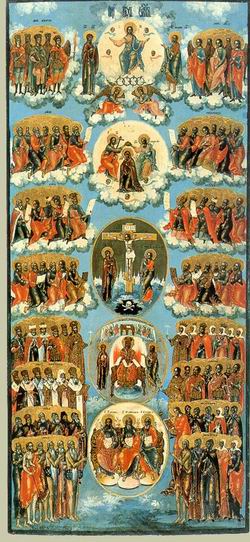
(Icon from the same page as Fr Ambrose's sermon)

Monday, June 16, 2014

Does the Path to Antichrist’s Enthronement Run through Iraq?

At the end of their report on how the West is funding both sides in the war against the ‘terrorists’, Alex Jones and Kurt Nimmo write (bolding added--W.G.),

 . . .

Iran, Iraq and Syria may indeed unite to rid Iraq of the current Wahhabist scourge threatening to take over the country and destabilize the region. However, as we have learned since the CIA, Pakistan and Saudi Arabia built and unleashed the terror group and its surrogates, al-Qaeda is tenacious and in the past has experienced miraculous resurgence.

The globalists are primarily interested in fomenting chaos and disorder. Iraq was invaded in 2003 because it was a relatively strong contender in the neighborhood – and this is, as well, why it was coaxed into attacking Iran and, fatefully, Kuwait. Bush’s” Mission Accomplished” was not a tribute to the defeat of Saddam Hussein. It was an acknowledgement that Iraq had been reduced to a failed state on par with Yemen and countries in sub-Sahara Africa.

ISIL and other Saudi-financed and supported terrorist groups may desire a caliphate in the Middle East. However, for the global elite, such a prospect comes in a distant second to its primary objective – taking down all contenders and reconfiguring the world order for its ultimate end: the establishment of a one world totalitarian government.


As if in anticipation of what these two would write, Father Andrew Phillips wrote the following about Archbishop Averky the day before, which adds the needed spiritual dimension to the above report (bolding added--W.G.).

 . . .

He reposed in 1976, known for his Orthodox writings and sermons calling to repentance, his saintly life, adherence to the Tradition against ecumenism and extremism, and his conviction that the end of the world was rapidly approaching amid contemporary apostasy.

The mystery that concerns us is why the Archbishop was so convinced that the end was near. After all, forty years on, we are still here. The answer, however, is not complex. Already, over 1950 years ago, the Apostle Paul wrote similarly of the end of the world. Is it possible then that saints can be wrong? In reality, the saints are not wrong. The end of the world has been near on several occasions. Saints and the saintly have intuitions of this and this is precisely why they are sent by God to warn us and to call to repentance. This is what the Apostle Paul did and it is also what Archbishop Averky did. And people did listen to him and others.

In 1981, five years after Archbishop Averky’s repose, the Synod of Bishops canonized the New Martyrs and Confessors of Russia. Thanks to their prayers, persecution ceased in the Russian Lands and there began the process of the Rebaptism of Rus. With this act of repentance for the overthrow of Old Russia and its Orthodox foundations three generations before in 1917, the world changed. God gave an extension to the world and the end that had indeed been near in the 1960s and 1970s, just as the holy Archbishop had said, drew back.

Today, with the world situation on a knife edge, with the Western world gripped by the Satanic urge for global military and economic control and seeking to destroy the last vestiges of spiritual life everywhere, with many Orthodox countries like Greece, Cyprus, Romania and Bulgaria compromised by Western propaganda, with many of the last strongholds of Orthodox piety, including Serbia, Georgia, Moldova and now the Ukraine, under threat, and with Russia only half-way to repentance, it is clear that the end is approaching once more. Now only the Mother of God can extend history and grant us another period for repentance. Now we should turn again to the prophecies and warnings of Archbishop Averky.

Source:  http://www.events.orthodoxengland.org.uk/the-mystery-of-archbishop-averky/, posted 12 June 2014, accessed 16 June 2014

May we all in one accord beseech the Most Holy Mother of our God for mercy, which she has received from her Son in great abundance to give to the world, with which she remains most closely joined.  Here is a prayer service that is well suited for the times:


For our Protestant friends who may not be so willing to do this, we ask you to prayerfully read the following about the Mother of our Lord before banishing the idea completely from your mind.


Friday, June 13, 2014

The Trinity in Politics

One of the places in the West where the effects of her overly rationalistic doctrine of the Holy Trinity may be seen is in her politics.  And it is here that the South, sadly, shows herself to be a participant in large measure in Western heresy.

In the Western Trinity (that of the Roman Catholics and many Protestants), one begins with the simple divine
essence, de-emphasizing the Persons, who only take on their attributes and something resembling personhood through a process of opposing one Person to another.  Speaking of the Western Trinity, Dr Joseph Farrell comments,

This simply reiterates the tension in the doctrine inherent from the beginning.  It repeats the predicament of Plotinos, for there is a fundamental limitation that the dialectic of oppositions imposes upon trinitarian relations.  It can deal with only two terms, two polarities at any one time, and is thus wholly inadequate to deal with the Trinity.  The logic must always, somewhere, compromise the absolute status of the Trinity by compromising the absolute divinity and person of the Holy Spirit.  On the other hand, it must also compromise the simplicity of the essence, for there is always an interior dialectic within it.  The Trinity of persons is incomplete, for just at the precise moment when the Spirit proceeds from the Father and the Son, the whole process, according to Aquinas, collapses back into the essence “from which the proceeding began.”  There is, thus, in the doctrine of the filioque an ubiquitous, nascent binitarianism,109 a tendency that Saint Photios does not hesitate to call “semi-Sabellianism.”110

In the final analysis, the filioquist triadology has no real Trinity, but only a dyad of Father-Son opposed to Essence-Spirit.111 

Source:  ‘A Theological Introduction to the Mystagogy of St Photios’, http://www.anthonyflood.com/farrellphotios.htm, posted 9 September 2009, accessed 13 June 2014

When this Western doctrine of the Trinity is transferred to the political realm, it looks much like the parliamentary system of today’s western European nations, the [u]nited States, and their colonies around the world.  It too is based on a system that starts with a simple essence (‘the people’), from which are formed two opposed entities (the legislature and the executive).  This dyad in its turn produces a third entity (the judiciary) that is in opposition to the other two.

So what Rush Limbaugh, the TEA Party, and many conservatives laud to the hilltops, the [u.] S. Constitution, is in actuality one of the most refined manifestations of heresy mankind has ever witnessed.

The South, for her part, is fully a part of this catastrophe, though she knows not what she does, careful as she has always been to defend orthodox beliefs in every sphere of life.

But her political philosophers give her away.  They are always praising not Christian virtues in politics but worldly ones:  Thomas Jefferson and ‘jealousy’ in ‘The Kentucky Resolutions of 1798’, Patrick Henry and ‘self-love’ of States and people in the Virginia Ratification Debates of 1788, the self-interest upstirred by John C. Calhoun's system of the concurrent majority, etc.  And more directly, every constitution of the Southern States, and of the Confederacy, has had a structure similar to the one described above.

In a nation whose people think rightly about and have true communion with the Holy Trinity, things are different.  There, all orders of society generally move together as one under the guidance of king and bishop toward their one goal, the salvation of their souls.   The reader may see two examples from Orthodox countries, one from St Nikolai Velimirovich (Serbia) and one from Prof James Kelley (the Eastern Roman Empire), in the Easter message posted 23 April 2014. 


Another important example comes from Russia, in the long years prior to her fall to the Soviet invaders: 

In order that State life should develop strongly and correctly, flourish with education, and bring forth the fruit of public prosperity, it is necessary that family life should be strong with the blessed love of the spouses, the sacred authority of the parents, and the reverence and obedience of the children, and that as a consequence of this, from the pure elements of family there should arise similarly pure principles of State life, so that with veneration for one’s father veneration for the tsar should be born and grow, and that the love of children for their mother should be a preparation of love for the fatherland, and the simple-hearted obedience of domestics should prepare and direct the way to self-sacrifice and self-forgetfulness in obedience to the laws and sacred authority of the autocrat… (Metropolitan Philaret in Vladimir Moss, Autocracy, Despotism, and Democracy, Part 1, http://www.orthodoxchristianbooks.com/downloads/469_AUTOCRACY_PART_1.pdf, p. 12).

The Russian example is therefore one of familial love between the Tsar and the people (not of ever-present distrust and undeclared warfare between ruler and ruled as in the West), just as it should be among every people that professes a right belief in the Holy Trinity.

No government will ever be perfect in this fallen world, but we make them so much the worse when we place within them unnecessary vices and conflicts due to a false understanding of God. 

Metropolitan Kallistos Ware writes something that makes for a fitting end to the week’s posts on the Holy Trinity:

Our social programme, said the Russian thinker Feodorov, is the dogma of the Trinity.  Orthodoxy believes most passionately that the doctrine of the Holy Trinity is not a piece of ‘high theology’ reserved for the professional scholar, but something that has a living, practical importance for every Christian.  The human person, so the Bible teaches, is made in the image of God, and to Christians God means the Trinity:  thus it is only in the light of the dogma of the Trinity that we can understand who we are and what God intends us to be.  Our private lives, our personal relations, and all our plans of forming a Christian society depend upon a right theology of the Trinity.  ‘Between the Trinity and Hell there lies no other choice’1 (The Orthodox Church, New York, Ny., Penguin, 1997, p. 208).

And what is it we see day after day, if not Hell itself unfolding all around us in the South and throughout the Western nations?

(Thanks to JA for helping me with these ideas some years back.)

Wednesday, June 11, 2014

The Holy Trinity in the North and the South

St Nikolai Velimirovich writes in his Prayers by the Lake (Prayer XXXIV),

Where there is one, there is no love.  Where there are two united there is only a semblance of love.  Where three are united, there is love.  Your name is Love because Your name is trinity in Unity.

If You were solitary, You would not be love but hatred.

If You were a duality, You would be an alternation of love and hatred.  But You are a trinity, and therefore You are love, and in You there is neither darkness nor alternation.

 . . .

Love sacrifices itself, and does not feel that the sacrifice is giving but rather receiving (pgs. 60-1).

There is no love in one, for there is no ‘other’ on behalf of whom he can sacrifice himself, for whom he can completely empty himself.  Two can exchange love in this way, but their love is still incomplete.  A third person is needed (the Holy Ghost), one who can rejoice in the love of the first two (the Father and the Son), while strengthening and perfecting their love with his own.  Thus does the All Holy Trinity become all perfect and radiant and harmonious in the mutual life of the Father, the Son, and the Holy Ghost (Fr Dumitru Stăniloae, The Holy Trinity, pgs. 24-5).

Furthermore, ‘If there were four [or more--W. G.], everything would not be in this direct, uninterrupted relationship.  There would always be a “He” on the outside.  It would be obvious that someone would always be left out’ (p. 58).

The teaching of the Holy Trinity:  Here is a bright separating line between New England and the South.

The Puritans of New England drifted into Unitarianism (and worse) long ago (A. J. Conyers, ‘The Real Old Time Religion’, http://www.thesouthernpartisan.com/wp-content/uploads/2011/02/03.1-ARCHIVEConyersOldTimeRel-25p.pdf, pgs. 10-14), the idea of the lonely god.  It is not surprising, then, that New Englanders come across as cold and unfriendly; they partake of the nature of their god.

The South, having kept a stronger sense of the trinitarian nature of God (Thomas Landess, ‘A Note on the Origin of Southern Ways’, Why the South Will Survive, p. 161), reflects this in the warmth, kindness, givingness, and hospitality of her people.

But her moorings were not secure (being severed from the firm ground of Orthodoxy from her beginning), and she was further shaken by the War and Reconstruction that destroyed the plantation system, which had been a bulwark against very much harmful innovation in religion and other areas.

The hearts of her people are now hardening all the more, as New England dogmas of God, man, and the creation seep into them:  Worldly success is the sign of God’s favor; those cursed by God (the poor and ‘undeveloped’ peoples) and all the natural world may be exploited to attain ‘success’, for God is not in these fallen creatures and corrupted matter - only in his chosen ones (gnosticism); wars of aggression may be waged to take resources from the ‘accursed’ peoples or to try to ‘reform’ them (‘exporting democracy’); money, comfort, and things for oneself are the end of life.

And the political leaders of the South are taking us straight down this path of perdition: preaching economic development and growth as the cure for all ills.  Nor do the churches speak much of renunciation, continual repentance, and the like.  Thus do they betray their own people.

‘Little children, keep yourselves from idols’ (I John 5:21).


Works Cited

Landess, Thomas H.  ‘A Note on the Origin of Southern Ways’.  Why the South Will Survive: Fifteen Southerners Look at Their Region a Half Century after I’ll Take My Stand.  Wilson, ed.  Athens, Ga.: U. of Georgia Press, 1981.

Stăniloae, Fr Dumitru.  The Holy Trinity: In the Beginning There Was Love.  Clark, trans.  Brookline, Mass.:  Holy Cross Orthodox Press, 2012.

Velimirovich, St Nikolai.  A Treasury of Serbian Orthodox Spirituality, Vol. V:  Prayers by the Lake.  3rd ed.  Mika and Scott, trans.  Grayslake, Il.:  Diocese of New Gracanica and Midwestern America, 2010.

Monday, June 9, 2014

Sometimes the West Admits Its Errors Plainly

In an otherwise good essay on the failures of modern public education, Steven Jonathan Rummelsburg says this, ‘Where Jerusalem and Athens meet, the cardinal virtues are made perfect by the theological virtues that signal the true ends of all human souls . . .’ (‘The False Promises of Public Education’, http://www.theimaginativeconservative.org/2014/05/false-promises-public-education.html, posted May 2014, accessed 13 May 2014).  Here in one short sentence is seen the main trouble with the West:  It has imported pagan Greek theology into Christianity, particularly the Neoplatonic theology of Plotinus, which posits a trinity of the One, the Nous, and the World-soul:

There are two finite particulars which the One creates in Plotinos’ system: the Nous (mind) and the World-soul.  The One, without any activity on its part, naturally produces the Nous.  This Nous in turn produces the World-soul in company with the agency of the One.  The Neoplatonic universe thus takes on a definitive, three-storied structural subordination.  At the pinnacle is the One, acting as the Uncaused Cause of all.  In an intermediary position comes the Nous (mind), caused by the One and, along with the One, causing the World-soul.  In the last position comes the World soul, emanating from both the Uncaused Cause and the Caused Cause.  As a study of Aristotelian logic and physics, this subordination is classic: the One has absolutely no distinctions; the Nous has one distinction, that of being caused by the One, and the World-soul, has two distinctions, those of being caused by two different types of causes.

Source:  Dr Joseph Farrell, ‘A Theological Introduction to the Mystagogy of St Photios’, http://www.anthonyflood.com/farrellphotios.htm, posted 9 September 2009, accessed 9 June 2014

In the Roman Catholic and Protestant churches, as Dr Farrell goes on to show, the Father, the Son, and the Holy Spirit correspond to the One, the Nous, and the World-soul, respectively.  What the Western churches have done in this marriage of paganism and Christianity is to reject the personhood and divinity of the Holy Spirit.  Paul Elmer More, a New England Roman Catholic (from New Hampshire), spells this out most clearly in his book The Catholic Faith (1931).  Speaking of the Apostles’ Creed, he says:

‘In the treatment of the Father and the Son the note is definitely personal, as the words Father and Son themselves imply, and as the activities ascribed to the second person affirm.  On the contrary, the activity connected with the Holy Ghost . . . is not of a person, nor of an individual, but denotes rather the influence of the spirit of God (i.e. of the Father and the Son) working within and upon the spirit of man’ (p. 82).

Roman Catholics, he continues, reject ‘dogmatic trinitarianism’, ‘belief in three persons, equally distinct and equally individual’ and affirm instead ‘a double personality, or the double revelation of a personal God, whose spirit of Grace is the Comforter of our human spirit and its eternal Advocate.’  He quotes Hippolytus for support:  ‘I will not say two Gods, but one God and two persons, and a third economy which is the Grace of the Holy Ghost’ (p. 83).

Prof More quite flatly declares the Roman Catholic dogma of God to be ‘binatarianism’ rather than trinitarianism (pgs. 83-4). 

In the West, therefore, all who accept the Roman Catholic view of God (including the Protestants who have not rejected this part of their Catholic inheritance) confess belief in two divine persons, the Father and the Son, and in one created impersonal spirit (the Holy Spirit).  This dogma has been crystallized in the Western version of the Nicene Creed, which states that the Holy Spirit proceeds from the Father and the Son, rather than from the Father alone, as is found in the original form of the Creed and the Holy Scriptures.

From here all the sicknesses of the West do flow.  The Pope, proclaiming himself the Vicar of Christ on earth, makes bold to share with Him control over the grace of the Holy Spirit, giving it to whom he pleases.  Protestants, not well disposed to this idea (and rightfully so), declare the universal priesthood of believers - that the grace of God is available to all who ask for it, without the mediation of clergy of any kind.  Just as in Plotinian theology, so now in Western theology and life, an endless series of opposing pairs is begun, bringing with them endless wrack and strife, not limited to the religious sphere, a deranged shifting between one extreme and the other: the one and the many, dictator vs the masses, ruler vs ruled, socialism vs libertarianism, the Pope vs Protestants, clergy vs laymen, celibacy vs debauchery, heaven vs earth, corporations vs labor, collective vs individual, executive vs legislature, national vs local, and so on and so on.

All of this is quite foreign to Orthodox Christianity, which remains free of pagan distortions, in which the full divinity and personhood of each of the three Persons of the Holy Trinity is preserved.  Here, in Orthodoxy, though elevated to a special rank because of the duties they are expected to perform, bishops, priests, and secular rulers are not cut off wholly from the congregation and citizenry as some sort of separate castes, but remain a part of their number.  All are one in the Church: separate gifts and duties, but one Divine-human Body. 

Humility, love, the cutting off of one’s will for the sake of another, harmony, peacefulness, and other virtues have thus been more readily seen in Orthodox countries (though they have their faults, as any human society will) than in those that have fallen into the downward spiral of Western theology since the Great Schism.  For the life of the All Holy Trinity (which is reflected in the Orthodox Church) is the voluntary self-emptying of Each of the Persons, all equal in dignity and holiness, for the sake of the Others out of love, and not an opposition of One to Another out of a necessity created by the inequality of the Persons.

Because the South’s trinitarianism was stronger than New England’s (though still imperfect, being crusted over with Catholic and Protestant thought), she fared better until recently when the latter’s ideas began to firmly root themselves here.  It is the South’s great need (and that of all Western peoples) to return to an Orthodox understanding of the Holy Trinity, or truly the path of Antichrist will be opened wide as the desire for another savior will continue to grow in the hearts of men amid all the sturm and drang issuing from false dogma.

So, what shall we have?  Life and love from the Holy Trinity?  Or hatred and death from the two posing as three? 

Works Cited

More, Paul Elmer.  The Catholic Faith.  Princeton, Nj.:  Princeton UP, 1931.

Pentecost Monday, 9 June 2014