Tuesday, April 5, 2016

God, Man, and Democracy

Why does democracy fare so poorly as a political system?  Because it is not in accord with reality.  Mankind, democracy says to us, is a mere collection of completely separate, self-enclosed individuals who have no inner, ontological connection with one another.  There is little thought of the common good, only self-interest.

But the truth of the nature of mankind is the opposite.  Like the Holy Trinity, in Whose image and likeness man has been made, we are many persons/hypostases sharing one human nature.  Like the Persons of the Father, Son, and Holy Ghost, each man reaches the fulness of personhood only by emptying himself, by becoming the servant of all.  ‘The other’ is not my enemy, a competitor for scarce resources, a business or political rival, or any other such thing as Darwin, Locke, Hobbes, and other Enlightenment thinkers teach us.  He is my salvation; he is my doorway into the Kingdom of Heaven.

St Macarius the Great of Egypt said this as clearly as anyone could:

‘There is no other way to be saved but through our neighbour; according as He enjoined, Forgive, and ye shall be forgiven’ (Fifty Spiritual Homilies of St Macarius the Egyptian, Homily XXXVII, Forgotten Books, 2012, p. 251).

Democracy, we may say then, is a sin against love.  But love is the reason there is a creation at all, which came into being because of the overflowing of the love of the Persons of the Holy Trinity.  So perfect is Their love that They wanted others outside Themselves to share in the joys of knowing it, so They created the angels and man and all the cosmos.  Love undergirds and upholds the created world (Archimandrite Vasileios, The Saint: Archetype of Orthodoxy, 2nd ed., Dr Elizabeth Theokritoff, trans., Montréal, Québec: Alexander Press, 1999, p. 8). 

So when man acts contrary to love, as he does in modern Western democracies, where the basis of man’s existence is said to be mistrust and fear of those around him; when each and all see themselves as totally closed-off, mutually repelling, atomistic individuals in competition with one another rather than as persons who were made to embrace all the creation within themselves; when they do this, they move away from love, which called all things into being and which holds all things together, and towards non-existence (see, e.g., http://www.ancientfaith.com/podcasts/freeman/to_tell_the_truth).  The resulting chaos and trouble should not be a surprise to any of them.  But it is.  And, sadly, their answer in many cases is ‘Give us more democracy!’

Christ’s one and only Incarnation also shows the oneness of man’s nature.  If it were not so, our Lord would have had to undergo the whole redemptive process – incarnation, life, death, resurrection, ascension – for each individual, rather than once for the whole of mankind.

Because of its underlying teaching about man, pluralistic/secular democratic political life necessarily stirs up vices:  anger, slander, revenge, pride, greed, lust for power, unnecessary talk.  In short, constant agitation and disquiet.  There is no stillness.  And where there is no stillness, there is no pure prayer.  And where there is no pure prayer, there is no real union with God.  And where there is no real union with God, as said above, all things fall apart.

Political life in a Christian kingdom on the other hand gives birth to virtues:  Obedience, humility, self-sacrifice, love, calmness, quietness, harmony.  Here, life in the Holy Trinity can be known; here, the goal of God being all in all can begin to be approached.

Democracy is not consistent with the fulness of personhood we are called to achieve but with the emptiness and shriveled smallness of individualism.  Democracy reduces man to the level of an impersonal mathematical variable, an empty cipher to be manipulated in a political consultant’s election calculus:

‘ . . . unlike the individual, the person is not a quantitative category, in the sense that he or she can be numbered on an arithmetical basis and so form part of an impersonal total.  The person is a qualitative category, one that derives from the possession of certain inner qualities.  Thus the person has nothing to do with numbers and transcends and even abolishes arithmetical categories.  . . . A relationship between persons consequently cannot be established through any outward bond or constitution.  It can be established only through mutual recognition that each possesses and embodies the same inner qualities, an identical inner reality [i.e., all must recognize that ‘The person . . . is the ‘image of God’, a spiritual value . . . .’ something which at the very least is implicitly denied by the behavior of political opponents who speak to one another and treat one another as though they were less than human--W.G.]’ (Philip Sherrard, Church, Papacy and Schism: A Theological Enquiry, Limni, Evia, Greece: Denise Harvey, 2009, p. 26).

In a kingdom, however, man is seen differently, not as an abstraction but as a concrete, personal being who has real, deep connections with other people:

‘ . . . in a traditional monarchy the relationship between king and subject is that of a middle-aged father and his mature son, not that of a young father and an infant’ (Erik von Kuehnelt-Leddihn, Liberty or Equality: The Challenge of Our Time, Front Royal, Va.: Christendom Press, 1993, p. 138).

Family members do not think of one another as variables in a mathematical problem.

So then, a king will always be present in a society that retains some semblance of sanity.  There can be and often have been other officers and institutions around him (elected assemblies, judges, advisors, and so on).  This is perfectly natural.  In the Orthodox Church herself, one sees such a thing with bishop-appointed priests and elected parish councils governing the local parish together in harmony.  In countries where the Orthodox Faith has been manifested in its fulness, one also sees a like conjunction of God-anointed king over the nation and small local villages governed by democratic ways, with little friction between the two (as in Tsarist Russia or Old England before the Norman Conquest).

What we must beware of is the one-sidedness of democracy.  Jay Dyer writes of one of its kindred, anarchism,

 . . .

Anarchism, like all derivatives of the revolutionary philosophy, is grounded upon the notion of the metaphysical primacy of the many over the one. Whereas most statist philosophies, like that expressed in Plato’s Republic, for example, envision the people as embodying a vast man with the head symbolizing a king, emperor or philosopher-ruler, so in dialectical opposition the anarchist principle imagines some magical metaphysical primacy in the many. Ironically, even number theory itself shows there is no qualitative primacy given to “one” over “many,” as 1 possesses just as much “numberness” as 2, 3, 4, etc. In Orthodox Trinitarian philosophy, the one and the many have always been viewed as balanced, based on the equality of Persons in the Godhead. Thus, in the Church, the bishop is as much a bishop as any other, with no supreme bishop (Rome) to trump the rest. Good philosophy is based on good theology, where there is a balance of the principle of the one and the many. This is reflected in both religious and political life. Anarchism, with no divine authority in revelation or the supernatural, can only offer competing human opinions, leading to progressive disintegration.

Likewise, in Orthodox Imperial praxis, embodied in the symphonia, the State was to act in harmonia with the Church, each in their proper sphere. According to this philosophy, the Emperor was divinely appointed and a real authority, fulfilling the Old Testament prophecies in Isaiah that kings and rulers would convert to serve the Messiah. The Messianic Age does not, you’ll note, result in anarchism.

Anarchism is based on the presupposition of non serviam, and in praxis, non serviam results in the obliteration of all metaphysical categories and groupings, including tribe, family, race and gender. Are these metaphysical impositions not also “tyrannies” of the Demiurge that must be transcended, since they limit “liberty?”  Indeed, for the outworking of revolutionary philosophies, including anarchism, one need only look at the political and social discourse of our day, where the need to become post-human (transhumanism) is manifestly the logical outcome of anarchism and her revolutionary cousins. Cheeto-fueled online libertarians’ desire to proclaim non serviam is comical, as they are likely being manipulated by think tanks and intelligence fronts.

Source:  ‘The Folly of Anarchism’, http://souloftheeast.org/2016/03/25/the-folly-of-anarchism/, accessed 27 March 2016

In the disorder of their hearts, the adherents of the democratic project have become like Zeus and the other gods (projections of the heathen Greek passions) in Homer’s The Iliad, glorying in the strife and din and chaos of politics, which has become a kind of bloodless (most of the time) warfare:

 . . . But now for total war,
bearing down on the other gods, disastrous, massive,
their fighting-fury blasting loose from opposing camps—
the powers collided!  A mammoth clash—the wide earth roared
and the arching vault of heaven echoed round with trumpets!
And Zeus heard the chaos, throned on Olympus heights,
and laughed deep in his own great heart, delighted
to see the gods engage in all-out conflict (Book 21, lines 437-44, Penguin Books, trans. Robert Fagles, 1990, p. 532).

But in this, there is some hope.  For the pre-Christian Greek peoples embraced Christianity with a great fervor, and since then have brought forth some of the greatest saints (from St Basil the Great in the 4th hundredyear to St Paisios of Mt Athos in the 20th) and cultural achievements (Byzantine chant, Hagia Sophia, and so on) of the Orthodox Church.  If the Souð and the rest of the Western world are becoming like the Greeks in their pre-Christian behavior, perhaps, with God’s help, we will become like them in their later zeal for union with the Holy Trinity within the Orthodox Church as well.

Friday, April 1, 2016

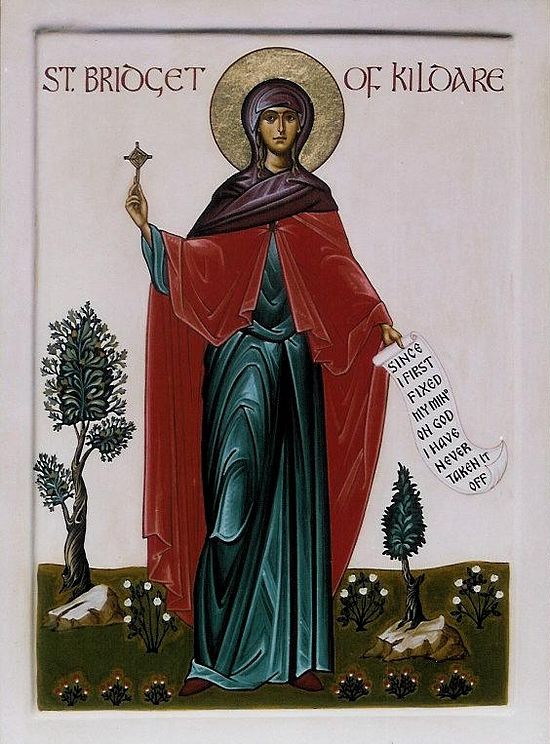
On Being a Good Neighbor: St Brigid of Kildare


Hospitality is one of the best known Southern virtues, part of the inheritance that has come down to us from our English and Celtic forebears.  Our Holy Mother Brigid is one of those largely forgotten figures who helped enrich our patrimony with this virtue, who helped to cultivate it in the souls of Southrons past and present.  But as love toward God and man grows cold in the South and elsewhere in the West, and old traditions and virtues are forgotten, we would do well to learn again of this holy woman who, despite our unthankfulness, always intercedes for us before God.  Ms Mary Dugan Doss’s account of St Brigid begins:

The life of Saint Brigid of Ireland offers us new insight into the virtue of hospitality, the cheerful, generous giving of food and shelter. We know that this virtue is praised throughout the Scriptures. The hospitality of Abraham to three young men who visited him was revealed to be offered to none other than the three Persons of the Holy Trinity. In fact, it is in the forms of these three young visitors that the Holy Trinity is most often represented in iconography. Our Lord Jesus Christ commanded us to offer hospitality when He said:

For I was hungry and ye gave Me meat:  
I was thirsty and ye gave Me drink:
I was a stranger and ye took Me in....

(Matthew 26:35, 40)

Of course, the law of nature also urges us to generously provide for the traveller who has no place to lay his head, and so hospitality, even without the love of Christ, has become an important facet of civilized culture. In pre-Christian Ireland every freeman was required by secular law to provide hospitality to anyone of or below his own class who asked it of him. The type and quality of food and shelter he was obliged to offer varied depending on the class of his guest, but he was expected to provide well for noble and low-born alike, or be subjected to heavy fines as well as social ostracism. Saint Brigid took this legal and social obligation of her people and, by infusing it with the love of Christ, transformed it into a holy rule and a godly art.

Brigid was born at Faughart in County Down in 452, less than fifty years after the beginning of Saint Patrick’s widespread missionary efforts among the Irish. At the time of her birth, the faith was just starting to grow great in the hearts of the Irish people. But by the end of her life, and partly through her efforts, her land would become holy Ireland, a land of saints and scholars, a land of monasteries from which missionaries would go forth to all of Europe and beyond.

 . . .

Source:  ‘A Gift of Hospitality—Saint Brigid, Abbess of Kildare’, http://www.pravoslavie.ru/english/90659.htm, accessed 19 Feb. 2016

Holy Mother Brigid of Kildare, pray for us wretched sinners at the South!


Source:  http://www.pravoslavie.ru/english/90659.htm, accessed 1 April 2016


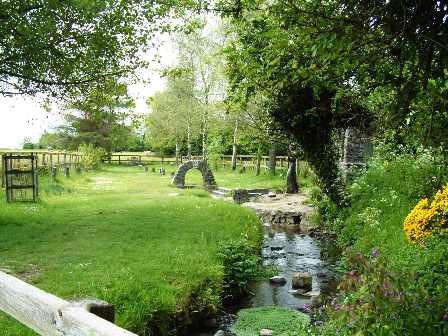
St Brigid’s Well
Source:  http://www.kildare.ie/kildareheritage/?page_id=65, accessed 1 April 2016

Tuesday, March 29, 2016

'Chrismation'


In the new and better Eden
Before the altar and the bearded priest
The white-haired catechumen, kneeling, barefoot,
Voices his profession of the Orthodox Faith
After many years of patient waiting.
The Holy Ghost is called upon,
The holy myrrh anoints body and soul.
Do you see the Gladsome Light,
Dancing just out of sight,
Dancing just beneath the surface,
Of tables and icons and walls?
The Church embraces with joy
The newly-illumined John
With her life-filled arms.
Blessed is our God!

'New Roads'


Sea of concrete,
Sea of asphalt,
Hard and grey,
Hard and black.
No life teems within you,
But much that goes
About upon you
Meets an awful doom.

Friday, March 25, 2016

Foundation Stones


As Easter mirthmotes (celebrations) for the Western churches (Catholic and Protestant) draw near, a certain sadness creeps in with them.  Sadness in what has been lost in the West by its falling away from the wholeness of the Orthodox Faith in exchange for rationalist, philosophical constructs about God and/or emotionalist approaches to Him (which can never bring a man to true union with God).  One of the greatest losses has been the Saints, those holy, living stones from whom God’s Grace, His Love, overflows and who are such strong supports in the edifice of the Church, whose work helps join us poor strugglers to the foundation of the Apostles and the Prophets and to the cornerstone of Christ Himself, that we might know the Father in Him through the Holy Ghost.

Soþlice (Truly), if they are not present among a people claiming to be Christian, then the society they are building has no strong supports and is in danger of collapsing/falling apart.

So it is in the South and Western Europe in this age:  They are full of material wonders but bereft of divine-human ones, who can help us escape the Kingdom of Man (which is hell) and enter the Kingdom of God.

Bearing this in mind, let us repent and take note of a few particularly important Saints for the South and Western Europe who reposed in February and March.  Let us learn to love and honor them as wonderfully wrought men and maidens of the Father’s Kingdom, our beloved kinsmen, from whom the beauty of the All-Holy Trinity flows forth.


1 February:  St Brigid of Kildare (Ireland)


Come, ye faithful, from the west and from the north, from the sea and from the east: let us make haste to the radiant feast, glorifying the wise enlightener of the Irish land and praising her struggles; and, clapping our hands, let us cry aloud: Glory to Thee, O Christ God, Who art wondrous in Thy saints!

Having brought to thy homeland the light of Orthodoxy, which is that of the threefold Sun, and which heralded the day of salvation, O venerable one, by thy life didst thou instruct the people who, having been enlightened by faith, cried out: Glory to Thee, O Christ God, Who art wondrous in Thy saints!

Forsaking princely rank and spurning earthly glory, thou didst choose slavery to Christ and voluntary poverty, desiring the angelic rank. Wherefore, having found thee to be a new and fervent intercessor, we cry out in thanksgiving: Glory to Thee, O Christ God, Who art wondrous in Thy saints!

 . . .

Instructed by the discourse of the holy Patrick, thou didst arrive at the uttermost west, heralding the Orient Who hath visited us from on high. Wherefore, we bless thee, O venerable mother Brigid, and cry out to thee: Pray thou in behalf of our souls

 . . .

Rejecting thy noble rank, and loving the godly monastic life, from oaken wood didst thou build a convent, the first in thy land; and having there united a multitude of nuns to God, thou didst teach the surrounding lands to cry to the Lord: Have mercy on us!

 . . .

Source:  http://orthodoxengland.org.uk/pdf/servs/brigid.pdf , accessed 25 March 2016


1 March:  St David of Wales


O all-glorious wonder! From childhood thou didst adorn thy life with virtue, and having been made a priest of Christ wast truly shown to be a luminary for His flock. Wherefore, having vanquished the demons by thy tireless spiritual warfare, in soul thou hast ascended on high, where thou beholdest thy Lord and Master face to face in the splendour of His glory.

O all-glorious wonder that human flesh could be so mortified! For, following the ascetics of the desert thou didst lay waste thy body, resisting all the temptations of the flesh and putting away from thee all carnal thoughts, O David blessed of God; wherefore, arrayed in garments of purity as for a wedding feast, thou hast entered, rejoicing, into the joy of thy Lord.

O all-glorious wonder, the grace of God which doth sanctify and deify filled thy humble soul, O David, and thou didst preach with eloquence against the accursed Pelagius, refuting his vile heresy, watchfully fending off from the faithful from its pernicious harm, and leading them in gladness into the splendid courts of Christ, to the mansions of the righteous.

 . . .

Come, O ye assembly of the faithful, and with reverent voices let us praise the holy bishop David, who as a good shepherd guided his flock to the Faith with the word of Truth, by his virtues teaching them to tread the straight and narrow path which leadeth to paradise. Truly, for his obedience the Almighty hath bestowed upon him manifold spiritual gifts, which he freely imparteth to those who bless his holy memory, entreating Christ to have pity on us and grant us remission of sins.

 . . .

Let the Christians of Wales join in gladsome chorus, uplifting their voices in joyous jubilation, as we celebrate the feast of the wondrous David, their holy father and enlightener, who now dwelleth with the saints on high, and doth ever earnestly intercede for us sinners.

 . . .

O thou who didst willing take up thy cross and follow Christ the Lord, and didst fill thy land with new communities dedicated to Him, send down from heaven the grace of God, O great and wondrous David, that we Christians may prevail over all heresies, having thee as an invincible ally amid our struggle for piety.

 . . .


17 March:  St Patrick, Apostle of Ireland


Troparion — Tone 3


Holy Bishop Patrick, / Faithful shepherd of Christ’s royal flock, / You filled Ireland with the radiance of the Gospel: / The mighty strength of the Trinity! / Now that you stand before the Savior, / Pray that He may preserve us in faith and love!

Kontakion — Tone 4


From slavery you escaped to freedom in Christ’s service: / He sent you to deliver Ireland from the devil’s bondage. / You planted the Word of the Gospel in pagan hearts. / In your journeys and hardships you rivaled the Apostle Paul! / Having received the reward for your labors in heaven, / Never cease to pray for the flock you have gathered on earth, / Holy bishop Patrick!


Here is his wonderful Breastplate prayer:

I bind unto myself today the strong Name of the Trinity, by invocation of the same, the Three in One, and One in Three.
I bind this day to me forever, by power of faith, Christ's Incarnation; His baptism in the Jordan river; His death on cross for my salvation;

His bursting from the spicéd tomb; His riding up the heavenly way; His coming at the day of doom: I bind unto myself today.
I bind unto myself the power of the great love of cherubim; the sweet "Well done" in judgement hour; the service of the seraphim;

confessors' faith, apostles' word, the patriarchs' prayers, the prophets' scrolls; all good deeds done unto the Lord, and purity of virgin souls.
I bind unto myself today the virtues of the starlit heaven, the glorious sun's life-giving ray, the whiteness of the moon at even,

the flashing of the lightning free, the whirling wind's tempestuous shocks, the stable earth, the deep salt sea, around the old eternal rocks.
I bind unto myself today the power of God to hold and lead, His eye to watch, His might to stay, His ear to hearken to my need;

the wisdom of my God to teach, His hand to guide, His shield to ward; the word of God to give me speech, His heavenly host to be my guard...
...against the demon snares of sin, the vice that gives temptation force, the natural lusts that war within, the hostile men that mar my course;

of few or many, far or nigh, in every place, and in all hours against their fierce hostility, I bind to me these holy powers.
Against all Satan's spells and wiles, against false words of heresy, against the knowledge that defiles against the heart's idolatry,

against the wizard's evil craft, against the death-wound and the burning the choking wave and poisoned shaft, protect me, Christ, till thy returning.
Christ be with me, Christ within me, Christ behind me, Christ before me, Christ beside me, Christ to win me, Christ to comfort and restore me;

Christ beneath me, Christ above me, Christ in quiet, Christ in danger, Christ in hearts of all that love me, Christ in mouth of friend and stranger.
I bind unto myself the Name, the strong Name of the Trinity, by invocation of the same, the Three in One, and One in Three.

Of whom all nature hath creation, eternal Father, Spirit, Word: praise to the Lord of my salvation, salvation is of Christ the Lord.


20 March:  St Cuthbert the Wonderworker of Lindisfarne


Loving chastity and meekness from thy youth, O Cuthbert, with steadfast intent thou didst acquire pure love for Christ, and thereby hast drawn nigh unto God. Wherefore, entreat Him now most earnestly, that He deliver from all afflictions those who celebrate thy yearly memorial.

Assembling today, O ye Orthodox, with psalms and hymns let us praise the holy Cuthbert, crying out to him with reverence: O blessed and most glorious one, boast of hierarchs and monastics, beseech the Lord in our behalf, that He take pity and save our souls.

O venerable hierarch Cuthbert, the multitudes of pilgrims who piously have recourse to thee in prayer are filled with joy and gladness; for the shrine of thy precious relics is shown to be a fount of healing for all the afflicted who approach with faith and love unfeigned.

 . . .

O successor of the godly apostles of Christ, steadfast pillar of the Orthodox Faith, teacher and defender of true piety, holy hierarch Cuthbert! Like a good shepherd thou didst watch over thy flock with vigilance, for which cause thou hast won great favor with Christ, the Chief Shepherd, and standest now with the sheep at His right hand in glory. Wherefore, intercede thou for all of us who honor thy holy memory as is meet.

 . . .

O Cuthbert, boast of monastics and true model for the servants of God, by thy struggles and pure manner of life thou hast come to shine forth like the brilliant sun upon the faithful; for Christ hath enriched thee with the gift of miracles. Wherefore, O venerable hierarch, we cry out to thee most fervently: In thy supplications be thou ever mindful of those who honor thy most splendid memory with faith and love!

 . . .

Source:  http://orthodoxengland.org.uk/pdf/servs/cuthbert.pdf, accessed 25 March 2016

Tuesday, March 22, 2016

Welcoming Lengtentima (Lententime/Spring) - 2016


‘Chloris’
By Paul Hamilton Hayne
Source:  Poems of Paul Hamilton Hayne: Electronic Edition, http://docsouth.unc.edu/southlit/hayne/hayne.html, 1999, accessed 22 March 2016, pgs. 147-8.  © This work is the property of the University of North Carolina at Chapel Hill. It may be used freely by individuals for research, teaching and personal use as long as this statement of availability is included in the text.


WHAT time the rosy-flushing West
Sleeps soft on copse and dingle,
Wherein the sunset shadows rest,
Or richly float and mingle;

When down the vale the wood-dove's tone
Thrills in a cadence tender,
And every rare, ethereal mote
Turns to a wingèd splendor.

Just as the mystic cloudlands ope,
Far up their sapphire portal,
Fair as the fairest dream of Hope,
Half goddess and half mortal,

I see that lovely genius rise,
That child of Orient trances,
On whose sweet face the glory lies
Of weird Hellenic fancies,--

Chloris! beneath whose procreant tread
All earth yields up her sweetness,
The violet's scent, the rose's red,
The dahlia's orbed completeness,

And verdures on the myriad hills,
The breath of her pure duty
Hath nursed to life by sparkling rills
And foliaged nooks of beauty;

Till bloom and odor, blush and song,
So fill earth's radiant spaces,
The fading touch of sin, or wrong,
Leaves glad the weariest faces;

And so, through happy spring-tide dells,
O'er mount, and field, and river,
Her zephyr's fairy clarion swells,
Her footsteps glance forever!

Friday, March 18, 2016

‘The Man of the People’


The democrat is a busybody
Whose hands harass his neighbors
Through the state’s cold machinery.

The king is a shepherd
Whose scepter guards each person
From over-reaching arms,
Giving to all the quiet freedom
The democrat is always behesting
But never bestowing.