Friday, May 16, 2014

‘ . . . mighty men which were of old, men of renown’ -- Genesis 6:4, Part V

It is time now to say something of the holy women in St Bede’s Ecclesiastical History.  St Hilda shall be first.

CHAPTER XXIII

OF THE LIFE AND DEATH OF THE ABBESS HILDA.

[A.D. 680]

IN the year of the incarnation of our Lord 680, the most religious servant of Christ, Hilda, abbess of the monastery that is called Streaneshalch, as above­mentioned, after having performed many heavenly works on earth, passed from thence to receive the rewards of the heavenly life, on the 17th of November, at the age of sixty­six years; the first thirty­three of which she spent living most nobly in the secular habit; and more nobly dedicated the remaining half to our Lord in a monastic life. For she was nobly born, being the daughter of Hereric, nephew to King Edwin, with which king she also embraced the faith and mysteries of Christ, at the preaching of Paulinus, the first bishop of the Northumbrians, of blessed memory, and preserved the same undefiled till she attained to the sight of him in heaven.

Resolving to quit the secular habit, and to serve him alone, she withdrew into the province of the East Angles, for she was allied to the king; being desirous to pass over from thence into France, to forsake her native country and all she had, and so live a stranger for our Lord in the monastery of Cale, that she might with more case attain to the eternal kingdom in heaven; because her sister Heresuid ' mother to Aldwulf, king of the East Angles, at that time living in the same monastery, under regular discipline, was waiting for her eternal reward. Being led by her example, she continued a whole year in the aforesaid province, with the design of going abroad; afterwards, Bishop Aidan being recalled home, he gave her the land of one family on the north side of the river Wear; where for a year she also led a monastic life, with very few companions.

After this she was made abbess in the monastery called Heruteu, which monastery had been founded, not long before, by the religious servant of Christ, Heiu, who is said to have been the first woman that in the province of the Northumbrians took upon her the habit and life of a nun, being consecrated by Bishop Aidan; but she, soon after she had founded that monastery, went away to the city of Calcacestir, and there fixed her dwelling. Hilda, the servant of Christ, being set over that monastery, began immediately to reduce all things to a regular system, according as she had been instructed by learned men; for Bishop Aidan, and other religious men that knew her and loved her, frequently visited and diligently instructed her, because of her innate wisdom and inclination to the service of God.

When she had for some years governed this monastery, wholly intent upon establishing a regular life, it happened that she also undertook either to build or to arrange a monastery in the place called Streaneshalch [Whitby], which work she industriously performed; for she put this monastery under the same regular discipline as she had done the former; and taught there the strict observance of justice, piety, chastity, and other virtues, and particularly of peace and charity; so that, after the example of the primitive church, no person was there rich, and none poor, all being in common to all, and none having any property. Her prudence was so great, that not only indifferent persons, but even kings and princes, as occasion offered, asked and received her advice; she obliged those who were under her direction to attend so much to reading of the Holy Scriptures, and to exercise themselves so much in works of justice, that many might be there found fit for ecclesiastical duties, and to serve at the altar.

In short, we afterwards saw five bishops taken out Of that monastery, and all of them men of singular merit and sanctity, whose names were Bosa, Hedda, Oftfor, John, and Wilfrid. We have above taken notice, that the first of them was consecrated bishop at York; of the second, it is to be observed that he was appointed bishop of Dorchester. Of the two last we shall speak hereafter, as they were consecrated: the was bishop of Hagulstad, the second of the church of York; of the third, we will here take notice that, having applied himself to the reading and observation of the Scriptures in both the monasteries of Hilda, at length, being desirous to attain to greater perfection, he went into Kent, to Archbishop Theodore, of blessed memory; where having spent some more time in sacred studies, he also resolved to go to Rome, which, in those days, was reckoned of great moment : returning thence into Britain, he took his way into the province of the Wiccii, where King Osric then ruled, and continued there a long time, preaching the word of faith, and making himself an example of good life to all that saw and heard him. At that time, Bosel, the bishop of that province, laboured under such weakness of body, that he could not perform the episcopal functions; for which reason, this Oftfor was, by universal consent, chosen bishop in his stead, and by order of King Ethelred, consecrated by Bishop Wilfrid, of blessed memory, who was then bishop of the Midland Angles, because Archbishop Theodore was dead, and no other bishop ordained in his place. Before the aforesaid man of God, Bosel, Tatfrid, a most learned and industrious man, and of excellent ability, had been chosen bishop there, from the same abbess's monastery, but had been snatched away by an untimely death, before he could be ordained.

Thus this servant of Christ, Abbess Hilda, whom all that knew her called Mother, for her singular piety and grace, was not only an example of good life, to those that lived in her monastery, but afforded occasion of amendment and salvation to many who lived at a distance, to whom the fame was brought of her industry and virtue; for it was necessary that the dream which her mother, Bregusuit, had, during her infancy, should be fulfilled. At the time that her husband, Hereric, lived in banishment, under Cerdic, king of the Britons, where he was also poisoned, she fancied, in a dream, that she was seeking for him most carefully, and could find no sign of him anywhere; but, after having used all her industry to seek him, she found a most precious jewel under her garment, which, whilst she was looking on it very attentively, cast such a light as spread itself throughout all Britain; which dream was brought to pass in her daughter that we speak of, whose life was a bright example, not only to herself, but to all who desired to live well.

When she had governed this monastery many years, it pleased Him who has made such merciful provision for our salvation, to give her holy soul the trial of a long sickness, to the end that, according to the apostle's example, her virtue might be perfected in infirmity. Falling into a fever, she fell into a violent heat, and was afflicted with the same for six years continually; during all which time she never failed either to return thanks to her Maker, or publicly and privately to instruct the flock committed to her charge; for by her own example she admonished all persons to serve God dutifully in perfect health, and always to return thanks to Him in adversity, or bodily infirmity. In the seventh year of her sickness, the distemper turning inwards, she approached her last day, and about cock-crowing, having received the holy communion to further her on her way, and called together the servants of Christ that were within the same monastery, she admonished them to preserve evangelical peace among themselves, and with all others; and as she was making her speech, she joyfully saw death approaching, or if I may speak in the words of our Lord, passed from death to life.

That same night it pleased Almighty God, by a manifest vision, to make known her death in another monastery, at a distance from hers, which she had built that same year, and is called Hackness. There was in that monastery, a certain nun called Begu, who, having dedicated her virginity to God, had served Him upwards of thirty years in monastical conversation. This nun, being then in the dormitory of the sisters, on a sudden heard the well known sound of a bell in the air, which used to awake and call them to prayers, when any one of them was taken out of this world, and opening her eyes, as she thought, she saw the top of the house open, and a strong light pour in from above; looking earnestly upon that light, she saw the soul of the aforesaid servant of God in that same light, attended and conducted to heaven by angels. Then awaking, and seeing the other sisters lying round about her, she perceived that what she had seen was either in a dream or a vision; and rising immediately in a great fright, she ran to the virgin who then presided in the monastery instead of the abbess, and whose name was Frigyth, and, with many tears and sighs, told her that the Abbess Hilda, mother of them all, had departed this life, and had in her sight ascended to eternal bliss, and to the company of the inhabitants of heaven, with a great light, and with angels conducting her. Frigyth having heard it, awoke all the sisters, and calling them to the church, admonished them to pray and sing psalms for her soul; which they did during the remainder of the night; and at break of day, the brothers came with news of her death, from the place where she had died. They answered that they knew it before, and then related how and when they had heard it, by which it appeared that her death had been revealed to them in a vision the very same hour that the others said she had died. Thus it was by Heaven happily ordained, that when some saw her departure out of this worId, the others should be acquainted with her admittance into the spiritual life which is eternal. These monasteries are about thirteen miles distant from each other.

It is also reported, that her death was, in a vision, made known the same night to one of the holy virgins who loved her most passionately, in the same monastery where the said servant of God died. This nun saw her soul ascend to heaven in the company of angels; and this she declared, the very same hour that it happened, to those servants of Christ that were with her; and awakened them to pray for her soul, even before the rest of the congregation had heard of her death. The truth of which was known to the whole monastery in the morning. This same nun was at that time with some other servants of Christ, in the remotest part of the monastery, where the women newly converted were wont to be upon trial, till they were regularly instructed, and taken into the society of the congregation (Ecclesiastical History of the English People, Book IV, Chapter XXIII, http://www.fordham.edu/halsall/basis/bede-book4.asp, posted December 1997 by Paul Halsall, accessed 16 May 2014).

Our holy mother St Hilda, pray to God for us sinful Southrons, thy little wayward children!
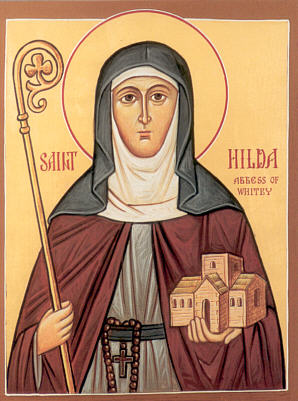

(Icon appears at this web page: http://orthodoxengland.org.uk/hilda.htm)

Wednesday, May 14, 2014

The South’s Retreat from Golgotha

The South underwent a crucifixion - rape, murder, starvation, homelessness, church desecration, and other terrors and oppressions - during the War of Northern Aggression and afterward during the so-called Reconstruction.  But unlike Christ, she did not remain on her cross.  When she was mocked and scorned by the scribes and Pharisees of the North, when she was told to save herself by coming down from her cross, many of her people did so, fleeing torment and hardship in exchange for the worldly comforts that friendship with their enemies could gain for them. 

A few have remained steadfast, transfixed on the cross the Lord gave the Southern people to bear - the persecution of Northern radicals and their fellow travelers.  But too many over the years, especially in these latter days, have denied it.  They think they will experience greater joy in life by renouncing hardship and struggle.  Truly, they will not.  Our Lord Christ Himself and His holy disciples over the last 2,000 years bear continual witness that the life of sacrifice and self-denial is most blessed.

St Justin Popovich said it this way:

‘The fifth ascetic virtue is the God-human virtue of patience and humility: Which is to say, to endure ill-use, not to render evil for evil, to forgive in total compassion all assault, slander, and hurt.  This is what it is to be of Christ: to feel yourself perpetually crucified to the world, persecuted by it, violated and spat upon.  The world will not tolerate Christ-bearing men just as it would not tolerate Christ.  Martyrdom is the state in which a Christian brings forth fruit.  . . . For the Orthodox, martyrdom is purification’ (‘The Inward Mission of Our Church’, Orthodox Faith and Life in Christ, 3rd ed., A. Gerostergios et al., trans., Belmont, Ma.: Institute for Byzantine and Modern Greek Studies, 2005, p. 28, emphasis added).

And one of the righteous Christian elders and confessors of Romania who suffered greatly during the atheistic rule of the Communists in that country, Justin Pârvu, said of his time in the torture chamber prisons,

‘I . . . was more joyful than I had been when I was free in the world.  . . . our spiritual life deepened much more during imprisonment.  Those were extraordinary and unique days of sacrifice and renunciation.  It was painful to see a man dying before your eyes.  This was real suffering. . . .   Those were days of light and joy, and life was abundant in those moments’ (Simona Irime, ‘A Life of Sacrificial Love: The Life and Teachings of Elder Justin Pârvu, Part II’, The Orthodox Word, 49.6 (2013), p. 262).

The New South of money and machines and technology and ease and greed and pleasure, smiled upon by Christ-hating New England and Western European elites, is wasting away more and more each day, though she may think the opposite.  Until the Southern people complete their martyrdom, their crucifixion, their rejection of all the evil bound up in the selfish and childish ‘American Dream’ and the murderous American Empire, they will never know the glorious, unfathomable, transfigured life of the Resurrection.  They will never know the fulness of life or the unique work the Almighty Father has in store for them as a new creation.

She must follow Elder Justin’s ensample:  ‘We joyfully suffered this martyrdom, enduring every injustice, so that through the offering of our patient endurance we would atone for our sins and the sins of our nation’ (Simona Irime, ‘A Life of Sacrificial Love: The Life and Teachings of Elder Justin Pârvu, Part I’, The Orthodox Word, 49.5 (2013), p. 231).

And as in so much else, Russia, too, is a light for her path - tradition-loving, humble, Christian Russia.  Ivan Ilyin wrote a letter on these subjects that every Southerner ought to read.  Here below is its beginning (introduced and translated by Mark Hackard):

Even in the darkness of revolutionary terror and enslavement, White Russian philosopher Ivan Ilyin (1883-1954) believed in the sacred mission of his people, one to be achieved through suffering and repentance, spiritual strength and discipline. Here is a 1928 letter he addressed to his comrades in emigration, assuring them that one day a new Russia, a nation of faith and power, would arise. Translation by Mark Hackard.

However hard it might be for you in life and heavy on your soul, to you who selflessly love Russia, believe: the just cause shall prevail! And therefore never be troubled by the onslaught of evil; it is temporary and fleeting. But first of all and most of all, seek out rightness – only it is truly vital – and only therein shall be born and arise a new force, leading, saving and directing…

The just cause shall prevail. This hardly means that it is protected from earthly failures, temporal trials and periods combining genuine suffering with visible humiliation. No, all of this is not only possible, but it is directly unavoidable. And an innumerable multitude of times, people walking the right path, clearly suffering and by all appearances humiliated, prayed and will still pray as the Son of God did – that this cup would pass them over, and asking why the Lord had forsaken them… Yet namely in these prayers, after Golgotha, there will always live the deepest surety that rightness will be granted victory, and that in visible “dying,” in “clear” failure, resurrection is prepared unseen and brought into being.

Yes, the bearers of the faithful ideal and the just cause are fated to have their hours of failure and suffering. Yet all these failures and all this suffering shall but form the purification for future exploits, the school of future victory. For no one of these men is ready for heroism from the very day of his birth, but for each is needed a long ordeal, his trial and tempering. And from among other peoples, perhaps, we, Russians, need tempering most of all – with our weak-willed passion and our dreamy carelessness. In this lack of character and with this carelessness, in the chaotic mix of good and evil, it was impossible to build Russia any further: neither her Church nor her state, neither her economy nor her spiritual culture. War and the Revolution proved this with certainty; and having proven their point, they brought us into a period of severe trials and ruthless tempering.

This period has already lasted for ten years now. In this time we were shown naked evil so that we would turn to God. We were witness to shamelessness and dishonor so that we might affirm ourselves in conscience and honor. The greatest traitors in the world stood out from our ranks so that we ourselves would strengthen our loyalty. We experienced untold lawlessness and enslavement to learn to value the just law and the right measure of freedom. All our belongings were taken from us and Communism instituted so that we understood the necessity of property, its meaning and purpose. The family and the Motherland were extinguished, the essence of the soldier and the army perverted so that we would apprehend the holiness of the hearth and the fortress and the warrior’s sacred meaning. In poverty and dark work, in tight living spaces, in exile and expulsion, surrounded by temptations and dangers, we suffer unto a new perception of God, a new national feeling, a new style of character, a new awareness of law and a new national attitude to the army and property. Herein is the great meaning of our trial and our tempering. Herein is our service to Russia, both there, under the yoke, and outside the country, in our dispersion overseas. We should accept this cup and drain it until emptied. We shall not dare to pray that it pass us over; we must be solidly sure that on this path, we are forsaken by God.

Our cause does not concern who has temporarily triumphed for now, but who is right at the very essence, before the face of God. For essential rightness is faithful not only in heaven, but on earth. It is not “righteousness,” abstracted from life and unneeded to the world, but a creative vitality necessary to the world – a source not of weakness, but strength, and not of defeat, but victory.

 . . .

Source:  ‘The Just Cause, http://souloftheeast.org/2014/04/11/the-just-cause/, posted 11 April 2014, accessed 29 April 2014

The Southern cause - Christianity, true community, limits to the power of money, the life of tilling the soil, patriarchy, a non-absolute government, etc. - will be vindicated, surely in Heaven and maybe on earth, but only if she follows the path the Lord has lain before her feet, the path of struggle, not friendship, with her enemies (those inside her people’s souls as well as those outside of them).

Monday, May 12, 2014

What Is the Aim of a Christian Society?

St John Maximovitch tells us plainly in two of his sermons (bolding has been added) - acquire the Kingdom of Heaven (holiness, virtues), not the Kingdom of Earth (riches, power, glory, knowledge, etc.):

The Day commemorating the saints who have shown forth in the Russian land points to that spiritual heaven beneath which the Russian land was founded and lived.

Before the holy Prince Vladimir, there lived on the Russian land separate, pagan tribes that warred with one another. The holy Prince Vladimir brought them a new faith, a new consciousness and meaning of life, a new inner spiritual state; he gave them a new spirit of life that united everyone, and thus a single nation was formed.

The very existence of the Russian nation is tied to the begetting of spiritual life within it, with the assimilation of the fundamentals of a Christian world-view. It is senseless to seek the meaning and purpose of life in earthly life, which ends with death. One must strive to acquire the Divine, grace-filled, eternal life, and then this temporal, earthly life will arrange itself as well: Seek ye first the Kingdom of God and his righteousness; and all these things shall be added unto you (Matt. 6:33).

Faith and the Orthodox Church united the separate tribes into one nation. Faith in the Kingdom of God and the search for it, the search for righteousness [pravda] became the most salient characteristic of the Russian people.

For the sake of the Kingdom of God, for the sake of participation in it, for the sake of prayer, Russian ascetics left the vanity of the world and went into the forests, onto uninhabited islands. They sought only the Kingdom of God. They did not want to found or build anything; they went away from people, but people followed after them for the sake of the Kingdom of God, which was present on those islands and in those forests around the righteous ones, and thus lavras and monasteries grew up.

The search for righteousness is a basic thread in the life of the Russian people, and it is not by chance that the first written code of laws, which was designed to regulate life, was called "Russian Justice" [Russkaya Pravda ].

It was not only those who withdrew from the world and from the company of men, who thought about heaven and the Kingdom of God; all believing Russian people understood the meaning of life. All who truly contributed to the development of Russia as a nation, likewise considered that their primary concern was to be faithful to the Divine Kingdom and to Divine Truth [Pravda].

In Russia there were princes, military leaders, landowners, people of all ranks and occupations; and all had in common a fundamental understanding and striving, which were the acquisition of the Kingdom of God and participation in it. This was the meaning of life.

 . . .

Source:  ‘All Saints of Russia’, http://www.holytrinitymission.org/books/english/sermons_john_maximovich.htm#_Toc100019523, accessed 11 May 2014

We do this with help from the saints, with whose help (together with the help of all Christians, for the Church is one; no Christian is ever separated from the rest) we are working out our salvation:

The feast of All Saints of Russia is not a feast of just righteous ones, but of saints. God is filled with holiness; "Holy is the Lord our God." But man is created in the "image and likeness" of God, and the Lord at creation breathed into him the power to partake of the Divine essence [Something may have been lost in translation, for as St John and all Orthodox acknowledge, no man can know God in His hidden, transcendent essence - only in His manifested energies. -- W. G.], and thereby come closer to God. And the closer a man is to God, the holier he is. Saints are those who have partaken of the Divine essence and made it their own; to God, they become "His own." The saints enjoy blessedness, for God is blessed. From them there is light for men. Through them the power of God is revealed. Saints retain all that is characteristic of the human condition; they know everything that is ours. They are near to God, but they are also near to us; they walked and dwelt among us.  . . . Celebrating the saints, we desire to be together with them and to acquire the power of God through their holiness. They know us, our nature, our characteristics and spirits, and they know our souls, too — what is necessary for us. We are close to them as children are close to their parents. The Apostle Peter prayed for his disciples. St. Demetrius of Thessalonica rushes to help the Greeks because this is his own nation. Sts. Boris and Gleb help their relatives (e.g., Alexander Nevsky), and their own Russian people [just as the saints of our Southern forebears from Scotland, Spain, England, Africa, Germany, and the rest pray for and help us -- W. G.].

Source:  ‘Feast of All Saints of Russia’, http://www.holytrinitymission.org/books/english/sermons_john_maximovich.htm#_Toc100019524, accessed 11 May 2014.

Saturday, May 10, 2014

‘ . . . mighty men which were of old, men of renown’ -- Genesis 6:4, Part IV

There are other Irishmen of note in St Bede’s Ecclesiastical History besides St Fursey, who was mentioned previously, but today we should let our gaze fall for a time on one in particular, St Aidan.  More of his life is told elsewhere in the History, but this is a good place to begin.

CHAPTER V

OF THE LIFE OF BISHOP AIDAN. [A.D. 635.]

FROM the aforesaid island, and college of monks, was Aidan sent to instruct the English nation in Christ, having received the dignity of a bishop at the time when Segenius, abbot and priest, presided over that monastery; whence, among other instructions for life, he left the clergy a most salutary example of abstinence or continence; it was the highest commendation of his doctrine, with all men, that he taught no otherwise than he and his followers had lived; for he neither sought nor loved any thing of this world, but delighted in distributing immediately among the poor whatsoever was given him by the kings or rich men of the world. He was wont to traverse both town and country on foot, never on horseback, unless compelled by some urgent necessity; and wherever in his way he saw any, either rich or poor, he invited them, if infidels, to embrace the mystery of the faith or if they were believers, to strengthen them in the faith, and to stir them up by words and actions to alms and good works.

His course of life was so different from the slothfulness of our times, that all those who bore him company, whether they were shorn monks or laymen, were employed in meditation, that is, either in reading the Scriptures, or learning psalms. This was the daily employment of himself and all that were with him, wheresoever they went; and if it happened, which was but seldom, that he was invited to eat with the king, he went with one or two clerks, and having taken a small repast, made haste to be gone with them, either to read or write. At that time, many religious men and women, stirred up by his example, adopted the custom of fasting on Wednesdays and Fridays, till the ninth hour, throughout the year, except during the fifty days after Easter. He never gave money to the powerful men of the world, but only meat, if he happened to entertain them; and, on the contrary, whatsoever gifts of money he received from the rich, he either distributed them, as has been said, to the use of the poor, or bestowed them in ransoming such as had been wrong. fully sold for slaves. Moreover, he afterwards made many of those he had ransomed his disciples, and after having taught and instructed them, advanced them to the order of priesthood.

It is reported, that when King Oswald had asked a bishop of the Scots to administer the word of faith to him and his nation, there was first sent to him another man of more austere disposition, who, meeting with no success, and being unregarded by the English people, returned home, and in an assembly of the elders reported, that he had not been able to do any good to the nation he had been sent to preach to, because they were uncivilized men, and of a stubborn and barbarous disposition. They, as is testified, in a great council seriously debated what was to be done, being desirous that the nation should receive the salvation it demanded, and grieving that they had not received the preacher sent to them. Then said Aidan, who was also present in the council, to the priest then spoken of, "I am of opinion, brother, that you were more severe to your unlearned hearers than you ought to have been and did not at first, conformably to the apostolic rule, give them the milk of more easy doctrine, till being by degrees nourished with the word of God, they should be capable of greater perfection, and be able to practice God's sublimer precepts." Having heard these words, all present began diligently to weigh what he had said, and presently concluded, that he deserved to be made a bishop, and ought to be sent to instruct the incredulous and unlearned; since he was found to be endued with singular discretion, which is the mother of other virtues, and accordingly being ordained, they sent him to their friend, King Oswald, to preach; and he, as time proved, afterwards appeared to possess all other virtues, as well as the discretion for which he was before remarkable (Book III, Chapter V, http://www.fordham.edu/halsall/basis/bede-book3.asp, posted February 1999 by Paul Halsall, accessed 10 May 2014).

Holy St Aidan, pray for us sinners at the South, the unworthy sons and daughters of those you evangelized in England!


(Icon appears at this web page: http://orthodoxengland.org.uk/aidan.htm)

Wednesday, May 7, 2014

For the West, the Time of Decision Has Arrived

‘But precisely Eastern Orthodoxy, according to Bildt [i.e., Carl Bildt, Sweden’s Minister for Foreign Affairs and heavily involved in the European Union - W. G.], is the main threat to western civilisation’ (http://agora-dialogue.com/rex-carl-bildt-thinks-eastern-orthodoxy-is-main-threat-to-western-civilisation/?COLLCC=3204679222, accessed 7 May 2014).

If the Foreign Minister did indeed say this, those in the West, especially Western Christians, have come to a crucial point:  Whom will you follow, Christ or Antichrist, the Orthodox Church or Western Civilization? 

There is a reason why Western Europe and the [u]nited States have progressed from Christianity towards godlessness over the last 1,000 years, and it has nothing to do with constitutions or economic programs, checks and balances or supply and demand.  But it has everything to do with their loss of the Orthodox Faith in 1054 A. D. (the Great Schism).  The Western churches, whether Protestant or Catholic, have lost the full grace of God; they have lost the true faith given by Christ to his apostles; they have replaced the religion of the God-man with a religion of man - with a Christianity re-fashioned by the Roman Pope (Gregory VII, John Paul II, etc.), or by Luther, Calvin, Queen Elizabeth I, Knox, Wesley, Campbell, Rick Warren, John Piper, or by any other number of Protestant preachers or leaders, or with a Christianity according to one’s own emotions or reason.

The Western world, without repentance and reunion with the Orthodox Church, could not have avoided sliding into the satanism at which it has arrived.  There were and still are (and probably will continue to be) some who encounter the grace of God in the Protestant and Catholic churches, but the drift of Western nations (including the South) as a whole will continue to be toward evil because of their rejection of the True Faith, of the True God-man, the incarnate Truth Himself.

So, as we said, Westerners must choose with whom they will side:  The increasingly godless, satanic civilization of the uS and EU (the latest bitter fruit of the Great Schism), as represented by the Western Elite of Bildt, Cameron, Obama, Clinton, Bush, Boehner, Rockefeller, Bezos, etc. or with the Orthodox Church (the church of their Western European forefathers before the Schism). 

The Western Elite have announced their choice in various ways:  Orthodoxy is their enemy.  Not the Roman Catholic Church, nor the Southern Baptists, nor Presbyterians, and so on - but the Orthodox (they do hate the former because of their association with God, but the relativism within them makes them far easier to corrupt and conquer than the Orthodox):

Zbigniew Brzezinski is far from being the only American strategist to state that: ‘After the collapse of the USSR, the main enemy of the USA will be the Russian Orthodox Church’ (Fr Andrew Phillips, http://orthodoxengland.org.uk/geopolitics.htm, posted 21 Nov. 2007, accessed 7 May 2014).

See also, more vaguely, here:

That the enemies of God have such vehement hatred of the Orthodox Church - this should give us pause.

Do not think that we are dwelling on retribution for past wrongs, dredging up pointless arguments to bestir controversy, or attempting to divide and weaken the opposition to the evil Elite.  Indeed, there cannot be any effective opposition to the Elite until we are united, not around empty slogans for human liberty and progress, but in Christ, by becoming living, organic members of his One True Body, the Divine-human Holy Orthodox Church, by which we at last have life in and for one another (true community and true individuality after the manner of the Holy Trinity) and through which we receive the wisdom and power to vanquish all evil (both inside and outside of us).

To this haven, Southrons and all Westerners, Protestants and Catholics and unbelievers, run with all thy strength and with all thy might!

Monday, May 5, 2014

‘Beowulf’ as Evangelical Literature

Pastor Douglas Wilson looks at the Old English tale Beowulf from a different angle in ‘The Anglo-Saxon Evangel’.  He begins,

Beowulf is not just an artistic gem. It is also a profound example of a potent apologetic for the Christian faith. Both the pagan and Christian elements in the poem are obvious, and I want to argue that the poet placed these two elements in tension deliberately, and that he did this to accomplish a very shrewd apologetic for the Christian faith: a kind of catechesis for a people who were recently pagan, and who still had to deal with pagans around them.

The poet is not like one of those backsliding monks at Lindisfarne, sternly rebuked by Alcuin for paying attention to the ancient heroic tales. Speaking of a minor character in Beowulf, Alcuin asked:

What has Ingeld to do with Christ? The house is narrow, it cannot contain both. The king of the heavens will have nothing to do with heathen and damned so-called kings. For the eternal king rules in the heavens, the lost heathen repines in hell.

Our poet is no conflicted monk, reading James Joyce under the covers at night with a flashlight. A thoroughly Christian poet is not showing us this paganism to say, “See, pagans can be noble too—even without Jesus!” Rather, he is refusing to engage in a fight with a heathen straw man of his own devising. He acknowledges the high nobility that could be present in that culture, but then bluntly shows us that same nobility at the point of profound despair.

The effect is extremely potent. Instead of saying that nobility is possible without Christ, the poet shows that such nobility does not keep a people from being utterly and completely lost.

Though a heroic poem about pagans that never mentions Christ, Beowulf is the opposite of syncretistic compromise. It is written to highlight the treachery as a way of life that afflicted these pagan societies from within, and the greed and plunder as a way of life that afflicted them from without (whether they were the marauders or the victims).

Our poet shows us this pagan hopelessness in a period of history just before their conversion to the Christian faith. He is recounting the testimony of his people, and, just as with modern testimonies, the sin is highlighted. But it is art to conceal art, and he leaves us hanging just before the explicit moment of conversion. His original listeners knew exactly what was going to happen next.

The rest is available here:
http://www.touchstonemag.com/archives/article.php?id=20-06-030-f, originally published in July/August 2007 issue of Touchstone, accessed 5 May 2014.

Friday, May 2, 2014

‘ . . . mighty men which were of old, men of renown’ -- Genesis 6:4, Part III

The Irish are quite in the forefront of St Bede’s Ecclesiastical History, laboring for the conversion of the English.  Here is the account of St Fursey, a holy Irish monk whose life, teachings, and visions are worthy of study.

CHAPTER XIX

HOW FURSEY BUILT A MONASTERY AMONG THE EAST ANGLES, AND OF HIS VISIONS AND SANCTITY, OF WHICH, HIS FLESH REMAINING UNCORRUPTED AFTER DEATH BORE TESTIMONY. [A.D. 633.]

WHILST Sigebert still governed the kingdom, there came out of Ireland a holy man called Fursey renowned both for his words and actions, and remarkable for singular virtues, being desirous to live a stranger for our Lord, wherever an opportunity should offer. On coming into the province of the East Saxons, he was honorably received by the aforesaid king, and performing his usual employment of preaching the Gospel, by the example of his virtue and the efficacy of his discourse, converted many unbelievers to Christ, and confirmed in his faith and love those that already believed.

Here he fell into some infirmity of body, and was thought worthy to see a vision from God; in which he was admonished diligently to proceed in the ministry of the word which he had undertaken, and indefatigably to continue his usual watching and prayers; inasmuch as his end was certain, but the hour of it would be uncertain, according to the saying of our Lord, "Watch ye therefore, because ye know not the day nor the hour." Being confirmed by this vision, he applied himself with all speed to build a monastery on the ground which had been given him by King Sigebert, and to establish regular discipline therein. This monastery was pleasantly situated in the woods, and with the sea not far off; it was built within the area of a castle, which in the English language is called Cnobheresburg, that is, Cnobher's Town; afterwards, Anna, king of that province, and the nobility, embellished it with more stately buildings and donations. This man was of noble Scottish blood, but much more noble in mind than in birth. From his boyish years, he had particularly applied himself to reading sacred books, and following monastic discipline, and, as is most becoming to holy men, he carefully practiced all that he learned was to be done.

In short, he built himself the monastery, wherein he might with more freedom indulge his heavenly studies. There, falling sick, as the book about his life informs us, he fell into a trance, and quitting his body from the evening till the cock crew, he was found worthy to behold the choirs of angels, and to hear the praises which are sung in heaven. He was wont to declare, that among other things he distinctly heard this: "The saints shall advance from one virtue to another." And again, "The God of gods shall be seen in Sion." Being restored to his body at that time, and again taken from it three days after, he not only saw the greater joys of the blessed, but also extraordinary combats of evil spirits, who by frequent accusations wickedly endeavored to obstruct his journey to heaven; but the angels protecting him, all their endeavors were in vain. Concerning which particulars, if any one desires to be more fully informed, that is, with what subtle fraud the devils represented both his actions and superfluous words, and even his thoughts, as if they had been written down in a book; and what pleasing or disagreeable things he was informed of by the angels and saints, or just men who appeared to him among the angels; let him read the little book of his life which I have mentioned, and I believe he will thereby reap much spiritual profit.

But there is one thing among the rest, which we have thought may be beneficial to many if inserted in this history. When he had been lifted up on high, he was ordered by the angels that conducted him to look back upon the world. Upon which, casting his eyes downward, he saw, as it were, a dark and obscure valley underneath him. He also saw four fires in the air, not far distant from each other. Then asking the angels, what fires those were? he was told, they were the fires which would kindle and consume the world. One of them was of falsehood, when we do not fulfil that which we promised in baptism, to renounce the Devil and all his works. The next of covetousness, when we prefer the riches of the world to the love of heavenly things. The third of discord, when we make no difficulty to offend the minds of out neighbors even in needless things. The fourth of iniquity, when we look upon it as no crime to rob and to defraud the weak. These fires, increasing by degrees, extended so as to meet one another, and being joined, became an immense flame. When it drew near, fearing for himself, he said to the angel, "Lord, behold the fire draws near me." The angel answered, "That which you did not kindle shall not burn you; for though this appears to be a terrible and great fire, yet it tries every man according to the merits of his works; for every man's concupiscence shall burn in the fire; for as every one burns in the body through unlawful pleasure, so when discharged of the body, he shall burn in the punishment which he has deserved."

Then he saw one of the three angels, who had been his conductors throughout both visions, go before and divide the flame of fire, whilst the other two, flying about on both sides, defended him from the danger of that fire. He also saw devils flying through the fire, raising conflagrations of wars against the just. Then followed accusations of the wicked spirits against him, the defense of the good angels in his favor, and a more extended view of the heavenly troops; as also of holy men of his own nation, who, as he had long since been informed, had been deservedly advanced to the degree of priesthood, from whom he heard many things that might be very salutary to himself, or to all others that would listen to them. When they had ended their discourse, and returned to heaven with the angelic spirits, the three angels remained with the blessed Fursey, of whom we have spoken before, and who were to bring him back to his body. And when they approached the aforesaid immense fire, the angel divided the flame, as he had done before; but when the man of God came to the passage so opened amidst the flames, the unclean spirits, laying hold of one of those whom they tormented in the fire, threw him at him, and, touching his shoulder and jaw, burned them. He knew the man, and called to mind that he had received his garment when he died; and the angel, immediately laying hold, threw him back into the fire, and the malignant enemy said, "Do not reject him whom you before received; for as you accepted the goods of him who was a sinner, so you must partake of his punishment." The angel replying, said, "He did not receive the same through avarice, but in order to save his soul." The fire ceased, and the angel, turning to him, added, "That which you kindled burned in you; for had you not received the money of this person that died in his sins, his punishment would not burn in you." And proceeding in his discourse, he gave him wholesome advice for what ought to be done towards the salvation of such as repented.

Being afterwards restored to his body, throughout the whole course of his life he bore the mark of the fire which he had felt in his soul, visible to all men on his shoulder and jaw; and the flesh publicly showed, in a wonderful manner, what the soul had suffered in private. He always took care, as he had done before, to persuade all men to the practice of virtue, as well by his example, as by preaching. But as for the matter of his visions, he would only relate them to those who, from holy zeal and desire of reformation, wished to learn the same. An ancient brother of our monastery is still living, who is wont to declare that a very sincere and religious man told him, that he had seen Fursey himself in the province of the East Angles, and heard those visions from his mouth; adding, that though it was in most sharp winter weather, and a hard frost, and the man was sitting in a thin garment when he related it, yet he sweated as if it had been in the greatest heat of summer, either through excessive fear, or spiritual consolation.

To return to what we were saying before, when, after preaching the word of God many years in Scotland [Ireland], he could no longer bear the crowds that resorted to him, leaving all that he seemed to possess, he departed from his native island, and came with a few brothers through the Britons into the province of the English, and preaching the word of God there, as has been said, built a noble monastery. These things being rightly performed, he became desirous to rid himself of all business of this world, and even of the monastery itself, and forthwith left the same, and the care of souls, to his brother Fullan, and the priests Gobban and Dicull, and being himself free from all that was worldly, resolved to end his life as a hermit. He had another brother called Ultan, who, after a long monastical probation, had also adopted the life of an anchorite. Repairing all alone to him, he lived a whole year with him in continence and prayer, and labored daily with his hands.

Afterwards seeing the province in confusion by the irruptions of the pagans, and presaging that the monasteries would be also in danger, he left all things in order, and sailed over into France, and being there honorably entertained by Clovis, king of the Franks, or by the patrician Erconwald, he built a monastery in the place called Latiniacum, and falling sick not long after, departed this life. The same Erconwald took his body, and deposited it in the porch of a church he was building in his town of Perrone, till the church itself should be dedicated. This happened twenty-seven days after, and the body being taken from the porch, to be re-buried near the altar, was found as entire as if he had just then died. And again, four years after, a more decent tabernacle or chapel being built for the same body to the eastward of the altar, it was still found free from corruption, and translated thither with due honour; where it is well known that his merits through the divine operation, have been declared by many miracles. These things and the incorruption of his body we have taken notice of, that the sublimeness of this man may be the better known to the readers. All which, whosoever will read it, will find more fully described, as also about his fellow-laborers, in the book of his life before mentioned (Ecclesiastical History of the English People, Book III, Chapter XIX, http://www.fordham.edu/halsall/basis/bede-book3.asp, posted February 1999 by Paul Halsall, accessed 2 May 2014).

Such wonderful things we would witness in our day (as faithful Orthodox nations have continued to see down through the centuries - even now), if we would but hold to the true Orthodox faith of our forefathers in Ireland, England, Africa, etc.  Holy St Fursey, pray to God for us sinners at the South!