Tuesday, June 16, 2015

Worshipping Politics


The dogged stubbornness with which the South has held to its evangelical Christianity is very admirable in some ways, yet, as we have discussed heretofore, its more troublesome aspects do manifest themselves from time to time.  A case-in-point is seen in this 1890 quote from Sen John Warwick Daniel, spoken in honor of Pres Jefferson Davis:

Daniel said, “Jefferson Davis never advocated an idea that did not have its foundation in the Declaration of Independence; that was not deducible from the Constitution of the United States as the fathers who made it interpreted its meaning; that had not been rung in his ears and stamped upon his heart from the hour when his father baptized him in the name of Jefferson . . . (Source:  Brion McClanahan, ‘Jefferson Davis and the Lame Lion of Lynchburg’, http://www.abbevilleinstitute.org/blog/jefferson-davis-and-the-lame-lion-of-lynchburg/, posted 1 June 2015, accessed 5 June 2015).

Æfter Western European Christians (Protestant and Roman Catholic) had become so exhausted from fighting wars amongst themselves over religious doctrine in the seventeenth hundredyear, they decided that tolerance and pluralism rather than correct doctrine were preferable.  Thus, Western Christianity became the concern of the individual merely.  The Church could no longer be the unifying force for society, that which integrates all into one body.  But man longs for integration with others, as Richard Weaver says in his book Visions of Order; he longs for a creed held in common with his fellows.  The Church’s unique, Divine-human characteristic of being a universal brotherhood, a body in which all kinds of men can be joined together and become one, was therefore imitated by Western man to the best of his ability in other institutions: in most cases in the nation-state.

Because of all this, Southerners usually do not argue much over religious doctrine.  ‘Just believe in Jesus’ is good enough for most; the other doctrines of Christianity aren’t worth fighting over, even though, as St Justin Popovich says, ‘The sacred dogmas are the eternal and saving divine Truths’ (Orthodox Faith and Life in Christ, 3rd ed., Belmont, Ma., 2005, p. 201) the rejection of which leads to our being sundered from God.

However, ask a Southerner about his view of the [u.] S. Constitution or politics in general, and one will get an earful.  We are to be gravely concerned about how the ‘fathers of the Constitution’ interpret that document, but to care little for what the Holy Fathers say about the Holy Scriptures.  We may be baptized in the name of political heroes like Jefferson and Washington, but to speak of Saints of the Orthodox Church, and how much more so to be baptized with their names, is silly superstition.

Đe South, and the Western theods (nations) in general, now define themselves primarily by politics.  Political creeds trump religious creeds.  So when immigrants come to the [u]nited States they swear loyalty not to the Holy Trinity or to Jesus Christ or to a Christian denomination but to the Holy Constitution, which makes of Americans one people regardless of ‘race, color, or creed’, as it is often said.

But as history has shown us, politics is thin gruel for the sawl (soul) of man.  How long it will be before Southrons tire of their daily political bread of talk radio and newspapers we cannot say.  But we pray that they will soon be enlightened by the prayers of the Holy Mothers and Fathers of their forebears of France, Scotland, Africa, England, and the rest, and of the Most Holy Mother of God, the Protectress of the Southland; turn away from the worship of the Kingdom of Man, whether known or unknown; and become a ghostly (spiritual) community rooted in the Holy Orthodox Church, which alone can show us the true God - Father, Son, and Holy Ghost - and the way to true union with Him and with one another.

 . . . Enlightened, as was this man:

Friday, June 12, 2015

Know the Past


Sen Sam Ervin of North Carolina reminds us in this laughsome story that we ought to know our Souðern history. 


Thanks to the Abbeville Institute for posting the reel:

Tuesday, June 9, 2015

The Scriptures and the South - Part IV

Most Southern Christians, being the evangelical, Protestant kind, hold to this view of Holy Scripture:

VII. All things in Scripture are not alike plain in themselves, nor alike clear unto all: yet those things which are necessary to be known, believed, and observed for salvation are so clearly propounded, and opened in some place of Scripture or other, that not only the learned, but the unlearned, in a due use of the ordinary means, may attain unto a sufficient understanding of them (Westminster Confession, http://www.reformed.org/documents/wcf_with_proofs/index.html?body=/documents/wcf_with_proofs/ch_I.html, accessed 9 June 2015).

But with such a view ‘the centre cannot hold’.  Unity of faith will fly apart as individual interpretations multiply, as pride and delusion give birth to schism after schism.  Indeed, the very need for a Church disappears if one believes that the Bible is the one thing needful for a person’s salvation.  With the Church thus rent apart and sore weakened by arguments over what is true and what is not, souls become disordered, and vice tramples virtue underfoot in secret and in the open.  

If the South wants to keep same-sex ‘marriage’, transgender rights, pornography, no-fault divorce, theft, rioting, and all the rest of it from flooding into every corner of her land, she will have to show humility by returning to the Ancient Faith of her forebears and learning from the Holy Mothers and Fathers of the Church how to rightly interpret the Scriptures.  Without the unifying, life-giving effects of the Orthodox Faith, Dixie will remain defenseless before the march of ‘Progress’.  As it has been elsewhere in the West, so will it be here.

So let us once again listen to Elder Cleopa Ilie of Romania:

 . . .

Holy Scripture contains within it unanswerable passages or, as Saint Gregory of Nyssa puts it, strong bones. Some would like to break these bones of Scripture with their wisdom teeth as of yet still only suitable for sucking milk. However, such a thing they would never be able to manage. All who have desired to plunge into the depths of Scripture have drowned in the fathomless ocean that is the wisdom of God. Such was the portion shared by Origen, Arius, Macedonius, Nestorius, Sabellius, Dioscorus, Eutyches and all the other chiefs of the ancient heresies who have been swallowed up in the unfathomable sea of Holy Scripture. The profundity and depth of Scripture was not the cause of their fall and drowning, but rather they themselves were the cause, due to their own insufficiencies, of being drowned in the depths of the mysteries of the Scriptures.

Holy Scripture is like a fountain or an endless spring, of the wisdom of God in which we must be steeped and partake in accordance with our level of wisdom and spiritual maturity. Just as we take water from the well with a bucket, empty it into our pitcher and then into our glass in order to quench our bodys thirst, so must we also do with our spiritual thirst when we are urged to drink of the deepest ocean of wisdom, the Holy Scriptures. Thus, spiritually speaking, if we draw more water from the well of Scripture than is drinkable (out of desire for the purity of our intellect (νούς) and heart), due to our pride and inquisitiveness we will be destroyed in our attempt to grasp the incomprehensible with our limited human faculties. If, for example, we were to see a child from the first grade trying to learn and to teach others that which is taught at the university, how much laughter and amusement would it provoke in us! The same and worse happens to those who desire to scrutinize and unravel the incomprehensible mysteries of the Scriptures with an intellect inexperienced and unenlightened by the Holy Spirit.

The divine Prophets and Apostles, as well as the holy Fathers of the Church, while by the purity of their lives attaining to the simplicity and innocence of infants, at the same time also, on account of their wisdom, became as perfect spiritual men (Eph. 4:13). Nevertheless, they were never so bold as to delve into the impenetrable mysteries of the wisdom of God. Before these elevated notions and expressions they remained as if enraptured saying, How great are Thy works, O Lord, exceeding deep are Thy thoughts, (Ps. 91:6) and Great is our Lord, and great is His strength, and of His understanding there is no measure (Ps. 146:5). Still further, in another place, it is said: Hast thou not known? Hast thou not heard, that the everlasting God, the Lord, the Creator of the ends of the earth, fainteth not, neither is weary? There is no searching of his understanding (Is. 40:28). Listen also to the vessel of election, the Apostle Paul, as he says with wonderment; O the depth of the riches both of the wisdom and knowledge of God! How unsearchable are his judgements, and his ways past finding out! For who hath known the mind of the Lord? Or who hath been his counsellor? (Rom. 11: 33-34).

You understand, therefore, my friend, that this fathomless depth of the wisdom of God cannot be approached by any intellect among His creatures, neither those found in the heavens, nor those on earth. Much more difficult is it for those who, without purifying their intellect (νούς) and heart from the passions, and being bereft also of divine enlightenment, presume on their own to penetrate the unbounded abyss of the Scriptures.

 . . .

Source:  The Truth of Our Faith, http://orthodoxinfo.com/inquirers/ec_salvation.aspx, accessed 9 June 2015

He says elsewhere in the same book,

 . . . Each Christian has the need to read Holy Scripture, yet each Christian does not also have the authority or ability to teach and interpret the words of Scripture. This privileged authority is reserved for the Church via its holy clergy and theologians, men who are instructed in and knowledgeable of the true faith. When we consider how our Saviour gave the grace of teaching to His Holy Apostles (Mat. 28:20) and not to the masses it is easy for us to see that the prerogative to teach is held only by the bishops, priests and theologians of our Church. It was the Apostles who were sent by Christ to teach and to celebrate the Holy Mysteries (Sacraments). Our Apostle Paul says: How shall they preach, except they be sent? (Rom. 10:15). Accordingly, the bishops are the lawful successors to the Apostles and those sent for the preaching (κήρυγμα) to the people. Paul entrusts the heavy burden of the instruction of the people to Timothy and not to the faithful. He speaks of this elsewhere: Are all apostles? Are all prophets? Are all teachers? (1 Cor. 12:29) Again he says to Timothy that the clergy must be apt to teach others (1 Tim. 3:2). He does not, however, say the same thing for the faithful. He makes a distinction between shepherd and sheep, between teacher and those taught. Still, the teachers cannot teach whatever they would like, but that which the Church teaches universally. They teach in the name of the Church and of Christ. Not everyone has the intellectual ability and the requisite divine grace necessary to expound Holy Scripture correctly. The Apostle Peter also says this in his second epistle, referring to the epistles of the Apostle Paul. He says the following: There are some things in them hard to understand, which the ignorant and unstable twist to their own destruction, as they do the other scriptures (2 Peter 3:16).

 . . .

Source:  The Truth of Our Faith, http://orthodoxinfo.com/inquirers/ec_holy_scripture.aspx, accessed 9 June 2015


Gabe Martini adds,

 . . .

As Orthodox Christians, we believe the proper context of scripture is the life of the Church.

Rather than isolating scriptures from the life of the Church and taking them “on their own,” we recognize that the life-giving Spirit inspiring the authors of holy writ is the same life-giving Spirit indwelling, guiding, and preserving the holy Church through history; the same life-giving Spirit that creates and perpetuates this “thing” we call holy tradition. After all, holy tradition is little more than the life of the Holy Spirit in the life of the Church.

As a consequence, understanding the scriptures depends more on a person’s unity with God than it does education. Deification or theosis—an acquisition of the Holy Spirit through ascesis, prayer, almsgiving, mercy, and the sacred Mysteries—is the path laid before us, and it’s a path every single person in the Church is called to follow (i.e. it is not for the super-spiritual alone). This is one of the reasons why on the Great Feast of Pentecost, we sing of simple, illiterate fishermen who became great apostles through the sending of the Holy Spirit.

Discovering the true context of scripture is not really all about the best exegesis or commentaries, but rather embracing the Mind of the Church.

Isolation Begets Schism


Going back to taking passages of scripture “on their own,” history paints a rather graphic picture of what happens when enough individual Christians adhere solely to this maxim.

Influenced largely by humanism and other concepts of individual liberty, the key architects of the Reformation paved the way for an uncontrollable revolution—a revolution in which anyone could be the final arbiter of truth. Instead of a single, corrupt papacy, there were now thousands of individual “popes,” all serving as the head of their own unique movement. And today we now have dozens of different English translations of the scriptures, each with its own “spin” on the text and various liberties taken to massage one passage here or there in a certain, doctrinal direction.

The goal of escaping every presupposition has failed—indeed, it is impossible—and we’re left with a choice of which presupposition. Left to our vices, discovering the “original context” of the Bible becomes an exercise in dividing the people of God.

Embracing the Body of Christ


For Orthodox Christians, the choice should be rather clear: we believe “in one holy, catholic, and apostolic Church,” as our Creed demands we acknowledge. A prerequisite to partaking of the very Body and Blood of Jesus Christ is a confession of this fact. And through that Mystery of Mysteries, we truly become the Body of Christ.

The Church is, of course, the pillar and foundation of the truth (1 Tim. 3:15), but this has little to do with us individually, and everything to do with her sole Head: Jesus Christ (Eph. 5:23; Col. 1:18). In Christ is truth personified, and so by following the words of his apostles and their successors, we embrace a continuation of Christ through the ages.

Additionally, we know that the Church is built on a foundation of the apostle and prophets, with Christ the chief cornerstone (Eph. 2:20). This is not a structure in need of linguistic or historical analysis in order to discover the hidden meaning behind words penned two thousand years ago (or more); she is rather a Body that lives and breathes through history, with a “great cloud of witnesses” (Heb. 12:1) alongside us each and every step of the way.

We are not Deists, believing that God has left us on our own until he decides to return—we are children of the Incarnation, of a God named Immanuel (“God with us”); of a personal and loving God that sends a Helper to guide us into all truth (John 14:26); of a long-suffering and merciful God that gives us his very Body and Blood for sustenance and communion in him (John 6:55ff). This is not a God merely of ideas and books, but of flesh and blood—of matter and substance.

Rather than facing the impossible task of discovering the “original context” of cultures and societies long past, we look to the Body of Christ. We look to the Saints and martyrs, the hymns and divine services, the iconography and sacred Mysteries. We look to our bishops and priests, men ordained in faithful succession from one of Christ’s apostles.

In the end, discovering the original context of the Bible is not a question of epistemology; it is a question of ontology. And as faithful Christians, we belong—body, mind, and spirit—to the all-holy Trinity. It is through our union with Christ and in his Body that we are guided into all truth.

Source:  ‘How to Read the Bible and Divide the Church’, http://blogs.ancientfaith.com/onbehalfofall/how-to-read-the-bible-and-divide-the-church/, posted 2 June 2015, accessed 9 June 2015

And finally St Gregory of Sinai warns,

 . . . For to act on one's own and not on the advice of those who have gone before us is overweening presumption - or, rather, it engenders such presumption. If the Son does nothing of His own accord, but does only what the Father has taught Him (cf. John 5:19-20), and the Spirit will not speak of His own accord (cf. John 16:3), who can think he has attained such heights of virtue that he does not need anyone to initiate him into the mysteries? Such a person is deluded and out of his mind rather than virtuous. One should therefore listen, to those who have experienced the hardships involved in cultivating the virtues and should cultivate them as they have - that is to say, by severe fasting, painful self-control, steadfast vigils, laborious genuflexions, assiduous standing motionless, constant prayer, unfeigned humility, ceaseless contrition and compunctive sorrow, eloquent silence, as if seasoned with salt (cf. Col. 4:6), and by patience in all things (ch. 15, ‘On Stillness: Fifteen Texts’, The Philokalia, Vol. IV, http://www.holybooks.com/wp-content/uploads/Philokalia.pdf, p. 1069, accessed 9 June 2015).  . . .

Be humble, O Souþron, be humble.

Tuesday, June 2, 2015

Escaping the Empire: Recovering the Past So That ‘It Might Be Otherwise’, Part II


Until the South welcomed more worldliness into her borders these last few decades than she had heretofore, she had done fairly well at keeping the past in the present, at remembering:  from family stories and folk tales/wisdom to classical learning.  Especially has she been fond of the Bible.  This love has done her much good, but not as much as it could have.  Lacking the right supports, it has been for most Southrons more of a manual of proper outward behavior (John Boles, The Great Revival: Beginnings of the Bible Belt, Lexington, Ky.: Univ. Press of Ky., 1996, p. 193) than of a means to union with God - an idea Protestant theology will not allow (nor Roman Catholic).

What she is missing is the presence of holy men and women - saints - who are living testimonies to the power of God spoken of in the Holy Scriptures to make us new creations in Christ.  These are they who manifest the Gospel teachings most fully in their lives, who are as it were new incarnations of Christ in the world, who help us understand the teachings of the Scriptures by their counsel, for they are full of the Holy Spirit.

Sundered from the Orthodox Church, wheðer the South remains primarily Protestant or converts to Catholicism, she will continue to be a dry and barren land for the cultivation of true holiness, of saints.  She will remain rooted in the rocky soil of religious systems created by mere man:  by the Bishop of Rome in the 11th hundredyear, or Calvin in the 16th, or Campbell in the 19th, etc.  Shorn of good roots, her soul will continue in its deformed state, unable to keep the fullness of the Church’s past with her in the present.

However, she may still choose the better way, the Orthodox way.  Then she will see and understand how important the saints are to our well-being in body and soul, how ever-present they are with us, how timeless are their teachings, how undying is the Orthodox Church’s memory of them and gratefulness towards them, how mightily the Holy Trinity works through them, how wonderful He is in them! 

Only when this time comes, when we know þe fullness of the Grace of God, will the South’s religious life blossom in all its beauty.

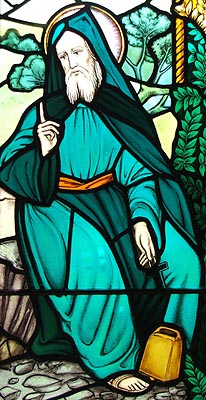
For an ensample of all this, of how it might yet be here in the South, we offer the life of our Holy Father the Venerable Beuno, who enlightened many of Dixie’s forebears in southwest England and who has never ceased to offer his help to those who trust in him as an intercessor before Almighty God.  Halig (Holy) Beuno, pray to God for us sinners at the South!


A stained glass image of St. Beuno.

Of the life of Venerable Abbot Beuno, probably the greatest saint in North Wales, we know very little. His Life was written many years after his repose, but even the bloody 16th-century Reformation could not erase the memory of this saint of God. Our holy father Beuno was born in the second half of the 6th century in the Welsh kingdom of Powys (according to another tradition – in the present-day western English county of Herefordshire, which at that time was part of Wales) and most likely was a grandson of a Welsh prince. As a young man, Beuno was taught in Herefordshire and learned the monastic life in the famous Bangor Monastery that had been founded by the holy Bishop Deiniol of Bangor (today the village Bangor-on-Dee in the Borough of Wrexham in north-east Wales).

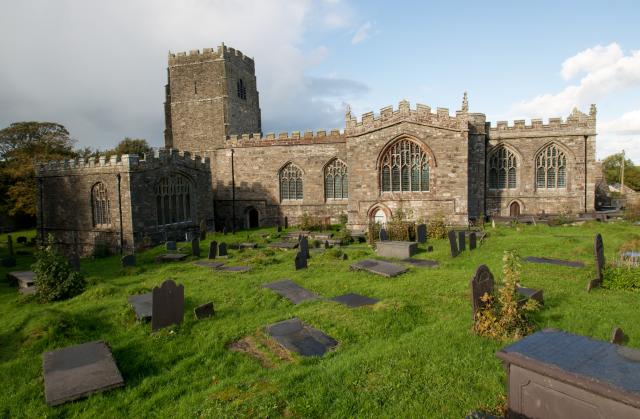
In about 616 Beuno founded his main monastery at Clynnog Fawr in the historic region and modern county of Gwynedd in northwest Wales. Owing to the tireless labors of the monks of Clynnog Fawr, most of North Wales was enlightened with the Gospel. Beuno was ordained priest at Bangor and then was invited to become its abbot. In all the venerable man established no fewer than nine monastic centers in Wales and all of them became famous. According to popular tradition, Beuno was the uncle, spiritual father and patron of the holy martyr Winifred, whose veneration throughout the Middle Ages was great. Her relics were in Shrewsbury in England and her wonder-working well at Holywell in Wales has been a focus for continual pilgrimages for 1350 years.

 St. Beuno's Church in Clynnog Fawr, Gwynedd.
    
It was said of Beuno that he was stern with stubborn sinners but was full of mercy and compassion for penitents and those who suffered. Towards the end of his life, Beuno was rewarded by the Lord with the gift of discernment and was able to penetrate into the depths and mysteries of the spiritual world. Throughout his life, Beuno worked numerous miracles of healing. He was also a very active and extremely successful missionary, his preaching of the Word of God reached many corners of Wales and south-west England. Among the contemporary theologians Beuno was famous for his knowledge of the Holy Scriptures.
    
The saint reposed peacefully a few days after Easter Sunday 640 (or 645) in Clynnog Fawr as a very old man. For most of his very long and fruitful life this holy man had wandered much, everywhere preaching the words of Eternal Life, founding monasteries, healing the sick and consoling the destitute, the suffering and those who had been forsaken by others. Frequently he retired to very secluded places for solitary prayer. Beuno established monasteries in Llanveynoe in Herefordshire in England (the Welsh form: Llanfeuno, “Church of Beuno”) and in Llanymynech. To this day there is a unique village called Llanymynech which is partly situated in Wales (Powys) and partly in England (Shropshire). Ancient traditions say that Beuno, as a wandering preacher, used to pay visits to the monastic islands in Wales at Bardsey and Anglesey. On Anglesey he may have founded a church, or, most likely, a monastery, in a place called Aberffraw.

Apparently Beuno for some while led a solitary ascetic life in Somerset in southwest England where a tiny and lovely church in Culbone – which stands to this day – served him as a cell (hence its name: cell = kill = killbeuno = Culbone). This is the smallest active parish church in all England. It is dedicated to St. Beuno who has been its patron for many centuries. This is a fine example (as well as the neighboring early English Church of St. Dubricius in Porlock) of an early hidden Celtic shrine in England and indicates the uninterrupted tradition of holiness. It is believed that it served Beuno as a cell and after his repose was converted into a chapel. Culbone church is located in a very quiet and remote place right beside the Bristol Channel, surrounded by nature, forest, pastures and small farms. Nearby is the steep Porlock hill and other high hills (typical for Somerset). The views are breathtaking and as you walk it seems that the sea merges with the sky and worldly civilization is far away. This is a typical setting for the ancient Celtic saints.

After his repose, Beuno was buried in Clynnog Fawr, and soon a chapel was erected above his grave. A great number of miracles occurred at his holy relics. Later the saint’s remains were translated to a new church where many miracles continued to occur. The veneration for Beuno was so strong that it even continued after the disastrous Reformation under Henry VIII, when all over Britain monasteries were closed, icons, relics and other holy objects were destroyed and the veneration of saints was officially prohibited.

Until the early 19th century there was a custom among the farmers in the vicinity of Clynnog Fawr to make donations to St. Beuno’s Church in the form of young lambs and calves on the feast of Whitsun (Trinity Sunday), as well as to lead sick cattle to the neighboring holy well dedicated to St. Beuno. There are records of countless cases of healing of sick domestic animals on that holy site. From the late medieval era, Clynnog Fawr church regularly celebrated a special service of intercession for the health of livestock. Children who suffered from many diseases – both before and after the Reformation – were brought and led to the holy well, bathed in it and left for a night inside the chapel on the grave or near the grave of the holy man; and many of them were miraculously cured. In most cases children and young people who had suffered from rickets and epilepsy left this place absolutely healthy.

There is written evidence that in the 18th, 19th and 20th centuries people were healed from many ailments on bathing in this sacred spring. St. Beuno is considered to be the patron of sick children and sick cattle in Wales to this day. Beuno’s well at Clynnog Fawr still remains a destination for pilgrimages today, even though it was partly damaged by vandals in 2010. There is another holy well dedicated to Beuno in Holywell, Flintshire, situated close to its far more famous neighbor – the well of Beuno’s niece St. Winifred. From this well there begins a heritage route devoted to St. Beuno. There is an ancient and now unused church of St. Beuno and a well associated with him at the foot of a hill in the village Carnguwch, Gwynedd.

 . . .

Source:  Dmitry Lapa, ‘Venerable Beuno, Abbot of Clynnog Fawr in Wales’, http://www.pravoslavie.ru/english/79097.htm, posted 4 May 2015, accessed 7 May 2015

Friday, May 29, 2015

Escaping the Empire: Recovering the Past So That ‘It Might Be Otherwise’, Part I


Þe Technocrats are fairly far along in turning Modern Man into, as Andrew Lytle calls him, Momentary Man - one who lives only for present pleasures with no thought for what came before or what will come hereafter.  This is precisely the model of man we must turn from in order to live a life that is more than a gratification of the flesh, which is death.  The best thing in this life, the most beautiful, is man filled with the Holy Ghost, man who is so pure that he reveals the wonderful Light of the Spirit that fills him and is joined with him.  Matter and ghost together, not sundered as latter day false teachers tell us it must be, whether with Church and state, work and faith, God and His creation, etc. 

We must recover the truths of the past like these if we would live rightly and well, if we would experience a foretaste of the Kingdom of God here on earth while we work out our salvation.  We must recover the truths of the past if the South is to become truly herself, to attain to the goal the Lord has set before us: the likeness of the forepattern of the heavenly Souð that the Lord God made when he called us into being as a people.

Father Andrew Phillips speaks of this work and what it entails below.  In a future post, we will look in more detail at how this work could manifest itself in the South.

The eleventh century made the distinction between the secular and the ecclesiastical fundamental to European society and culture for the first time and permanently. Since this distinction was the foundation on which European civilization has been constructed, it is not easy for Europe’s children to remember that it might have been otherwise. Our history has been written by the victors in the struggle to bring this social order into being, in the certainty that their victory was right, and because it was right, inevitable. By the middle of the twelfth century the victors dominated the record almost entirely and their spiritual descendants occupied the commanding heights of European historiography until the Enlightenment, and of much of European education, including higher education, until well into the twentieth century.

The First European Revolution c. 975-1215, R.I. Moore, Pp. 12-13

Introduction: A Spiritual Pilgrimage

I am one of ‘Europe’s children’, one of those who in the second half of the twentieth century ‘remembered’, first by instinct and then by knowledge, ‘that it might have been otherwise’ in Europe. In other words, I made a spiritual pilgrimage to the roots of Europe and found Another Europe. This was made possible firstly by the fact that I had been born into a family linked with farming in the English countryside, so into the most traditional of backgrounds. This took me back beyond the little that those in the big towns were allowed to know, especially those uprooted in unEnglish London, back to the great realm of lost knowledge. Secondly, with shock my father, a soldier of the Second World War, also told me in childhood what he had seen of the unjust way that the imperialist Norman British Establishment behaved in Egypt and in other colonies, a way completely at odds with the far older, neighbour-loving, Christian traditions of popular England. All this gave me a sense of the beyond, a sense of piercing the veil beyond the present and superficial, getting through to the essence and roots of things, and also to a sense of my own destiny.

The Consequence of the Sense of Beyond

The sense of the beyond came to me in my discovery of the Old Saints of England, who had lived locally. Their names in some form or other had been passed down in local place names, which is how I first came to hear of them, and yet their lives and feats had been made into foolish legends or else wholly forgotten: Felix, Cedd, Botolph, Audrey, Osyth, Albright, Edmund, Alfred and many others who witnessed to holiness, that which was quite unknown to the England of the present, meaning that all manner of charlatan could claim to be holy without being so. I noticed that these Old Saints had all lived long before the Middle Ages, itself a period long before the rapidly disappearing Protestant present of fifty years ago. And then I discovered at the age of twelve that that past was still alive in spirit in Orthodox Christian Russia and indeed in all the other much smaller and captive Local Orthodox Churches. At that time, however, the Russian Orthodox Church was Herself captive to an atheist regime, the ultimate, fully anti-Christian result of the spiritual degeneration of the Western world which had first begun to lose its way precisely by forgetting its saints, its Felixes, Cedds, Botolphs, Audreys, Osyths, Albrights, Edmunds, Alfreds and many others.

The Double Restoration

Therefore it has somehow been my calling, obviously in a very, very modest way, to help contribute to a double restoration. Firstly, there has been the restoration, contributed to by so many, of the veneration of those Old Saints, not only of Old England but of all Old Europe. And secondly, especially in the last twenty-five years since the slow but long hoped-for resurrection of Russia began, and again in a very, very modest way, to help contribute from outside Russia to the restoration, contributed to by so many others who have played far, far more important roles, of the Centre of the Orthodox Church in Russia. This has meant struggling for the purity of Holy Orthodoxy against all deviations to left and right, both inside the Russian Church and in the other Local Churches. And this has also meant defending the Incarnation of Orthodoxy into life, both inside Russia and also in other lands, through the preparation and hope for the restoration of the Christian Emperor, the Tsar. For, since our Faith is not some private, individualistic, Protestant-style fantasy, this incarnational public restoration is the only thing that stands between us and the apocalyptic End of the World.

Conclusion: Hope Against Hope

I have lived and fought for the Church of God, quite naturally centred outside the secularist Anti-Europe which in its anti-Christian delusions so fears, hates and tries to destroy the Centre of the Church. I have done this so that ‘it might be otherwise’. I have challenged the victors and their spiritual descendants, the historiographers, who have supported that false and secularist millennial social order. In the certainty that their victory was not only wrong, but also not at all inevitable, I therefore venerate the Saints of Old Europe and honour all the others for whom it was otherwise. I have struggled to reverse the temporary, though millennial, victory of their Anti-Europe and unfolded the vision that it once was and again shall be ‘otherwise’. For in the third millennium the revolutionary New Europe, that is, the second millennium Anti-Europe presaged by Charlemagne in Aachen, may yet be overthrown. Thus, first millennium Old Europe can be spiritually restored through the Church of God in Europe, made possible as a Metropolitan extension of the Christian Empire of a restored Holy Rus.

Source:  ‘The Restoration of Europe and of Russia’, Orthodox England events ‘blog, http://www.events.orthodoxengland.org.uk/the-restoration-of-europe-and-of-russia/, posted 6 May 2015, accessed 29 May 2015

Thursday, May 28, 2015

An Afterword for Memorial Day 2015


Holy days of the American religious calendar like Memorial Day serve to highlight how out of place the South remains in the American Empire, and will remain so long as she remains true to her calling as a Christian people (which calling she is in great danger of walking away from).

Quoting again from Bellah’s essay from the foregoing post, he says of the (in his view) wretched South,

 . . . Still, it has been difficult to use the words of Jefferson and Lincoln to support special interests and undermine personal freedom. The defenders of slavery before the Civil War came to reject the thinking of the Declaration of Independence. Some of the most consistent of them turned against not only Jeffersonian democracy but Reformation religion; they dreamed of a South dominated by medieval chivalry and divine-right monarchy.

 . . . The first time of trial had to do with the question of independence, whether we should or could run our own affairs in our own way [Why, then, was the South not allowed to peacefully secede so that she could ‘run her own affairs in her own way’?--W.G.]. The second time of trial was over the issue of slavery, which in turn was only the most salient aspect of the more general problem of the full institutionalization of democracy within our country. This second problem we are still far from solving though we have some notable successes to our credit.

So then, for trying to make the best of a bad situation (i. e., slavery, to which the Northmen contributed) and daring to hold to an understanding of God, man, and the creation that was different than the American understanding (which is to say, the Puritan-Yankee-New England view), Father Abraham and his Holy Army are to be justified and praised for sweeping down upon the South breathing murther and wrecking every bit of our theod (nation) - churches, houses, farms, fields, animals.  And after the bodily attacks had ended, those on Southern beliefs continued (even to this day), whether by promoting secular scientism, writing a false history of the [u]nited States, destroying the symbols of the South, or besmirching our heroes.

Any Southerner who thinks he needs to be a ‘good American’ first and foremost had better take some time to think about what that entails for him, his family, and his conquered and subjugated people.

Tuesday, May 26, 2015

Memorial Day 2015: A Celebration of the American Civil Religion


Fr John Strickland summarizes a bit of the Russian philosopher Vladimir Soloviev’s thoughts on nationhood in his book The Making of Holy Russia (Jordanville, Ny., Holy Trinity Publications, 2013, p. 153):

 . . . he [Soloviev] described how “nationality—either of the people or the nation—represents a positive force and every people has been appointed a special role to serve according to its special character.”  Every nation, he claimed, possessed an essential character that had been impressed upon it by God.  The character given to a Christian nation demanded that it fulfill its calling to preserve and disseminate the kingdom of heaven on earth.  In fact, it was justified exclusively by its fulfillment of this calling.  On the other hand, when a Christian nation ceased to fulfill its mission, or worked in opposition to it, it lost the justification to act on a world-historical plane.  This was true especially when it pursued the ideals of ethnic nationalism, which distorted the otherwise productive force of national self-consciousness.  In such a case, Soloviev claimed, “the positive force of nationality mutates into the negative force of nationalism.”  The result was an “extreme antagonism” toward other nations, wherein “nationalism destroys its own people and makes it an enemy of humanity.”  On the other hand, “Christianity, by abolishing nationalism, saves peoples because to be supranational is not the same as nationless.”  According to Soloviev, then, nationality was a legitimate, God-given form of human community.  Its divine purpose was to focus the community’s attention on the Christian mission to unify humanity and establish the kingdom of heaven on earth.

For those who get swept up in the emotionalism of Memorial Day and other American ‘holy days’, there are important things that need to be brought out from this passage and elsewhere.  First is the truth that ‘America’ is not a nation in the proper sense of the word but rather an assemblage of peoples (Indian tribes, the Southern States, Hawai’i, and various other islands from the Caribbean to the Pacific Ocean) in thrall to Washington City, held together by little more than force.

Second, in keeping with Soloviev’s words, the current union of Captive American States shows that it is not primarily a Christian folk.  It does not worship the Most Holy Trinity but instead its own greatness.  This has led it to, as Soloviev says, show ‘extreme antagonism’ towards other countries, ‘destroy its own people’ (physically through abortion and endless war and spiritually through mindless ‘fun’ and materialism (the ‘American Dream’)), and ‘make it an enemy of humanity’.

Robert Bellah elaborates on this theme of Americans setting up a religion of nationalism in his essay ‘Civil Religion in America’ (1967, http://www.robertbellah.com/articles_5.htm, posted n. d., accessed 13 May 2015).  Writing of Memorial Day, he says,

Memorial Day, which grew out of the Civil War, gave ritual expression to the themes we have been discussing. As Lloyd Warner has so brilliantly analyzed it, the Memorial Day observance, especially in the towns and smaller cities of America, is a major event for the whole community involving a rededication to the martyred dead, to the spirit of sacrifice, and to the American vision.[xi]  Just as Thanksgiving Day, which incidentally was securely institutionalized as an annual national holiday only under the presidency of Lincoln, serves to integrate the family into the civil religion, so Memorial Day has acted to integrate the local community into the national cult. Together with the less overtly religious Fourth of July and the more minor celebrations of Veterans Day and the birthdays of Washington and Lincoln, these two holidays provide an annual ritual calendar for the civil religion. The public school system serves as a particularly important context for the cultic celebration of the civil rituals.

A homegrown political idol is bad enough, but what is worse is that the religion of ‘Americanism’ is being used by Bellah, Manly Hall, the Bush family, and others as a stepping stone to their desired end - an antiChristian one world government:

Out of the first and second times of trial have come, as we have seen, the major symbols of the American civil religion. There seems little doubt that a successful negotiation of this third time of trial-the attainment of some kind of viable and coherent world order-would precipitate a major new set of symbolic forms. So far the flickering flame of the United Nations burns too low to be the focus of a cult, but the emergence of a genuine transnational sovereignty would certainly change this. It would necessitate the incorporation of vital international symbolism into our civil religion, or, perhaps a better way of putting it, it would result in American civil religion becoming simply one part of a new civil religion of the world. It is useless to speculate on the form such a civil religion might take, though it obviously would draw on religious traditions beyond the sphere of biblical religion alone. Fortunately, since the American civil religion is not the worship of the American nation but an understanding of the American experience in the light of ultimate and universal reality, the reorganization entailed by such a new situation need not disrupt the American civil religion's continuity. A world civil religion could be accepted as a fulfillment and not as a denial of American civil religion. Indeed, such an outcome has been the eschatological hope of American civil religion from the beginning. To deny such an outcome would be to deny the meaning of America itself (Bellah, ibid).

Make no mistake - the American civil religion is a real religion, a substitute for Christianity:

 . . . The Declaration of Independence and the Constitution were the sacred scriptures and Washington the divinely appointed Moses who led his people out of the hands of tyranny.  . . .

With the Civil War, a new theme of death, sacrifice, and rebirth enters the new civil religion. It is symbolized in the life and death of Lincoln. Nowhere is it stated more vividly than in the Gettysburg Address, itself part of the Lincolnian "New Testament" among the civil scriptures. Robert Lowell has recently pointed out the "insistent use of birth images" in this speech explicitly devoted to "these honored dead": "brought forth," "conceived," "created," "a new birth of freedom."  . . .

Behind the civil religion at every point lie biblical archetypes: Exodus, Chosen People, Promised Land, New Jerusalem, and Sacrificial Death and Rebirth. But it is also genuinely American and genuinely new. It has its own prophets and its own martyrs, its own sacred events and sacred places, its own solemn rituals and symbols. It is concerned that America be a society as perfectly in accord with the will of God as men can make it, and a light to all nations (ibid).

How can one tell if he is a worshipper of ‘America’ ræther than the one true God?  One place to start is by looking back at what received the most emphasis at one’s church and home these past couple of weeks:  the Church’s holy days of our Lord’s Ascension and Pentecost, or the American holy day of Memorial Day?

Let those who have ears to hear and eyes to see understand and flee from the religion and culture of America the New Babylon, and live instead as much as they are able by þe teachings, calendar, and all the rest of Christ’s Holy Orthodox Church.