Tuesday, April 19, 2016

The Liturgical South

We have noted before the close kinship betwixt the Southern and the Orthodox ways of life.  The Southerner’s view that his life and all the creation - time and space and all material things, living or not - participate in a mystery beyond themselves, in a great cosmic liturgy or dance, is another manifestation of this closeness.  The Southern belief is beworded nicely in the poem below by the Tennessee poet, historian, etc. Donald Davidson, while Archimandrite Vasileios in the word-sharings that follow shows what the South is reaching for in her agrarian mysticism.

   I
Now let us leave the gate unshut
On hayfields grown too ripe to cut.
That Adirondack will not change its pose,
And this northern light looks back before it goes
Till Kirby Peak turns rose.

Whoever asks the day of the week
Can hold the wind on his western cheek,
Walk, and find an unblazed road where Monday
Measures as good a blueberry mile as Sunday.

Lest we should sin by being fanatic
We let the red squirrel all the attic.
Knowing God is, we say our vows
When vesper deer come forth to browse,
Telling the beads of many a yesterday.
Nine shadows lined against the wood;
The tenth you cannot see,
But count that other shadow where the gray
Boulder remembers the glacial flood,
And that will make our rosary.
Ave Maria while the evening star leans low
Brings dew upon the head.
Our Paternoster’s said.
The lamp is lit within, and we must go.

   II
We ask God for no better proof
Than that moss likes our shingle roof.
Locusts give shade; the sun will set;
Asters proclaim it will rise again.
The red ants know we will have rain
Though the merry cricket says, “Not yet!”

 . . .

 . . . So the red fox invades the lawn.
Bony and lean, he has a brush
Would serve Odysseus for a bush.
The little, naked red fox peers
With prayerful face and upright ears,
Then genuflects, with sweep of paw,
To mark the rigor of God’s law
And catch, of grasshoppers in riot,
His portion of a hermit’s diet,
Which, if it is not sacrament,
Owes naught to secular government.

   III
Once and again a tantara
Hails like a distant Gloria.
 . . .

 . . . How could she learn, without research,
The Gradual of our mountain church
If not from logs of pine and birch
That lift from every morning fire
The plainsong of our primitive choir?
 . . .

(Donald Davidson, ‘Gradual of the Northern Summer’, Poems 1922-1961, Minneapolis, Minn.: U. of Minn. Press, 1966, pgs. 8-10)


 . . . everyone who has entered into the Liturgy sees the “words”, the inner principles of existent things, concelebrating with the one incarnate Word, the “One who offers and is offered” in the Liturgy of the whole world.

The life of the world, its creation and its history, are a divine Liturgy which leads all things to a blessed end.  “Earthly things have become heaven” (Feast of the Annunciation).

One who is truly baptized into the spirit of the Divine Liturgy never departs from that spirit.  He is always within the divine Liturgy.  Everything is revealed to him concelebrating, voluntarily or involuntarily, with the one Word.  And this person in every time and place is nourished by the music of heaven.  He receives light from the Light which knows no evening.  And he goes forward, while remaining in the same place, because his inner doxology and joy never stop.  And he does not know whether it is rather that he offers joy and light to all, or that he receives gladness and rejoicing from everywhere.  He finds himself part of a Liturgy concelebrated by the entire universe.  He sees the whole of creation as a theophany, a burning bush which is not consumed: because through the Liturgy, “all things have been filled with light” (Archimandrite Vasileios, ‘“The Light of Christ Shines upon All” through All the Saints’, Dr Elizabeth Theokritoff, trans., Montreal, Quebec: Alexander Press, 2001, pgs. 23-4).

* * * * *

 . . . [God] loves the whole person, and his freedom.  And it is of great importance to approach God in freedom, when your time comes.  It is important to take a risk at some point in taking your personal step.  To dare to express your objections or doubts, as did the Apostle Thomas.  To confess the truth.  To hear the Good Shepherd calling you by name.  To cross the threshold of fear and hesitation.  To tear up the contract of slavery.  To go forward in freedom.  And to take the next step: voluntarily to enslave yourself to God.  To say: My God, I have no confidence in myself.  My true self is You, who created me, who love me and who call me to the dangerous adventure of freedom so that I can find my soul by deliberately losing it.  This is why I ask and want Your will to be done, and not my own.

Then you begin to tread different ground; to fly on the wings of the winds of the Spirit.  And divine grace cares for you as a hen her chicks (Archimandrite Vasileios, pgs. 13-4).

The Orthodox Church does not destroy cultures but brings about their fulfillment by pruning away that which is evil (idolatry, vices, etc.) and bringing into full flower that which is good.  The South, still being pre-modern (to borrow Dr Clark Carlton’s word) in many ways, and thus sharing much in common with Orthodoxy, her pruning as it were would perhaps not be that painful. 

Nevertheless, many Southerners no doubt hesitate about conversion to Orthodoxy.  ‘Is it faithful to the Southern tradition, to the ways of our forefathers?’  To which we answer with our most solemn Yes.  In the purity of the Orthodox Faith, a man becomes whole:  All the wounds of sin, all the distortions of his nature, are healed.  Any deviations from that Faith which Christ gave to His Apostles will not allow him to heal completely, to achieve full personhood, full union with God. 

The same holds true for countries as well.  For Dixie to be baptized into the Christ of the Orthodox Church would be for her to become most truly herself (‘My true self is You, who created me’); and that is the end any people strives for, including our own forebears from Robert Beverley to John C. Calhoun and William Gilmore Simms to Rev R. L. Dabney and Mel Bradford.  Just as Spain was not truly Spain until she entered the baptismal waters blessed by the Orthodox Church, nor was England truly England, nor Russia truly Russia, and so on. 

By all means, as Archimandrite Vasileios said, voice your doubts, ye sons and daughters of the South, but do not be afraid to cross the threshold into the Orthodox Church when the time comes, when the Good Shepherd calls.  For God is our life, and anything that hampers our union with Him brings death to us.  May our Heavenly Father bring the South life and joy and gladness and salvation through our union with the Body of Jesus Christ His only-begotten Son in the Holy Ghost, now and forever.

Tuesday, April 12, 2016

Ted Cruz, Dominionism, and the Dangers of ‘Sola Scriptura’


As the years pass on, one thing the [u]nited States may well be remembered for (unhappily) is being a breeding ground for a great multitude of new sects of Christianity.  At the heart of this continuous fracturing is the idea that the Bible alone (Sola Scriptura) is to be the foundation and rule of the Christian life.  As we have noted before, however, there can be as many interpretations of the Holy Scriptures as there are people who read them, and with no other guiding principle than one’s private opinions, schism is sure to multiply.  And it has.

One of the latest fruits that the crooked tree of Sola Scriptura has borne is Seven Mountains Dominionism.  We mention it here because so many well-meaning Christians in the South and elsewhere have fallen in love as it were with Sen Ted Cruz, who espouses this false teaching (as does Glenn Beck and some other notables).

 . . .

Anyone who has watched Cruz on the stump knows that he often references the important role that his father, traveling evangelist Rafael Cruz, has played in his life. During a 2012 sermon at New Beginnings Church in Bedford, Texas, Rafael Cruz described his son’s political campaign as a direct fulfillment of biblical prophecy.

The elder Cruz told the congregation that God would anoint Christian “kings” to preside over an “end-time transfer of wealth” from the wicked to the righteous. After this sermon, Larry Huch, the pastor of New Beginnings, claimed Cruz’s recent election to the U.S. Senate was a sign that he was one of these kings.

According to his father and Huch, Ted Cruz is anointed by God to help Christians in their effort to “go to the marketplace and occupy the land … and take dominion” over it.  This “end-time transfer of wealth” will relieve Christians of all financial woes, allowing true believers to ascend to a position of political and cultural power in which they can build a Christian civilization. When this Christian nation is in place (or back in place), Jesus will return.

Rafael Cruz and Larry Huch preach a brand of evangelical theology called Seven Mountains Dominionism. They believe Christians must take dominion over seven aspects of culture:  family, religion, education, media, entertainment, business and government. The name of the movement comes from Isaiah 2:2: “Now it shall come to pass in the latter days that the Lord’s house shall be established on the top of the mountains.”

Barton’s Christian nationalism is a product of this theological approach to culture.  Back in 2011, Barton said that if Christians were going to successfully “take the culture” they would need to control these seven areas. “If you can have those seven areas,” Barton told his listeners to his radio show, “you can shape and control whatever takes place in nations, continents and even the world.”

Seven Mountains Dominionism is the spiritual fuel that motors Cruz’s campaign for president.

 . . .

Source:  John Fea, ‘Ted Cruz’s Campaign Is Fueled by a Dominionist Vision for America’, http://www.religionnews.com/2016/02/04/ted-cruzs-campaign-fueled-dominionist-vision-america-commentary/, posted 4 Feb 2016, accessed 23 March 2016 (thanks to www.infowars.com for posting their story about this)

Some things to note:

First, Christ’s kingdom is not of this world (St John’s Gospel 18:36).  Treating it as though it were, that Christians must conquer worldly institutions and wield worldly power in order to bring about Christ’s Second Coming, is playing straight into the hands of the devil, whose Antichrist would fit quite nicely into this scheme of the Dominionists.

Second, the Kingdom of God is already near at hand, and even within us, and may be experienced here and now in this age, if only we would look for it in the right way: 


Third, we must safeguard ourselves against false teachers by taking a different approach to the Holy Scriptures than that of the Protestant churches.  The teachings of the Orthodox Church, she which has kept unimpaired the Faith given by Christ to His Holy Apostles, are our only sure hope.

From the Council of Jerusalem of 1672:

Decree 2


We believe the Divine and Sacred Scriptures to be God-taught; and, therefore, we ought to believe the same without doubting; yet not otherwise than as the Catholic Church [not ‘Catholic’ as in ‘Roman Catholic’ but ‘catholic’ as in ‘complete’ or ‘full’ or ‘lacking nothing’--W.G.] has interpreted and delivered the same. For every foul heresy accepts the Divine Scriptures, but perversely interprets the same, using metaphors, and homonymies, and sophistries of man’s wisdom, confounding what ought to be distinguished, and trifling with what ought not to be trifled with. For if [we were to accept Scriptures] otherwise, each man holding every day a different sense concerning them, the Catholic Church would not  by the grace of Christ continue to be the Church until this day, holding the same doctrine of faith, and always identically and steadfastly believing. But rather she would be torn into innumerable parties, and subject to heresies. Neither would the Church be holy, the pillar and ground of the truth, {1 Timothy 3:15} without spot or wrinkle; {Ephesians 5:27} but would be the Church of the malignant {Psalm 25:5} as it is obvious the church of the heretics undoubtedly is, and especially that of Calvin, who are not ashamed to learn from the Church, and then to wickedly repudiate her.

Wherefore, the witness also of the Catholic Church is, we believe, not of inferior authority to that of the Divine Scriptures. For one and the same Holy Spirit being the author of both, it is quite the same to be taught by the Scriptures and by the Catholic Church. Moreover, when any man speaks from himself he is liable to err, and to deceive, and be deceived; but the Catholic Church, as never having spoken, or speaking from herself, but from the Spirit of God — who being her teacher, she is ever unfailingly rich — it is impossible for her to in any wise err, or to at all deceive, or be deceived; but like the Divine Scriptures, is infallible, and has perpetual authority.

Source:  http://www.crivoice.org/creeddositheus.html, accessed 12 April 2016 (thanks to Michael for sharing this web site with us)

And in the Institutes of St John Cassian (+435) we find this:  If we wish to understand the Scriptures aright, then we must first acquire purity of heart, which requires much labor (love of enemies, fasting, prayer, etc.).

Chapter XXXIII.


Of the solution of a question which Abbot Theodore obtained by prayer.


Chapter XXXIV.


Of the saying of the same old man, through which he taught by what efforts a monk can acquire a knowledge of the Scriptures.


For more on the Orthodox view of Sola Scriptura:

Friday, April 8, 2016

‘The Shrine of St Cuthbert’

To the tomb of Halig Cuthbert
The Reformers came, full of wrath and spite.
To the shrine of Halig Cuthbert
The marauders came, to steal and to spoil.
Bone rot they thought to find,
Being darkened in their minds.
But a body instead they saw,
Sweet-smelling and whole.
For God had not abandoned him,
The Lord, Who has hallowed him.

The Christ-hating band fell back,
But forward went again.
The Christ-hating mob,
No one could stay nor stop.
His wealth they robbed,
His leg they broke,
Leaving him forgot and fornaught--
Or so to them it seemed.

But the fathers are not the bairns;
Arise O Southron!
But the fathers are not the bairns;
Go forth O South son!
With your feet or in your heart,
Run to Durham, to the grace-filled relics
Of our God-bearing Father,
Cuthbert of Lindisfarne,
The holiest saint of Angle-kin,
And ask him with meekness and love
And tear after tear
To pray for the stricken Southland,
Until, uplifted by his labors,
She becomes the Eden
She has always striven to be:
The Garden of the Trinity.


Note:  ‘Halig’ is Old English for ‘holy’.


Tuesday, April 5, 2016

God, Man, and Democracy

Why does democracy fare so poorly as a political system?  Because it is not in accord with reality.  Mankind, democracy says to us, is a mere collection of completely separate, self-enclosed individuals who have no inner, ontological connection with one another.  There is little thought of the common good, only self-interest.

But the truth of the nature of mankind is the opposite.  Like the Holy Trinity, in Whose image and likeness man has been made, we are many persons/hypostases sharing one human nature.  Like the Persons of the Father, Son, and Holy Ghost, each man reaches the fulness of personhood only by emptying himself, by becoming the servant of all.  ‘The other’ is not my enemy, a competitor for scarce resources, a business or political rival, or any other such thing as Darwin, Locke, Hobbes, and other Enlightenment thinkers teach us.  He is my salvation; he is my doorway into the Kingdom of Heaven.

St Macarius the Great of Egypt said this as clearly as anyone could:

‘There is no other way to be saved but through our neighbour; according as He enjoined, Forgive, and ye shall be forgiven’ (Fifty Spiritual Homilies of St Macarius the Egyptian, Homily XXXVII, Forgotten Books, 2012, p. 251).

Democracy, we may say then, is a sin against love.  But love is the reason there is a creation at all, which came into being because of the overflowing of the love of the Persons of the Holy Trinity.  So perfect is Their love that They wanted others outside Themselves to share in the joys of knowing it, so They created the angels and man and all the cosmos.  Love undergirds and upholds the created world (Archimandrite Vasileios, The Saint: Archetype of Orthodoxy, 2nd ed., Dr Elizabeth Theokritoff, trans., Montréal, Québec: Alexander Press, 1999, p. 8). 

So when man acts contrary to love, as he does in modern Western democracies, where the basis of man’s existence is said to be mistrust and fear of those around him; when each and all see themselves as totally closed-off, mutually repelling, atomistic individuals in competition with one another rather than as persons who were made to embrace all the creation within themselves; when they do this, they move away from love, which called all things into being and which holds all things together, and towards non-existence (see, e.g., http://www.ancientfaith.com/podcasts/freeman/to_tell_the_truth).  The resulting chaos and trouble should not be a surprise to any of them.  But it is.  And, sadly, their answer in many cases is ‘Give us more democracy!’

Christ’s one and only Incarnation also shows the oneness of man’s nature.  If it were not so, our Lord would have had to undergo the whole redemptive process – incarnation, life, death, resurrection, ascension – for each individual, rather than once for the whole of mankind.

Because of its underlying teaching about man, pluralistic/secular democratic political life necessarily stirs up vices:  anger, slander, revenge, pride, greed, lust for power, unnecessary talk.  In short, constant agitation and disquiet.  There is no stillness.  And where there is no stillness, there is no pure prayer.  And where there is no pure prayer, there is no real union with God.  And where there is no real union with God, as said above, all things fall apart.

Political life in a Christian kingdom on the other hand gives birth to virtues:  Obedience, humility, self-sacrifice, love, calmness, quietness, harmony.  Here, life in the Holy Trinity can be known; here, the goal of God being all in all can begin to be approached.

Democracy is not consistent with the fulness of personhood we are called to achieve but with the emptiness and shriveled smallness of individualism.  Democracy reduces man to the level of an impersonal mathematical variable, an empty cipher to be manipulated in a political consultant’s election calculus:

‘ . . . unlike the individual, the person is not a quantitative category, in the sense that he or she can be numbered on an arithmetical basis and so form part of an impersonal total.  The person is a qualitative category, one that derives from the possession of certain inner qualities.  Thus the person has nothing to do with numbers and transcends and even abolishes arithmetical categories.  . . . A relationship between persons consequently cannot be established through any outward bond or constitution.  It can be established only through mutual recognition that each possesses and embodies the same inner qualities, an identical inner reality [i.e., all must recognize that ‘The person . . . is the ‘image of God’, a spiritual value . . . .’ something which at the very least is implicitly denied by the behavior of political opponents who speak to one another and treat one another as though they were less than human--W.G.]’ (Philip Sherrard, Church, Papacy and Schism: A Theological Enquiry, Limni, Evia, Greece: Denise Harvey, 2009, p. 26).

In a kingdom, however, man is seen differently, not as an abstraction but as a concrete, personal being who has real, deep connections with other people:

‘ . . . in a traditional monarchy the relationship between king and subject is that of a middle-aged father and his mature son, not that of a young father and an infant’ (Erik von Kuehnelt-Leddihn, Liberty or Equality: The Challenge of Our Time, Front Royal, Va.: Christendom Press, 1993, p. 138).

Family members do not think of one another as variables in a mathematical problem.

So then, a king will always be present in a society that retains some semblance of sanity.  There can be and often have been other officers and institutions around him (elected assemblies, judges, advisors, and so on).  This is perfectly natural.  In the Orthodox Church herself, one sees such a thing with bishop-appointed priests and elected parish councils governing the local parish together in harmony.  In countries where the Orthodox Faith has been manifested in its fulness, one also sees a like conjunction of God-anointed king over the nation and small local villages governed by democratic ways, with little friction between the two (as in Tsarist Russia or Old England before the Norman Conquest).

What we must beware of is the one-sidedness of democracy.  Jay Dyer writes of one of its kindred, anarchism,

 . . .

Anarchism, like all derivatives of the revolutionary philosophy, is grounded upon the notion of the metaphysical primacy of the many over the one. Whereas most statist philosophies, like that expressed in Plato’s Republic, for example, envision the people as embodying a vast man with the head symbolizing a king, emperor or philosopher-ruler, so in dialectical opposition the anarchist principle imagines some magical metaphysical primacy in the many. Ironically, even number theory itself shows there is no qualitative primacy given to “one” over “many,” as 1 possesses just as much “numberness” as 2, 3, 4, etc. In Orthodox Trinitarian philosophy, the one and the many have always been viewed as balanced, based on the equality of Persons in the Godhead. Thus, in the Church, the bishop is as much a bishop as any other, with no supreme bishop (Rome) to trump the rest. Good philosophy is based on good theology, where there is a balance of the principle of the one and the many. This is reflected in both religious and political life. Anarchism, with no divine authority in revelation or the supernatural, can only offer competing human opinions, leading to progressive disintegration.

Likewise, in Orthodox Imperial praxis, embodied in the symphonia, the State was to act in harmonia with the Church, each in their proper sphere. According to this philosophy, the Emperor was divinely appointed and a real authority, fulfilling the Old Testament prophecies in Isaiah that kings and rulers would convert to serve the Messiah. The Messianic Age does not, you’ll note, result in anarchism.

Anarchism is based on the presupposition of non serviam, and in praxis, non serviam results in the obliteration of all metaphysical categories and groupings, including tribe, family, race and gender. Are these metaphysical impositions not also “tyrannies” of the Demiurge that must be transcended, since they limit “liberty?”  Indeed, for the outworking of revolutionary philosophies, including anarchism, one need only look at the political and social discourse of our day, where the need to become post-human (transhumanism) is manifestly the logical outcome of anarchism and her revolutionary cousins. Cheeto-fueled online libertarians’ desire to proclaim non serviam is comical, as they are likely being manipulated by think tanks and intelligence fronts.

Source:  ‘The Folly of Anarchism’, http://souloftheeast.org/2016/03/25/the-folly-of-anarchism/, accessed 27 March 2016

In the disorder of their hearts, the adherents of the democratic project have become like Zeus and the other gods (projections of the heathen Greek passions) in Homer’s The Iliad, glorying in the strife and din and chaos of politics, which has become a kind of bloodless (most of the time) warfare:

 . . . But now for total war,
bearing down on the other gods, disastrous, massive,
their fighting-fury blasting loose from opposing camps—
the powers collided!  A mammoth clash—the wide earth roared
and the arching vault of heaven echoed round with trumpets!
And Zeus heard the chaos, throned on Olympus heights,
and laughed deep in his own great heart, delighted
to see the gods engage in all-out conflict (Book 21, lines 437-44, Penguin Books, trans. Robert Fagles, 1990, p. 532).

But in this, there is some hope.  For the pre-Christian Greek peoples embraced Christianity with a great fervor, and since then have brought forth some of the greatest saints (from St Basil the Great in the 4th hundredyear to St Paisios of Mt Athos in the 20th) and cultural achievements (Byzantine chant, Hagia Sophia, and so on) of the Orthodox Church.  If the Souð and the rest of the Western world are becoming like the Greeks in their pre-Christian behavior, perhaps, with God’s help, we will become like them in their later zeal for union with the Holy Trinity within the Orthodox Church as well.

Friday, April 1, 2016

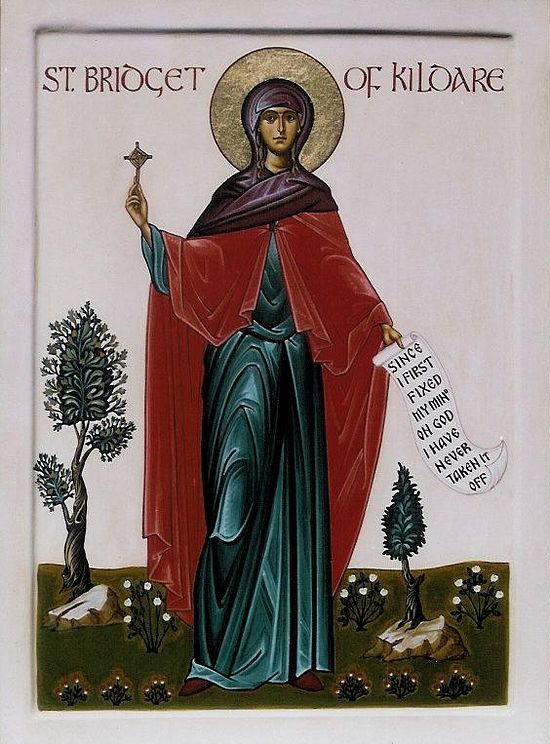
On Being a Good Neighbor: St Brigid of Kildare


Hospitality is one of the best known Southern virtues, part of the inheritance that has come down to us from our English and Celtic forebears.  Our Holy Mother Brigid is one of those largely forgotten figures who helped enrich our patrimony with this virtue, who helped to cultivate it in the souls of Southrons past and present.  But as love toward God and man grows cold in the South and elsewhere in the West, and old traditions and virtues are forgotten, we would do well to learn again of this holy woman who, despite our unthankfulness, always intercedes for us before God.  Ms Mary Dugan Doss’s account of St Brigid begins:

The life of Saint Brigid of Ireland offers us new insight into the virtue of hospitality, the cheerful, generous giving of food and shelter. We know that this virtue is praised throughout the Scriptures. The hospitality of Abraham to three young men who visited him was revealed to be offered to none other than the three Persons of the Holy Trinity. In fact, it is in the forms of these three young visitors that the Holy Trinity is most often represented in iconography. Our Lord Jesus Christ commanded us to offer hospitality when He said:

For I was hungry and ye gave Me meat:  
I was thirsty and ye gave Me drink:
I was a stranger and ye took Me in....

(Matthew 26:35, 40)

Of course, the law of nature also urges us to generously provide for the traveller who has no place to lay his head, and so hospitality, even without the love of Christ, has become an important facet of civilized culture. In pre-Christian Ireland every freeman was required by secular law to provide hospitality to anyone of or below his own class who asked it of him. The type and quality of food and shelter he was obliged to offer varied depending on the class of his guest, but he was expected to provide well for noble and low-born alike, or be subjected to heavy fines as well as social ostracism. Saint Brigid took this legal and social obligation of her people and, by infusing it with the love of Christ, transformed it into a holy rule and a godly art.

Brigid was born at Faughart in County Down in 452, less than fifty years after the beginning of Saint Patrick’s widespread missionary efforts among the Irish. At the time of her birth, the faith was just starting to grow great in the hearts of the Irish people. But by the end of her life, and partly through her efforts, her land would become holy Ireland, a land of saints and scholars, a land of monasteries from which missionaries would go forth to all of Europe and beyond.

 . . .

Source:  ‘A Gift of Hospitality—Saint Brigid, Abbess of Kildare’, http://www.pravoslavie.ru/english/90659.htm, accessed 19 Feb. 2016

Holy Mother Brigid of Kildare, pray for us wretched sinners at the South!


Source:  http://www.pravoslavie.ru/english/90659.htm, accessed 1 April 2016


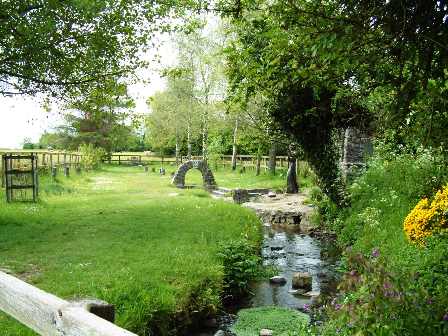
St Brigid’s Well
Source:  http://www.kildare.ie/kildareheritage/?page_id=65, accessed 1 April 2016