Thursday, July 4, 2019

Unintentional Arguments for a King


Mr William Federer gives us some:

Lord Acton wrote to Bishop Mandell Creighton, April 5, 1881:
​
"All power tends to corrupt and absolute power corrupts absolutely."

 . . .

James Madison stated at the Constitutional Convention, 1787:
​
"All men having power ought to be distrusted."


However, if ‘all men are kings’, possessing absolute power to make or unmake a government and its laws, as Mr Federer often claims, then by his own logic no man or group of men can be trusted to govern (it would even be unjust for them to govern), since as all-powerful they are all absolutely corrupt, and there ought, then, to be no organized, established government at all.  Thus, we must return to Hobbes’s ‘state of nature’ of the isolated individual and the war of all against all.  For where there is no trust in one’s fellow man, there is no co-operation, and no creative work is possible; there will be only fear and distrust of one another, hatred, violence, and destruction.

The answer is the anointed Orthodox Christian king, the great father of the extended national family, one who does not wield absolute power, but only that which the ancient laws and customs of his land, the Holy Scriptures, and the Holy Canons of the Church allow him to wield.  This is the one in whom the people may place their trust to govern them well, just as the small father may be trusted to work for the welfare of his little kingdom, the family.  Both are girded with the Grace of Holy Ghost for their rulership by sacraments, the king by the mystery of anointing, the father/husband by the mystery of marriage.  The ensample of the holy Orthodox tsar in Russia is helpful in giving us an understanding of this:

Br Nathanael: What is the essence of Russia’s tradition of sacred monarchy compared with that of the West’s?

Abp Gabriel: In the West, the King ruled by “divine right.”

But in the East, beginning with Emperor St Constantine of the Byzantine Empire to Tsar Nikolai II of the Russian Empire, by “divine grace.”

Br Nathanael: What’s the difference?

Abp Gabriel: Prior to the Bolshevik Revolution there existed in Russia a society ruled by “imperium and priesthood.”

This two-fold rule comes out of the Byzantine Orthodox tradition of “Symphonia of Church and State” whereby the emperor or “tsar” looks after the welfare of the people based on the Church’s teachings.

The Church, in turn, is guarded by the Tsar through a foreign policy which has as its uppermost aim the protection and defense of the Church.

This is why Putin, whom I have had the honor of meeting, in striving to find a variation of Symphonia, affirmed in his Easter speech:

“The Russian Orthodox Church plays an enormous role in preserving our rich historical and cultural heritage and in reviving eternal moral values. It works tirelessly to bring unity, to strengthen family ties, and to educate the younger generation in the spirit of patriotism.”

Br Nathanael: But isn’t this ‘monarchist ideal’ authoritarian and oppressive?

Abp Gabriel: Not in the Orthodox East of which Russia is now preeminent.

In the west, as it evolved in its distortion of Symphonia, “divine right” was absolutist and authoritarian, asserting that a monarch was subject to no earthly authority.

But in Orthodox autocracy, a sovereign rules by “Divine grace”—in Christ’s service—for the benefit of the people.

“Grace” is the charisma of the Holy Spirit operating in humans to regenerate and sanctify and to inspire virtuous impulses.

Br Nathanael: How does the Tsar’s “grace” differ from believers?

Abp Gabriel: The Tsar undergoes a regal anointing of grace which is a Holy Mystery of the Orthodox Church.

Coronations in Russia involved a religious ceremony in which the Tsar was crowned, anointed with holy chrism—which imparted the Holy Spirit’s gift to administer rule—and formally blessed by the Church to commence his reign.

As a Church sacrament, the anointing and crowning of the Orthodox monarch confers a spiritual benefit that mystically weds sovereign to subjects.

Thus, the Orthodox monarch does not rule by “divine right” but by the “grace of the Holy Spirit” and is subject to the moral and spiritual teachings of the Church of which he is accountable.


Political power should not be placed into millions of unaccountable hands who have no idea how to properly use it.  Who can name one voter, let alone a majority of voters, who has received any kind of reprimand for allowing a bad policy to come into effect by his vote (whether public censure, a fine, being barred from voting for an election cycle or two, etc.)?  Yet many are the names of the kings who have been deposed and even killed for their bad and/or unpopular policies.  It is the republican/representative democratic system in which irresponsible power rests, not the monarchical.

Ultimate political authority belongs, as the Holy Scriptures and the history of the Holy Orthodox Church show us, not in the hands of republicans but in the hands of Christian kings who have been specially anointed for service to God and to their subjects.  Christian kings, therefore, aren’t the problem, although folks in the States will hear just the opposite repeated ad nauseum this July 4th.  It is in fact their restoration that will help the nations overcome their spiritual and moral decline and their various political crises:

Br Nathanael: Will there be a restoration of the monarchy that would uninterruptedly resist Russia’s persistent enemies?

Abp Gabriel: As we tire of the world’s political corruption and cruelty, as we see the need to protect the Church from enmity toward Russia by the Western political system and its main stream media, we can easily recognize that only a sovereign Christ-bearing Tsar would be incorruptible and a stabilizing force.

Only he has no need for underhanded political intrigue, has no interest in any lobbies and cannot be bribed, but by the very essence of his service to Christ, he would never sacrifice the interests of his nation to her foes. The time is ripe for such an understanding.

The more the Russian people become churched and return to their Orthodox roots, then could come the restoration of our most treasured sacred monarchy.

--Ibid.

We await the return of the Western peoples to their Orthodox roots and the restoration of their sacred monarchies as well, begging God’s help.

--

Holy Ælfred the Great, King of England, South Patron, pray for us sinners at the Souð, unworthy though we are!

Anathema to the Union!

Tuesday, July 2, 2019

Two Bostons and Hope for New England


In an essay by John Sanidopoulos, the following is written about the resemblances between the Boston of Old England and the Boston of New England:

Saint Botolph's Church began its construction in 1309 and completed in 1390. The church tower, famously known as Boston's Stump or The Stump, was erected in 1425 and took another 90 years to complete. It is the highest tower of any parish church in England at 272 feet built to navigate ships six miles away. It is of this tower with its beacon and its bells that we hear in Jean Ingelow's touching poem, "High Tide On the Coast of Lincoln shire."  . . .

The people of Lincolnshire modeled many things in new Boston based on old Boston. On March 4, 1634 the Court of Assistants in new Boston, remembering the Stump of Saint Botolph's Church, passed the following resolution: "It is ordered that there shall be forth with a beacon set on the Centry hill at Boston to give notice to the Country of any danger, and that there shall be a ward of one person kept there from the first of April to the last of September; and that upon the discovery of any danger the beacon shall be fired, an alarm given, as also messengers presently sent by that town where the danger is discovered to all other towns within this jurisdiction." This also helps us to understand the significance of the light at Boston's Old North Church in today's North End that sparked the Revolutionary War and signaled the famous ride of Paul Revere.

Nathaniel Hawthorne traveled to old Boston in Lincolnshire. He hints that the winding streets of new Boston can be attributed to old St. Botolph's town: "Its crooked streets and narrow lanes reminded me much of Hanover Street, Ann Street, and other portions of our American Boston. It is not unreasonable to suppose that the local habits and recollections of the first settlers may have had some influence on the physical character of the streets and houses in the New England metropolis; at any rate here is a similar intricacy of bewildering lanes and a number of old peaked and projecting storied dwellings, such as I used to see there in my boyish days. It is singular what a home feeling and sense of kindred I derived from this hereditary connection and fancied physiognomical resemblance between the old town and its well-grown daughter."

The relationship between old Boston and new Boston is beautifully expressed by New England poet Henry Wadsworth Longfellow’s poem, “Boston”:

St. Botolph’s Town! Hither across the plains
And fens of Lincolnshire, in garb austere,
There came a Saxon monk, and founded here
A Priory, pillaged by marauding Danes,
So that thereof no vestige now remains;
Only a name, that, spoken loud and clear,
And echoed in another hemisphere,
Survives the sculptured walls and painted panes.

St. Botolph’s Town! Far over leagues of land
And leagues of sea looks forth its noble tower,
And far around the chiming bells are heard;
So may that sacred name forever stand
A landmark, and a symbol of the power,
That lies concentred in a single word.


What is most remarkable about both Bostons, as one may be suspecting at this point, is that they are named for a saint of the Orthodox Church, St Botolph of Ikanhoe in Suffolk.  The details of his life are given here:

Our Holy Father Botolph, Abbot of the Monastery of Ikanhoe (680)

'Saint Botolph was born in Britain about the year 610 and in his youth became a monk in Gaul. The sisters of Ethelmund, King of East Anglia, who were also sent to Gaul to learn the monastic discipline, met Saint Botolph, and learning of his intention to return to Britain, bade their brother the King grant him land on which to found a monastery. Hearing the King's offer, Saint Botolph asked for land not already in any man's possession, not wishing that his gain should come through another's loss, and chose a certain desolate place called Ikanhoe. At his coming, the demons inhabiting Ikanhoe rose up against him with tumult, threats, and horrible apparitions, but the Saint drove them away with the sign of the Cross and his prayer. Through his monastery he established in England the rule of monastic life that he had learned in Gaul. He worked signs and wonders, had the gift of prophecy, and "was distinguished for his sweetness of disposition and affability." In the last years of his life he bore a certain painful sickness with great patience, giving thanks like Job and continuing to instruct his spiritual children in the rules of the monastic life. He fell asleep in peace about the year 680. His relics were later found incorrupt, and giving off a sweet fragrance. The place where he founded his monastery came to be called "Botolphson" (from either "Botolph's stone" or "Botolph's town") which was later contracted to "Boston."' (Great Horologion)

--John Brady, http://www.abbamoses.com/months/june.html, entry for 17 June.  For more on St Botolph:  http://orthochristian.com/71898.html

Though New England has gone far astray from the Orthodox Faith of the Holy Apostles, which was practiced for hundreds of years in their homeland of eastern England before the Norman Invasion of the Roman Catholics and then the Protestant Reformation, there remains nevertheless an Orthodox root on the Yankee tree; the name of the Queen City of New England, Boston, is proof of this, as well as the following: 

. . . while driving through Boston along Massachusetts Avenue, I noticed that the street running parallel to Huntington Avenue was named St. Botolph Street. Though there is no church dedicated to Saint Botolph on this street, I did discover later on, besides the fact there is an apartment complex named after Saint Botolph, that on Huntington Avenue itself there is a YMCA with an Anglican chapel inside dedicated to Saint Botolph. Besides this there are few other mentions of Saint Botolph in the city of Boston (there is a club named after him, and the house of the president of the Jesuit-founded Boston College is also named after the Saint). Noteworthy is the fact that pieces of the Gothic window tracery of Lincolnshire’s Church of St. Botolph are incorporated into the structure of Trinity Church in Boston’s Copley Square.

--Sanidopoulos article

That root is nearly lifeless now, crowded and smothered, slashed and beaten and burned, by various philosophies, ideologies, and heresies that New Englanders have embraced over the years.  But it is still there, and there is still vibrant, unquenchable life in it - the True Life of the Holy Trinity.  When they discover this, and assimilate that Life into their own, real life will begin for them.  What has come before will seem like bitter ashes in comparison:  Puritanism, industrialism and commerce, the Rights of Man, and so on.

And that new life in the Orthodox Church has already begun to grow in New England, though quietly and unnoticed for now:

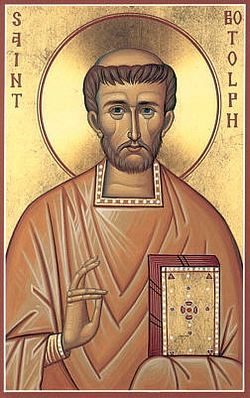
 . . . the Orthodox are slowly laying claim to their Saint in the hopes of sanctifying their city in the New World, as is traditionally done in the more Orthodox countries of the East. Besides the awareness Holy Transfiguration Monastery is promoting through their icon of Saint Botolph, there is also a Russian Orthodox Church Abroad parish in Roslindale named after Holy Epiphany that depicts an icon of Saint Botolph (painted by parishioner Zoya Shcheglov) on its south wall facing towards the city in full stature and giving blessing to the city that bears his name. Unfortunately there is no Orthodox church or chapel dedicated to Saint Botolph in Boston as of yet, but there is an Antiochian Orthodox Church dedicated to Saint Botolph in London.

--Sanidopoulos article

May it grow into the splendid likeness of the tree that grew up in the east of England in her Orthodox days, which was full of holy saints:


We look forward with eagerness to the fruits the Lord will bring forth from the New England folk when the names of Sts Botolph, Audrey, Edmund, Felix, and others like them are honored, rather than those of Mather, Winthrop, Adams, Emerson, or Dickinson.

The end of Fr Andrew’s post just above on the 112 Saints of the fens in the east of England is as fitting for overly rationalistic/scientistic New England just as much it is for Old England, so we will use it in closing this post as well:

Conclusion: Academia or Holiness

The Fens, the majority of which lie in Cambridgeshire, were once notable for the port of Cambridge, by the bridge over the River Cam. Situated at their southern limit, this location on the river by a bridge was the very reason for Cambridge’s existence. However, as we know, Cambridge has for centuries no longer been a port and rather became famed as a University, as a centre of rationalistic thinking and brainpower. In this way it opposed itself to the ascetic life of the Saints of the Fen Thebaid to the north. What a witness it would be if there were once more an Orthodox church in the Fens, expressing our veneration not of rationalism, but of asceticism, not of scientists, but of ascetic fendwellers, not of brainpower but of spiritpower. May God’s Will be done.

The Yankees are not just a nemesis or a foil for the South; they are our cousins, and we want the best for them just as we do for any people.  We hope, then, that they will find their way back to the Orthodox Church, the Church of their first and oldest Christian forefathers, and to all the blessings that come from loving her, Christ’s One True Body.

Holy icon of St Botolph from http://orthochristian.com/71898.html .

--

Holy Ælfred the Great, King of England, South Patron, pray for us sinners at the Souð, unworthy though we are!

Anathema to the Union!