Tuesday, April 7, 2015

‘A Ballad of Trees and the Master’


By Sidney Lanier

A lay to think upon as we go a-farin' þrough Holy Week toward Great and Holy Easter.

Into the woods my Master went,
Clean forspent, forspent.
Into the woods my Master came,
Forspent with love and shame.
But the olives they were not blind to Him,
The little gray leaves were kind to Him:
The thorn-tree had a mind to Him
When into the woods He came.

Out of the woods my Master went,
And He was well content.
Out of the woods my Master came,
Content with death and shame.
When Death and Shame would woo Him last,
From under the trees they drew Him last:
'Twas on a tree they slew Him — last
When out of the woods He came.

____ Baltimore, November, 1880.

Source:  Poems of Sidney Lanier, http://www.gutenberg.org/cache/epub/579/pg579.html, Etext #579 by A. Light, July 1996, accessed 7 April 2015

Friday, April 3, 2015

How to Respond to the Islamic State

There is a time to resist evil with arms.  But since so much of the answer by the neocons in the West to the presence of the Islamic State warriors is simply ‘kill and destroy’, it seems good to offer some other choices, especially as the winsome, life-giving day of Easter approaches.  Father Michael Gillis offers a few in his recording ‘A Christ-like Response to ISIS’, ƿhich the reader may listen to or download here:


Aside from his statement thæt the Church ought to bless whatever a nation’s government decides to do to oppose the Islamic State, they are all worth heeding.

Tuesday, March 31, 2015

War and the Church, Part III: The South

Richard Weaver bewords the South’s view of war as a ‘ritual’ or ‘game’ that must be performed because it is in man’s being to fight.  However, rituals and games are always offered to, or done for the sake of, another.  To whom do Dixie’s knights offer this ritual of war?  Largely, to the shame of the South, to themselves:  Southerners not possessed by the demonic ‘West is best’ ideology generally have fought (whether personal duels or wider wars) because of an affront to their honor; that is, their high-minded view of themselves has been wounded and now they must do battle with the offender to repair their reputation before others and to cheer their own hurt feelings (‘Southern Chivalry and Total War’, pgs. 163-4). 

It scarcely need be said that this is not a Christian but rather a humanistic approach to war.  There are, though, redeeming aspects in the Southern view of war.

Firstly, war as a ritual or game is by its nature fought according to rules, which helps keep the fighters from engaging in the most destructive and barbarous acts possible during battle (‘Southern Chivalry and Total War’, p. 164).

Also, a war to sooðe one’s hurt pride will most of the time be of a more limited kind than one fought for the sake of a religiously tinged ideology (fighting to ‘spread democracy’, for ‘economic freedom’, ‘women’s rights’, and so on).

(This may clearen to some extent why the persecutions of Christians under the Roman emperors were less severe than those under the communists in Russia and Eastern Europe or under the Islamic State’s fighters today in the Middle East and Africa:  The former centered on the worship of a living man, the emperor, each of whose particular virtues and vices would determine the harshness of the punishments he inflicted on the Christians if he felt threatened or slighted by them, thus setting some bounds to his acts.  The latter are based on inhuman ideas (godless materialism; the religious conquest of all peoples) that neither know nor are able to impart mercy or any other boundaries.)

Furthermore, there are utterances by those most representative of the Souð, like Robert E. Lee, about ‘the limitations of soldiering as a profession’:  It ‘does not prepare men for the pursuits of civilian life’ (Weaver, ‘Lee the Philosopher’, p. 176).

And there is Prof Weaver’s own important insight - mirroring the actions of the South’s patron saint, King Ælfred the Great, after he had defeated the Danes in England - ‘It [the materialistic, spoiled, short-sighted middle class--W.G.] cannot see that after one has defeated the enemy, one has the responsibility of saving his soul’ (‘Southern Chivalry’, p. 169).  This mind-set is one that sets the South apart from those who shallowly seek the ‘complete destruction of the enemy, so . . . we won’t be at the expense of having to do this [i.e., fight them--W. G.] again’ (p. 169).

Prof Weaver pondered how mankind’s warlike bent might be safely bounded so that peace might come to the world (‘Lee’, p. 174).  The answer he sought came with the coming of Christianity; and more specifically, with the coming of organized Christian monasticism.  Robert Boenig in his ‘Introduction’ to Anglo-Saxon Spirituality quoted André Vauchez on the monasticism of Dixie’s Old English forefathers:

By presenting religious life primarily as a ceaseless struggle against the “Ancient Foe,” monastic spirituality awakened widespread reverberation within a warlike society whose secular ethic . . . favored related values (p. 42).

For Orthodox Christians in general (who are all called to a life of asceticism, just like monks), but especially for the monks who leave the cares of the world to focus their attention only on the salvation of their souls (i.e., union with God), life is a war with the inner passions and the demons and the devil, who seek our downfall.  Here, then, is where the Southerner’s yearning for a fight, and all mankind’s, may be safely directed, just as it was with the South’s violent Anglo-Saxon and Celtic forebears:  to battle together with our brothers (or sisters) in the monasteries with the unseen forces in the ghostly realms for the salvation of our souls and bodies.  And may those of us still living in the world follow well their ensample, as Christians throughout the ages have sought to do.


Works Cited

Robert Boenig, ‘Introduction’, Anglo-Saxon Spirituality: Selected Writings, Boenig trans., Mahwah, Nj., Paulist Press, 2000.

Richard Weaver, ‘Southern Chivalry and Total War’ [1945], The Southern Essays of Richard M. Weaver, Curtis, III and Thompson, Jr., eds., Indianapolis, Ind., LibertyPress, 1987.

--, ‘Lee the Philosopher’ [1948], The Southern Essays of Richard M. Weaver, Curtis, III and Thompson, Jr., eds., Indianapolis, Ind., LibertyPress, 1987.

Friday, March 27, 2015

Welcoming Lengtentima (Lententime, Spring) - 2015


In honor of the season when planting begins in earnest, anoþer of Sidney Lanier’s lays in the landly Southern tongue:

"Thar's more in the Man than thar is in the Land".

I knowed a man, which he lived in Jones,
Which Jones is a county of red hills and stones,
And he lived pretty much by gittin' of loans,
And his mules was nuthin' but skin and bones,
And his hogs was flat as his corn-bread pones,
And he had 'bout a thousand acres o' land.

This man — which his name it was also Jones —
He swore that he'd leave them old red hills and stones,
Fur he couldn't make nuthin' but yallerish cotton,
And little o' THAT, and his fences was rotten,
And what little corn he had, HIT was boughten
And dinged ef a livin' was in the land.

And the longer he swore the madder he got,
And he riz and he walked to the stable lot,
And he hollered to Tom to come thar and hitch
Fur to emigrate somewhar whar land was rich,
And to quit raisin' cock-burrs, thistles and sich,
And a wastin' ther time on the cussed land.

So him and Tom they hitched up the mules,
Pertestin' that folks was mighty big fools
That 'ud stay in Georgy ther lifetime out,
Jest scratchin' a livin' when all of 'em mought
Git places in Texas whar cotton would sprout
By the time you could plant it in the land.

And he driv by a house whar a man named Brown
Was a livin', not fur from the edge o' town,
And he bantered Brown fur to buy his place,
And said that bein' as money was skace,
And bein' as sheriffs was hard to face,
Two dollars an acre would git the land.

They closed at a dollar and fifty cents,
And Jones he bought him a waggin and tents,
And loaded his corn, and his wimmin, and truck,
And moved to Texas, which it tuck
His entire pile, with the best of luck,
To git thar and git him a little land.

But Brown moved out on the old Jones' farm,
And he rolled up his breeches and bared his arm,
And he picked all the rocks from off'n the groun',
And he rooted it up and he plowed it down,
Then he sowed his corn and his wheat in the land.

Five years glid by, and Brown, one day
(Which he'd got so fat that he wouldn't weigh),
Was a settin' down, sorter lazily,
To the bulliest dinner you ever see,
When one o' the children jumped on his knee
And says, "Yan's Jones, which you bought his land."

And thar was Jones, standin' out at the fence,
And he hadn't no waggin, nor mules, nor tents,
Fur he had left Texas afoot and cum
To Georgy to see if he couldn't git sum
Employment, and he was a lookin' as hum-
Ble as ef he had never owned any land.

But Brown he axed him in, and he sot
Him down to his vittles smokin' hot,
And when he had filled hisself and the floor
Brown looked at him sharp and riz and swore
That, "whether men's land was rich or poor
Thar was more in the MAN than thar was in the LAND."

____ Macon, Georgia, 1869.

Source:  Poems of Sidney Lanier, http://www.gutenberg.org/cache/epub/579/pg579.html, Etext #579 by A. Light, July 1996, accessed 27 March 2015

Tuesday, March 24, 2015

War and the Church, Part II: The West


The Russian philosopher Ivan Kireevsky saw one hundred fifty years ago how the spirit of heaðen Rome had impressed itself upon much of Western Europe (‘On the Nature of European Culture and on Its Relationship to Russian Culture’, On Spiritual Unity, p. 200).  One of the main features of fore-Christian Rome that concerns us today is named by Dr Russell Kirk (one of those rare birds, a traditionalist from the North) in the title to Chapter IV of his book The Roots of American Order (p. IX), ‘Virtue and Power: the Roman Tension’.  In the West, the lust for power has won out in the struggle with virtue, though for a time, during the first several centuries of the Church’s life, it was otherwise. 

Archbishop Averky Taushev spoke of this:

‘The western world with Rome reigning at its head, before which all the nations of the world once trembled, demonstrated that it was incapable of properly assimilating and absorbing the spirit of Christian humility; pagan pride, love of authority, and the unquenchable thirst to rule and command continued to live even in Christian Rome, which had adopted the teaching of Christ superficially and shallowly.  This spirit of pagan pride expressed itself in the pretensions of the Roman patriarch-pope to rule the entire Christian world.  The pope continued the tradition of the pagan emperors of Rome, becoming as it were a successor to their politics of subjecting all nations under them’ (The Struggle for Virtue, p. 10).

Protestants, sadly, betake of the same heathen Roman ghost (p. 11), rejecting the teachings of Christ’s one and only Body, the first church, the only one, holy, catholic, and apostolic church - the Orthodox Church, and shaping Christianity according to the reasonings of their own minds, so that instead of one Pope, there are now millions, as each Protestant has made himself the final authority in matters of the Faith.

And from this pride and þis love of power and dominion has come new thinking about war.  We noted aforetime how the Orthodox Church viewed killing in war as murther, and required penance and contrition of those who had to be engaged in it.  In the West, this has all been thoroughly changed with the fall of Western Europe away from the Ancient Faith.  The abbot Bernard of Clairvaux, France, makes this abundantly clear in his work In Praise of the New Knighthood.  Đere he wrote

 . . .

To be sure, precious in the eyes of the Lord is the death of his holy ones, whether they die in battle or in bed, but death in battle is more precious as it is the more glorious (Ch. I, section 2).  . . .

BUT THE KNIGHTS OF CHRIST may safely fight the battles of their Lord, fearing neither sin if they smite the enemy, nor danger at their own death; since to inflict death or to die for Christ is no sin, but rather, an abundant claim to glory. In the first case one gains for Christ, and in the second one gains Christ himself. The Lord freely accepts the death of the foe who has offended him, and yet more freely gives himself for the consolation of his fallen knight.

The knight of Christ, I say, may strike with confidence and die yet more confidently, for he serves Christ when he strikes, and serves himself when he falls. Neither does he bear the sword in vain, for he is God's minister, for the punishment of evildoers and for the praise of the good. If he kills an evildoer, he is not a mankiller, but, if I may so put it, a killer of evil. He is evidently the avenger of Christ towards evildoers and he is rightly considered a defender of Christians. Should he be killed himself, we know that he has not perished, but has come safely into port. When he inflicts death it is to Christ's profit, and when he suffers death, it is for his own gain. The Christian glories in the death of the pagan, because Christ is glorified; while the death of the Christian gives occasion for the King to show his liberality in the rewarding of his knight. In the one case the just shall rejoice when he sees justice done, and in the other man shall say, truly there is a reward for the just; truly it is God who judges the earth.

I do not mean to say that the pagans are to be slaughtered when there is any other way to prevent them from harassing and persecuting the faithful, but only that it now seems better to destroy them than that the rod of sinners be lifted over the lot of the just, and the righteous perhaps put forth their hands unto iniquity (Ch. 3).  . . .

Bernard, before the passing of even one hundred years æfter the West's schism with the Orthodox Church, made of killing a holy act, while utterly dehumanizing those the new monk-warriors he was praising and justifying in New Knighthood fought against (‘he is not a mankiller but a killer of evil’).  By this he helped sow the seeds of full unforholden warfare that has been used by Western nations in very many battles from the Crusades onward to today’s American-E.U. proxy war with Russia in Novorossiya (the Ukraine). 

Where the South fits into this development of Western warlore we hope to write of soon.


Works Cited

Bernard of Clairvaux.  In Praise of the New Knighthoodhttp://www-rohan.sdsu.edu/~amtower/bernard.html.  Posted n. d.  Accessed 14 March 2015.

Kireevsky, Ivan.  ‘On the Nature of European Culture and on Its Relationship to Russian Culture’. On Spiritual Unity: A Slavophile Reader. Bird, Robert, and Boris Jakim, trans. Hudson, Ny.: Lindisfarne Books, 1998.

Kirk, Russell.  The Roots of American Order.  Wilmington, Del.:  ISI Books, 2004.

Taushev, Archbishop Averky.  The Struggle for Virtue: Asceticism in a Modern Secular Society.  Jordanville, Ny.: Holy Trinity Publications, 2014.


For further study, the reader may listen to Father John Strickland’s recording found here:

Friday, March 20, 2015

War and the Church, Part I: The Orthodox Church


The banksters, talking heads, and others of the Superclass of the West are clearly laying the groundwork for a war with Iran (or trying to).


With anoðer war looming, then, it is worth asking:  What does the Church say about war?

The tradition of the Orthodox Church answers:  There is no good war, not even those fought in defense of faith, family, and so on; all are alike sinful and destructive, although at times necessary.  Orthodox priest Father John McGuckin clarifies:

 . . .

Basil has several things to say about violence and war in his diocese. It was a border territory of the empire, and his administration had known several incursions by barbarian forces. Canon 13 of the 92 considers war:

Our fathers did not consider killings committed in the course of wars to be classifiable as murders at all, on the score, it seems to me, of allowing a pardon to men fighting in defense of sobriety and piety. Perhaps, though, it might be advisable to refuse them communion for three years, on the ground that their hands are not clean.

 . . .

Basils text on war needs, therefore, to be understood in terms of an economic reflection on the ancient canons that forbade the shedding of blood in blanket terms. This tension between the ideal standard (no bloodshed) and the complexities of the context in which a local church finds itself thrown in times of conflict and war, is witnessed in several other ancient laws, such as Canon 14 of Hippolytus (also from the 4th century):

A Christian is not to become a soldier. A Christian must not become a soldier, unless he is compelled by a chief bearing the sword. He is not to burden himself with the sin of blood. But if he has shed blood, he is not to partake of the mysteries, unless he is purified by a punishment, tears, and wailing. He is not to come forward deceitfully but in the fear of God.

The reasons Basil gives for suggesting that killing in time of hostilities could be distinguished from voluntary murder pure and simple (for which the canonical penalty was a lifelong ban from admission to the churches and from the sacraments) is set out as the defense of sobriety and piety. This is code language for the defense of Christian borders from the ravages of pagan marauders. The difficulty Basil had to deal with was not war on the large-scale, but local tribal insurgents who were mounting attacks on Roman border towns, with extensive rapinage. In such circumstances Basil has little patience for those who feel they cannot fight because of religious scruples. His sentiment is more that a passive non-involvement betrays the Christian family (especially its weaker members who cannot defend themselves but need others to help them) to the ravages of men without heart or conscience to restrain them.

The implication of his argument, then, is that the only fighting that Christians ought ever to accept, in order to defend the honor and safety of the weak, will be inherently a limited response, mainly because the honor and tradition of the Christian faith in the hearts and minds of pious and sober warriors will restrict the bloodshed to a necessary minimum.

His economic solution nevertheless makes it abundantly clear that the absolute standard of Christian morality turns away from war as an unmitigated evil. This is why we can note that the primary reason Basil gives that previous fathers had distinguished killing in time of war from the case of simple murder was on the score of allowing a pardon. There was no distinction made here in terms of the qualitative horror of the deed itself, rather in terms of the way in which the deed could be cleansed by the Churchs system of penance.

Is it logical to expect a Christian of his diocese to engage in the defense of the homeland, while simultaneously penalizing him if he spills blood in the process?

Well, one needs to contextualize the debarment from the sacrament in the generic 4th century practice of the reception of the Eucharist, which did not expect regular communion to begin with (ritual preparation was extensive and involved fasting and almsgiving and prayer), and where a majority of adult Christians in a given church would not yet have been initiated by means of baptism, and were thus not bound to keep all the canons of the Church.

By his regulation and by the ritual exclusion of the illumined warrior from the sacrament (the returning victor presumably would have received many other public honors and the gratitude of the local folk ), Basil is making sure at least one public sign is given to the entire community that the Gospel standard has no place for war, violence and organized death. He is trying to sustain an eschatological balance: that war is not part of the Kingdom of God (signified in the Eucharistic ritual as arriving in the present) but is part of the bloody and greed-driven reality of world affairs which is the Kingdom-Not-Arrived.

By moving in and out of Eucharistic reception Basils faithful Christian (returning from his duty with blood on his hands) is now in the modality of expressing his dedication to the values of peace and innocence, by means of the lamentation and repentance for life that has been taken, albeit the blood of the violent. Basils arrangement that the returning warrior may stand in the Church (rather than in the narthex, where the other public sinners were allocated spaces) but refrain from communion makes the statement that a truly honorable termination of war, for a Christian, has to be an honorable repentance.

Several commentators (not least many of the later western Church fathers) have regarded this as fudge, but it seems to me to express, in a finely tuned economic way, the tension in the basic Christian message that there is an unresolvable shortfall between the ideal and the real in an apocalyptically charged religion. What this Basilian canon does most effectively is to set a No Entry sign to any potential theory of Just War within Christian theology, and should set up a decided refusal of post-war church-sponsored self-congratulations for victory.

All violence, local, individual, or nationally-sanctioned, is here stated to be an expression of hubris that is inconsistent with the values of the Kingdom of God, and while in many circumstances that violence may be necessary or unavoidable (Basil states the only legitimate reasons as the defense of the weak and innocent), it is never justifiable. Even for the best motives in the world, the shedding of blood remains a defilement, such that the true Christian, afterwards, would wish to undergo the cathartic experience of temporary return to the lifestyle of penance, that is be penitent. Basils restriction of the time of penance to three years, seemingly harsh to us moderns, was actually a commonly recognized sign of merciful leniency in the ancient rule book of the early Church.

Source:  ‘St. Basil’s Guidance on War and Repentance’, In Communion, http://www.incommunion.org/2006/02/19/st-basil-on-war-and-repentance/, posted 19 Feb. 2006, accessed 20 March 2015

Þere is no ‘just war’ theory in Orthodox Christianity as there is in the Western churches:


And that is what Part II will look into - Western thoughts on war.

Tuesday, March 17, 2015

The ‘Alchemy’ of the Saints


Æforetime we saw how the Southern tradition regarding the creation was in accord with the Orthodox Church’s Holy Tradition.  Now we must look at how it differs.

While the Fathers agree that there are boundaries as to what man ought to do with the creation, they do not quite agree as to the place of man within the creation.  The Souðern Agrarians have seen him more often than not as a servant or steward merely, not as one that has any right to rule over it.  They have, as it were, lowered man too much in the order of creation:  It is too often portrayed as a brooding, unknowable force before which man must bow as before a god.  The Fathers teach us, ræther, that man, through much difficult self-denial, can see and know the inner ghostly essences of created things, and, further, that man was made to be the king, the ruler, over all the created world.  Here is what St Gregory of Nyssa said of man’s kingship in his On the Making of Man (I:5, II:1,2):

Now all things were already arrived at their own end: “the heaven and the earth,” as Moses says, “were finished,” and all things that lie between them, and the particular things were adorned with their appropriate beauty; the heaven with the rays of the stars, the sea and air with the living creatures that swim and fly, and the earth with all varieties of plants and animals, to all which, empowered by the Divine will, it gave birth together; the earth was full, too, of her produce, bringing forth fruits at the same time with flowers; the meadows were full of all that grows therein, and all the mountain ridges, and summits, and every hillside, and slope, and hollow, were crowned with young grass, and with the varied produce of the trees, just risen from the ground, yet shot up at once into their perfect beauty; and all the beasts that had come into life at God’s command were rejoicing, we may suppose, and skipping about, running to and fro in the thickets in herds according to their kind, while every sheltered and shady spot was ringing with the chants of the songbirds. And at sea, we may suppose, the sight to be seen was of the like kind, as it had just settled to quiet and calm in the gathering together of its depths, where havens and harbours spontaneously hollowed out on the coasts made the sea reconciled with the land; and the gentle motion of the waves vied in beauty with the meadows, rippling delicately with light and harmless breezes that skimmed the surface; and all the wealth of creation by land and sea was ready, and none was there to share it.

For not as yet had that great and precious thing, man, come into the world of being; it was not to be looked for that the ruler should appear before the subjects of his rule; but when his dominion was prepared, the next step was that the king should be manifested. When, then, the Maker of all had prepared beforehand, as it were, a royal lodging for the future king (and this was the land, and islands, and sea, and the heaven arching like a roof over them), and when all kinds of wealth had been stored in this palace (and by wealth I mean the whole creation, all that is in plants and trees, and all that has sense, and breath, and life; and—if we are to account materials also as wealth—all that for their beauty are reckoned precious in the eyes of men, as gold and silver, and the substances of your jewels which men delight in—having concealed, I say, abundance of all these also in the bosom of the earth as in a royal treasure-house), he thus manifests man in the world, to be the beholder of some of the wonders therein, and the lord of others; that by his enjoyment he might have knowledge of the Giver, and by the beauty and majesty of the things he saw might trace out that power of the Maker which is beyond speech and language.

For this reason man was brought into the world last after the creation, not being rejected to the last as worthless, but as one whom it behoved to be king over his subjects at his very birth.


Understand, however, that by ‘king’ we do not mean a cruel tyrant after the usual image of kings in the Western mind.  Adam was to serve creation as any real king serves his subjects during his reign, with kindness and love - with the greatest kindness and love in fact, raising all the things of the earth to participation in the divine life by uniting within himself all the created world together with the uncreated Grace of God (See pgs. 136-7, Chapter 7, ‘The Economy of the Son’, in Vladimir Lossky’s The Mystical Theology of the Eastern Church, Crestwood, Ny., St Vladimir’s Seminary Press, 1976 [1944]).

But Adam fell; and having fallen, he and all mankind lost the ability to carry out this work given them by God.  And yet Jesus Christ, the Second Adam, the God-man, fulfilled what the first Adam failed to do.  Now, by being united to Christ’s Divine-human body, the Church, through the work of the Holy Spirit, man (Southern man included) may take up again this work of hallowing the creation (ibid.).

This calling, though, still haunts the enemies of God, who try to transform the creation by other methods.

In contrast to common notions, the banking sector is in no way left to “market forces,” but is completely gamed, and the same plan is evident in the A.I. reconnaissance program known as the “Internet” and “Facebook.” It becomes evident in flash trading and wash trading, which is preparing us for a cashless global currency. The alchemy of A.I. is the alchemy of finance, as both are geared towards the reductionist quantification of all things. Humans are thus natural resources being trans-mutated into data resources, just as currency is becoming a digital “resource.”

Source:  Jay Dyer, ‘Alchemical Banksters’, Soul of the East, http://souloftheeast.org/2015/01/29/alchemical-banksters/, posted 29 Jan. 2015, accessed 17 March 2015

But the saints show us by their wonderful lives how God intends us to use His Grace to bless and hallow the creation in sooð.  One ensample:

"A wonder-worker of the Monastery of the Caves in Kiev, he was named the Orach-eater because the whole time he lived in the monastery, he never tasted bread but fed himself on orach [a kind of wild spinach] prepared according to his own particular method as a sort of bread. When he gave someone some of this bread with his blessing, it was as sweet as honey, but if someone stole some, it was as bitter as wormwood.   "At one time, when there was a dearth of salt in Russia, Prochorus distributed ashes to the people for salt. The ashes that he distributed with his blessing became salt; ashes, however, that anyone took for himself remained ordinary ashes. Prince Svyatopolk ordered that all the ashes from Prochorus' cell be brought to the court without his permission, let alone his blessing. When the ashes were brought there, it was obvious to everyone that they were ashes and not salt. Then Prochorus told all the people who came to him for salt to go to the prince's court, and, when the prince threw the ashes away, to take them and use them as salt. This they did, and the ashes again became salt. The prince himself, learning of this, was filled with a deep respect and love for him and, when Prochorus died in 1107, placed him with his own hands in a grave near the great Russian saints, Antony and Theodosius." (Prologue).

Source:  See under 10 February ‘Our Venerable Father Prochorus of the Kiev Caves (1107)’, http://www.abbamoses.com/months/february.html, posted n. d., accessed 17 March 2015

***

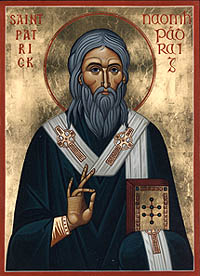
Þis being St Patrick’s Feast Day we encourage everyone (especially Southrons, in whom Irish blood makes up no small part) to honor him and pray to him for salvation and help.


But at the same time, ƿe (we) ought to show the same reverence for the many, many other Irish saints, known and unknown,


that we give to St Patrick.  For they are involved in our salvation and well-being just as that great missionary is.

Holy St Patrick and all ye holy Saints of Ireland, pray for us sinners at the South!


(Icon found at this site:  http://orthodoxwiki.org/Patrick_of_Ireland)