Tuesday, January 23, 2018

The Free Mind: The American Founding Fathers vs the Orthodox Church Fathers

Justifications for the modern, individualistic, social compact theory of the [u.] S. come in many forms.  Here is one by Vito Mussomeli based on his view of God and man:

Whereas, Almighty God hath created the mind free:
Beginning of Jefferson’s Statue for Religious Freedom, passed by the Virginia Legislature in 1786

I

With one intro line Jefferson explains the core of human liberty. Our minds, a composite of intellect and heart that defines us as human, are forever free to choose what to believe, where to inquire, who to love and who to turn from, including the Ineffable God who created us. If you wish to bootcamp humanity into armies of belief or regiments of affection, first you must remove our Creator. Both our Infinite God and our own minds recoil at the militarization of our lives. If we need not bow to our Creator, we never need bow to anyone or anything.

Here is the core of free will. Hebrew/Christian scriptures explain we are created in the image of our Creator. It is our minds, the seamless Being of our hearts and our intellects that are created in the image of our God. If our minds were not free, we would not be like our Creator. It is in our freedom that we are like God and, therefore, we must neither be enslaved nor enslave others.

Jefferson added something perhaps to explain the Ineffable to a strictly intellectual mind –

That (because) all attempts to influence it (our mind) by temporal punishments or burthens, or by civil incapacitations tend only to beget habits of hypocrisy and meanness, and therefore, are a departure from the plan of the holy author of our religion, who being Lord, both of body and mind yet chose not to propagate it by coercions on either, as was in his Almighty power to do;(emphasis added)

But can that be true?  That our Creator can create a Being that is not free? Such a Being would not be “like unto God”. The question is its own answer: any mind that God creates can only be ‘enslaved’ if it is not “like unto God”. We are not God but our Creator’s Life flows through us as the waters flow through the gills of fish.

The power of free will is quintessentially the power of sovereignty. Such power only makes sense when choices are individually made. Free will does not enforce a groupthink modality.
In our Founding, America accepted Jefferson’s view that personal sovereignty underlies our personal creation by Nature’s God. Personal sovereignty is the personal power to decide, to craft beliefs and loves and life and living. This means our Creator expects all people to self-govern themselves. It is our core duty. Yet not only may we differ, person to person, in fundamental beliefs of Life and Death and Transcendence, but in the mere earthly beliefs of how best to govern ourselves.

Our Founders believed in the ability and inevitability of human nature and existence to change. If systems of law are made, they must reflect this changeable world by providing a capability to adapt. Our inalienable powers of self-reflection, self-will and self-inquiry are parcel to our power to change. There is no Public or Governmental Natural Law, therefore, no Public or Governmental sovereignty over us. For our Creator has created neither. The public square and public government are our creations.

When individuals gather into a polity, they share their personal sovereignty with one another through compact or covenant to create a structure for their governance. But this sharing does not produce a separate sovereignty in their governmental structure because sovereignty is only and always personal. Sovereignty is seamless and cannot be divided in the same way you cannot axe a human mind into two minds and have the person continue to exist. What our Creator has not forced on us, our Creator has not provided to any of our artifacts.

Therefore, the powers of any government are wholly rooted in the personal sovereignty of every citizen. We are free to join or leave, to believe in this way or that way, in one God or another God or no God, in this government or that or none. Our God has forgone unconditional loyalty and we must also. For what Almighty God has decided not to do, no human person may decide to do … there lies the world of Cain. And there is the vanity of vanities.

 . . .


This needs to be corrected on a number of levels.

First, the definitions of terms need some rewriting.  The Glossary of the Philokalia, one of the greatest Orthodox manuals on the spiritual life, defines heart, reason/mind, and nous/intellect as follows:

HEART (καρδία - kardia): not simply the physical organ but the spiritual centre of man's being, man as made in the image of God, his deepest and truest self, or the inner shrine, to be entered only through sacrifice and death, in which the mystery of the union between the divine and the human is consummated. ' "I called with my whole heart", says the psalmist - that is, with body, soul and spirit' (John Klimakos, The Ladder of Divine Ascent, Step 28, translated by Archimandrite Lazarus [London, 1959], pp. 257-8).

'Heart' has thus an all-embracing significance: 'prayer of the heart' means prayer not just of the emotions and affections, but of the whole person, including the body.

REASON, mind (διάνοια - dianoia): the discursive, conceptualizing and logical faculty in man, the function of which is to draw conclusions or formulate concepts deriving from data provided either by revelation or spiritual knowledge (q.v.) or by sense-observation. The knowledge of the reason is consequently of a lower order than spiritual knowledge (q.v.) and does not imply any direct appre- hension or perception of the inner essences or principles (q.v.) of created beings, still less of divine truth itself. Indeed, such apprehension or perception, which is the function of the intellect (q.v.), is beyond the scope of the reason.

INTELLECT (νοϋς - nous): the highest faculty in man, through which - provided it is purified - he knows God or the inner essences or principles (q.v.) of created things by means of direct apprehension or spiritual perception. Unlike the dianoia or reason (q.v.), from which it must be carefully distinguished, the intellect does not function by formulating abstract concepts and then arguing on this basis to a conclusion reached through deductive reasoning, but it understands divine truth by means of immediate experience, intuition or 'simple cognition' (the term used by St Isaac the Syrian). The intellect dwells in the 'depths of the soul'; it constitutes the innermost aspect of the heart (St Diadochos, §§ 79, 88: in our translation, vol. i, pp. 280, 287). The intellect is the organ of contemplation (q.v.), the 'eye of the heart' (Makarian Homilies).


From this, we see that the mind/reason is not what makes us particularly made in the image of God, but the nous.  Nor is the mind the seat of man’s being, but the heart, where the nous is found.  Since this is so, we must go on to note, then, that the exercise of the mind, of choice, of free will, is not the greatest good, but rather union with God.  This in turn requires humility, the cutting off of our own will for the sake of loving, trusting, and obeying God and man.

These two differing ideas of the good lead to two very different political orders:  the first to the constitutional republic/democracy so popular today, which arises from the conflict created by the theory that each man is a sovereign who MUST exercise his personal sovereignty in the face of others in order to show that he is truly a creation of a vaguely defined ‘God’ and in order to affirm his unique, individual existence (a theory that is the product of unlove and distrust); the second to a hierarchy, which arises when men imitate the harmony of the self-emptying of the Three Persons of the One God, the Holy Trinity, confirming their unique, individual existences by making themselves the servants of all.  This is shone to us in an outstanding way in Christ’s death on the Cross for sinful man, by which His divinity and lordship are affirmed (Phil. 2:5-11). 

Mr Mussomeli is also drifting into Gnosticism by equating the image of God with only the immaterial aspects of man.  But the whole man - soul, nous, and body; material and immaterial - is made in the image of God, which is clearly shown in the icon of man’s creation.  The body is not extraneous in the work of salvation/deification; it too has value:


All of this foregoing is important, but the point we wish to emphasize is this one:  The mind is not free.  It is in the worst sort of thralldom to the devil and the demons and to the fallen passions because of the Fall of Adam and Eve.  St Macarius the Great in Homily XLV directly confronts the false, shallow, Enlightenment optimism of Jefferson and the other Founding Fathers that just government and a good national life can be obtained by balancing the powers of a few outward departments:

2. There have been also divers kinds of wise men according to the world; of whom some have displayed excellence by means of philosophy; others have been admired for their expertness in sophistry, others have dis- played oratorical skill; others have been men of letters and poets, and have composed histories according to the con- ventional plan. There have also been different kinds of artificers, who have practised the arts according to the world. Some have carved in wood all kinds of birds and fishes, and figures of men, and in those have endeavoured to display their excellence. Some have taken in hand to fashion portraits, statues in bronze and the like; others have erected great and beautiful buildings; others, mining the earth, bring up the silver and gold that perishes, others precious stones. Others, possessing personal beauties, were elated by the comeliness of their countenances and were the more enticed by Satan, and fell into sin. And all these artificers of whom I have spoken, being held by the serpent who dwells within, and not knowing the sin that abode with them, have been captives and slaves to the evil power, gaining no advantage from their science and their art.


Just before this, St Macarius expanded upon this idea of being in bondage to the devil, saying that no man

 . . . had the power to discern the evil which had invaded the soul in consequence of the first man's transgression, and had darkened it, that it knew not the change which had passed over it that the mind at first was pure and saw its Master, being in honour, and now, because of its banishment, is clothed with shame, the eyes of the heart being blinded, that it may not behold that glory, which our father Adam before his disobedience beheld.

Source:  Ibid, chapter 1.

Until the body, soul, and nous have been purified by much repentance, ascetic effort, and the sacraments of the Orthodox Church, the mind sits in a dark prison, and none of the lofty philosophizing about the sovereign individual can be true. 

The Russian, Orthodox philosopher Ivan Kireevsky has more to say on this idea of purity being necessary to grasp the truth.  His ideas, which summarize much of what the Church Fathers have to say about this matter, are beworded briefly below:

 . . .

1. Reason that is uncultivated and for a long time unpurified is an unreasonable reason, an iniquitous and untrue reason.  There are distinctions in reason, as in all other external things.  There is a perfect, spiritual reason, there is an average reason of the soul, and there is a rather coarse carnal reason.

2. The one who will not care to personally follow the narrow Evangelical path, and will neglect to purify his mind, is blind of soul, even if he has mastered all external wisdom; he keeps only to the letter that kills, without accepting the spirit that gives life.

3. Right and true reason cannot penetrate deeply into the soul without great and prolonged effort and labor; for to the degree that man’s lusts are mortified, to that degree does true reason grow and flourish.  But this ascetic labor must be of a particular kind; it must consist of external effort and mental activity.  The one is not effected without the other.

4. All those who have complied with the instructions pertaining to external labor while neglecting inward spiritual activity – the enlightenment and purification of reason – have lost their senses, have become corrupted by various passions, or have fallen into pernicious heresies.  And even as they did not like to retain God in their knowledge, God gave them over to a reprobate mind, to do those things which are not convenient (Rom. 1:28).

5. The mind that is purified and enlightened can understand everything external and internal, because the person is spiritual and judgeth all things, yet he himself is judged of no man (I Cor. 2:15).

 . . .

Source:  Unnamed author, https://web.archive.org/web/20050907021120/http://strannik.com:80/watchful_gate/Kirievsky.pdf, downloaded 16 Nov. 2017 (thanks to C for the link)

The Fathers of the Orthodox Church are unanimous:  Only those who have been healed of the fallen passions are free (i.e., the saints); all others are slaves to some sin or another, their thinking is darkened, and all talk of personal ‘freedom’ and ‘sovereignty’ is deceptive.  But if we try to put those ideas into practice despite this, as has been done in the after-Schism West, we put ourselves and those involved in the republican/democratic ‘experiment’ in great danger, earthly and ghostly, as well as those around us.

Since the body, soul, and nous have thus been darkened by the Fall, it is vital for us to remain in the God-given hierarchy to which we all belong (and which has been given to us for our good), and not strike out on our own as self-ruling sovereigns.  We hope to say more about hierarchy in the next post.

--

Holy Ælfred the Great, King of England, South Patron, pray for us sinners at the Souð, unworthy though we are!

Anathema to the Union!

Friday, January 19, 2018

Politics Is Inseparable from Theology


Theology (Godlore) is the fountainhead from which all other thought flows, including politics.  Whatever one believes about God, man, and the cosmos, this will affect his view of what form of government is best.  This is plainly seen in the connection between Protestant theology and the [u]nited States’ political system.

 . . .

New Man


Historian C. Gregg Singer traces the line of influence from the seventeenth century to the eighteenth century in his book, A Theological Interpretation of American History. He says,

Whether we look at the Puritans and their fellow colonists of the seventeenth century, or their descendants of the eighteenth century, or those who framed the Declaration of Independence and the Constitution, we see that their political programs were the rather clear reflection of a consciously held political philosophy, and that the various political philosophies which emerged among the American people were intimately related to the theological developments which were taking place. . . . A Christian world and life view furnished the basis for this early political thought which guided the American people for nearly two centuries and whose crowning lay in the writing of the Constitution of 1787.9

Actually, the line of influence extends back even further. Historian Arnold Toynbee, for example, has written that the American Revolution was made possible by American Protestantism. Page Smith, writing in the Religious Origins of the American Revolution, cites the influence of the Protestant Reformation. He believes that

The Protestant Reformation produced a new kind of consciousness and a new kind of man. The English Colonies in America, in turn, produced a new unique strain of that consciousness. It thus follows that it is impossible to understand the intellectual and moral forces behind the American Revolution without understanding the role that Protestant Christianity played in shaping the ideals, principles and institutions of colonial America.10

Smith argues that the American Revolution "started, in a sense, when Martin Luther nailed his 95 theses to the church door at Wittenburg." It received "its theological and philosophical underpinnings from John Calvin's Institutes of the Christian Religion and much of its social theory from the Puritan Revolution of 1640-1660.11

Most people before the Reformation belonged to classes and social groups which set the boundaries of their worlds and established their identities. The Reformation, according to Smith, changed these perceptions. Luther and Calvin, in a sense, created a re- formed individual in a re-formed world.

Key to this is the doctrine of the priesthood of the believer where each person is "responsible directly to God for his or her own spiritual state.... The individuals who formed the new congregations established their own churches, chose their own ministers, and managed their own affairs without reference to an ecclesiastical hierarchy."12

These re-formed individuals began to change their world including their view of government and authority.

 . . .

Source:  Kerby Anderson, https://bible.org/article/american-government-and-christianity, opened 11 Jan. 2018

For the modern American constitutional system, everything hinges on the idea that each individual person is an authority unto himself.  He is responsible to no man, only God.  Authority flows from this ‘new man’ and his fellow disconnected, atomistic citizens to whatever government they wish to establish.  And this, as we have just seen, is based on the Protestant interpretation of I Peter 2:9 that all believers are equally a ‘royal priesthood’, and therefore no hierarchy is valid.

But if this interpretation of the ‘priesthood of all believers’ is false, the system itself is false and therefore dangerous.  And, in fact, what one finds in the New Testament and in the Church Fathers is an abundance of references to hierarchy in the Church, in heaven and on earth:  Hebrews 13:17, James 5:14, I Corinthians 12, Rev. 4:4, etc.

St John Chrysostom in his commentary on I Corinthians says,

1 Corinthians 15:40
There are also celestial bodies, and bodies terrestrial; but the glory of the celestial is one, and the glory of the terrestrial is another.

1 Corinthians 15:41
There is one glory of the sun, and another glory of the moon, and another glory of the stars: for one star differs from another star in glory.

And what means he by these expressions? Wherefore from the resurrection of the body did he throw himself into the discourse of the stars and the sun? He did not throw himself out, neither did he break off from his purpose; far from it: but he still keeps to it. For whereas he had established the doctrine concerning the resurrection, he intimates in what follows that great will be then the difference of glory, though there be but one resurrection. And for the present he divides the whole into two: into bodies celestial, and bodies terrestrial. For that the bodies are raised again, he signified by the grain: but that they are not all in the same glory, he signifies by this. For as the disbelief of the resurrection makes men supine, so again it makes them indolent to think that all are vouchsafed the same reward. Wherefore he corrects both. And the one in the preceeding verses he had completed; but this he begins now. And having made two ranks, of the righteous and of sinners, these same two he subdivides again into many parts, signifying that neither righteous nor sinners shall obtain the same; neither righteous men, all of them, alike with other righteous, nor sinners with other sinners.

Now he makes, you see, first, one separation between righteous and sinners, where he says, bodies celestial, and bodies terrestrial: by the terrestrial intimating the latter, and by the celestial, the former. Then farther he introduces a difference of sinners from sinners, saying, All flesh is not the same flesh, but there is one flesh of fishes, another of birds, and another of beasts. And yet all are bodies; but some are in more, and some in lesser vileness. And that in their manner of living too, and in their very constitution.

And having said this, he ascends again to the heaven, saying, There is one glory of the sun, and another glory of the moon. For as in the earthly bodies there is a difference, so also in the heavenly; and that difference no ordinary one, but reaching even to the uttermost: there being not only a difference between sun and moon, and stars, but also between stars and stars. For what though they be all in the heaven? Yet some have a larger, others a less share of glory. What do we learn from hence? That although they be all in God's kingdom, all shall not enjoy the same reward; and though all sinners be in hell, all shall not endure the same punishment.  . . .

Source:  http://www.newadvent.org/fathers/220141.htm, opened 13 Jan. 2018

Fr John Whiteford also writes,

 . . .

As for the Protestant view of the "Priesthood of all believers," we would agree with them up to a point. St. Peter indeed says that "you also, as living stones, are being built up a spiritual house, a holy priesthood, to offer up spiritual sacrifices acceptable to God through Jesus Christ…. you are a chosen generation, a royal priesthood, a holy nation, His own special people, that you may proclaim the praises of Him who called you out of darkness into His marvelous light" (1 Peter 2:5, 9). You also find the same idea expressed three times in the book of Revelation (Revelation 1:6; 5:10; 20:6). But you also find the same idea in the Old Testament. For example in the Law of Moses it says "And you shall be to Me a kingdom of priests and a holy nation." These are the words which you shall speak to the children of Israel" (Exodus 19:6).

However, in the Old Testament, even though they were a kingdom of priests, they still had a distinct priesthood. And there is a very interesting incident found in Numbers chapter 16, in which some people began to assert that there should not be such a distinction. In fact, the basic argument of Korah, Dathan and Abiram is not much different than what you hear from many Protestants:

"They gathered together against Moses and Aaron, and said to them, "You take too much upon yourselves, for all the congregation is holy, every one of them, and the Lord is among them. Why then do you exalt yourselves above the assembly of the Lord?"" (Numbers 16:3).


If you read the rest of that chapter, you will see that this attempt to democratize the Liturgical Priesthood of the Old Testament did not end well for them.

Deacons, priests, and bishops have a special grace that is bestowed upon them by the laying on of hands (ordination), and so they have a distinct role in leading the people in worship, and performing the sacraments of the Church.  . . .  So we are all a kingdom of priests, but God has established a distinct priesthood to perform a particular role in the life of the Church.


There is hierarchy.  The philosophy upon which the American constitutional system rests is false.  It is, as we have said a few times before, a modern expression of Neo-Platonism:  Everything that exists is an emanation of the impersonal divine being called by Plotinus the One.


But in place of the One, the u. S. system substitutes the impersonal ‘will of the people’.  And as three levels of ‘reality’ emanate from the One, so too do three levels of governmental/societal ‘reality’ emanate from the will of the people:  legislative, executive, and judicial, or local, state, and national.  But none of these have any real independent existence; they could be wiped away by the One/the people’s will at any moment.  The only thing that is truly real in this system is the One/the people’s will (which wears the phony mask of 'Constitution').


As with most falsehoods, there is a kernel of truth in its attempted Trinitarianism.  But only the Orthodox political system has a Trinitarian order that is not the ephemeral out-breathing of an impersonal essence:

 . . .

Introduction

Seeking justification for their pagan Rome of unending greed for material riches and unquenchable thirst for global power that will end in the now foreseeable Apocalypse, some post-sectarians believe in a man called Jesus. However, we Orthodox Christians ‘worship the indivisible Holy Trinity, Who has saved us’. This Trinitarian Belief is embodied in the single phrase, Church, Empire and People, as also in the words Altar, Throne and Cottage, or Orthodoxy, Sovereignty and People.

The Kingdom of the Father

As we confess the Kingdom of the Father, so we confess the sacred Altar of the Church of Christ His Son. That is why we are opposed to Antichrist, whose prophesied reign is being prepared by Babylonian globalism, in opposition to our Jerusalem Church. For we confess the primacy of our Faith (Matt. 6, 33).

The Kingdom of the Son

As we confess the Church of the Son, so we confess His Incarnate Empire on earth. The Ruler on this Throne must oppose the Anti-Christianity of Secularism and fight for freedom, as we have just seen in Syria, for we oppose all centralized tyrannies and defend the freedom and sovereignty of the peoples.

The Kingdom of the Holy Spirit

As we confess the Holy Spirit, so we confess His potential to sanctify and save People living in the world from evil. We fight against the oppression of the Establishment elite/aristocracy/oligarchy and its bureaucrats/parliamentarians /hireling media, who deny the People Christ’s saving Truth and Justice.

Conclusion

The above explains why we fight for the Purity of Holy Orthodoxy against deviations, whether liberalist-secularist or ritualist-obscurantist. We believe in Christian Rome, the Sacred, which is why we so firmly opposed the documents of Crete, prepared by secularism and treachery. We do not confess and bless globalism through imitation of a mere human-being, we confess and bless the Kingdom of the Father, the Son and the Holy Spirit, the Eternal God Who is in Three Persons.

Source:  Fr Andrew Phillips, http://www.events.orthodoxengland.org.uk/our-combat/, opened 12 Jan. 2018

Rather than starting with humility towards the All-Holy Trinity, the u. S. system begins with the presumption of ‘the people’.  The Abbe Sieyes shows the underlying principle of pride in this type of system in his essay What Is the Third Estate? [the Third Estate was the bulk of the French people who were not nobles or clergy--W.G.]:

What is the Third Estate? Everything.
What has it been until now in the political order? Nothing.
What does it want to be? Something.


From this inversion of the source of authority, the Holy Fathers tell us, will come the kingdom of Antichrist, the incarnation of the devil’s malice toward God, man, and the whole creation.

The peoples of the States of all sections, since their War for Independence from Great Britain, have believed that they are doing something new in the world, that they are regenerating man politically in a very real way, that Christ’s birth and the birth of ‘America’ are the two major turning points in the history of the world:  They are throwing off all the dark and backward authoritarianism of king and bishop that their Western European forebears knew and founding an ‘empire of liberty’ (Jefferson’s words).  But it is just this ‘non-imperial imperium’ (Jay Dyer’s words), free of the last vestiges of the Holy Tradition of the Orthodox Church, that is helping so greatly to prepare the way for Antichrist.

It is time they came to their senses.  Understandably, the States have no desire to return to the brutal feudalism of after-Schism Western Europe, but there is another option:  The Orthodox Christian tradition of fore-Schism Western Europe and Africa:

 . . . This is not a question of conservatism. Those who are conservative simply regret the pyramid [of feudalism--W.G.] of the past. We reject both the past and the modern pyramid, for our guiding light is the Age of the Saints of the first millennium.

In this way we follow the Tradition, far more radical than mere liberal and mere conservative. We proclaim the values of the Old West, the values of the Saints who stand at the root of the real West. These are the values of:  the holy apostles Peter and Paul, the bearer of God Ignatius, the holy family Sophia, Faith, Hope and Charity, the fearless virgins Tatiana and Cecilia, Lawrence and Sebastian, Anastasia, Januarius and Pancras, the pure lamb Agnes, Irenaeus of Lyon, Eulalia of Barcelona, Ursula of Cologne, Hilary of Poitiers, Ambrose of Milan, Martin of Tours, John Cassian, Vincent of Lerins, Patrick of Ireland, Benedict of Cassino, Columba of Iona, Gregory the Great, Theodore of Tarsus, Clement of the Low Countries, Modest of Carinthia, Boniface of Fulda, Edmund of East Anglia, Anschar and Olaf and the great host of local saints, known and unknown. This is the lost West, the real West, the geographical West.

From the Service to All the Saints of the Western Lands

For one thousand years the light of the Sun of Righteousness shone forth from the East on the lands of the West forming a Cross over Europe, before they fell beneath the darkening shades of the Churchless night. Let us now return to the roots of our first confession of the Holy Spirit in the bright Sunrise of Orthodoxy, which is brought again from the East, and so shine forth the light of the Everlasting Christ once more.

O all the saints of the Western Lands, pray to God for our repentance and return, our restoration and resurrection. Tell the people to leave aside the things of men, the fallen fleshly mind and all its vain musings, for they are without the Saviour and the Spirit. And so, through your life in the Holy Trinity, shall we find salvation in the purity of the Orthodox Faith before the end.

Now do we sing to all the saints of the lands of the West and at their head the apostles Peter and Paul, the true glory of Old Rome, and, like stars in the dark night sky, to the constellation of the martyrs and fathers who followed in their apostolic footsteps, leaving behind them the great treasury of holy relics. O First Rome, who art glorious in thy saints alone, do thou return to the eternal faith of Orthodoxy through the Holy Spirit Who proceeds from the Father, as the Saviour tells us.

O all ye holy women, martyrs, matrons and queens, from Old Rome to Sicily of the south, from Sardinia to Iberia, from Gaul to the islands of Britain, from the Celtic realms to the Germanic lands of the north, preferring the humble truth of the Galilean to the proud might of paganism, ye have brought the words of Christ to dumb men, raising up infants and kings to the measure of the stature of Christ, so hallowing your peoples and our souls by the light of the Holy Trinity.

O constellation of all the saints of the Western lands, who shine forth in the night sky, together we gather in your name, in praise to ask you to intercede for us with your prayers. Bring back the Western peoples from the inglorious darkness of their unwisdom to the Wisdom of God, that they may cast aside all the illusions of the fallen reason and know again that the only true glory and enlightenment is in the acquisition of the Holy Spirit.

Source:  Fr Andrew Phillips, http://www.events.orthodoxengland.org.uk/the-feudal-west-and-the-lost-west/, opened 12 Jan. 2018

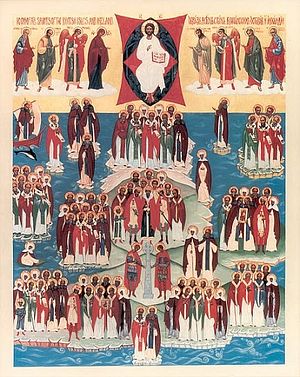
All Saints of the Isles.  Holy icon from http://orthochristian.com/95232.html, 15 Jan. 2018

--

Holy Ælfred the Great, King of England, South Patron, pray for us sinners at the Souð, unworthy though we are!

Anathema to the Union!