I.
Land and Sea
In
finding a country’s place in world politics, the categories of ‘land’ and ‘sea’
are key. Alexander Dugin writes,
The two primary concepts of geopolitics are land
and sea. Just these two elements —Earth and Water — lie at the roots of human
qualitative representation of earthly space. Through the experience of land and
sea, earth and water, man enters into contact with the fundamental aspects of
his existence. Land is stability, gravity, fixity, space as such. Water is
mobility, softness, dynamics, time.
. . . At the
level of global geopolitical phenomena, Land and Sea generated the terms:
thalassocratia and tellurocratia, i.e. “ power by means of the sea ” and “
power by means of the land ” (‘Sacred Geography to Geopolitics’).
He
says elsewhere,
In planetary
history, two opposing and constantly competing approaches to the mastery of the
Earth’s space, the “land” and “sea” approaches, have existed. Depending on
which orientation (“land” or “sea”) this or that state, people, or nation
belongs to, their historical consciousness, their foreign and domestic
policies, their psychology, and their worldview accord with entirely separate
rules. Given this peculiarity, it is fully possible to speak of a “land”, “continental,”
or even “steppe” (“steppe” is land in its pure, ideal form) worldview, and a
“sea”, “island”, “oceanic” or “aquatic” one (let us note in passing that we can
find the first hints at such an approach in the works of the Russian
Slavophiles, such as Khomyakov and Kireevsky).
In the
ancient history of “sea” power, Phoenicia
(Carthage)
became the historic symbol of “sea civilization” as a whole. The land empire
opposing Carthage was Rome. The Punic Wars are the clearest example
of the confrontation between “sea civilization” and “land civilization.” In
modern history, England
became the “island” and “sea” pole, the “mistress of the seas” followed by the
giant island-continent America.
England, like
ancient Phoenicia,
used primarily maritime trade and the colonization of coastal areas as the main
instrument of its rule. The Phoenician-Anglo-Saxon geopolitical type generated
a special “trade-capitalist-market” model of civilization based on economic and
material interests and the principles of economic liberalism. Therefore,
despite all possible historical variations, the general “sea” type of
civilization has always been associated with the “primacy of economics over
politics.”
Unlike the
Phoenician model, Rome
presents itself as a model military-authoritarian structure based on
administrative control, civil religiosity, and on the primacy of “politics over
economics.” Rome
is an example of colonization not by sea, but by land, a purely continental
type which penetrated deep into the continent and assimilated conquered
peoples, who automatically became “Romans” upon conquest.
In modern
history, the epitome of “land” power was the Russian Empire along with the
Central European Austro-Hungarian and German empires. Russia, Germany, and Austro-Hungary are
essential symbols of “geopolitical land” in the period of modern history.
In the last
several centuries, “sea civilization” has tended to be identified with
Atlanticism, just as the “sea powers” of today par excellence are England and America, i.e., the Anglo-Saxon
countries.
Atlanticism
embodies the primacy of individualism, “economic liberalism” and “democracy of
the Protestant type,” and opposes Eurasianism which presupposes
authoritarianism, hierarchy, and the posing of community-based, nation-state
principles against small human, individualist, hedonistic, and economic
interests. The Eurasian orientation in character is primarily pronounced in
Russia and Germany, the two most powerful continental powers whose
geopolitical, economic, and, most importantly, deep ideological interests are
fully opposed to the interests of England and the USA, that is, the
Atlanticists (‘The Great War of Continents’).
Finally,
Boris Nad writes,
The principle of the Sea (or Ocean), in the end,
symbolizes the blind forces, volatility, inconstancy, chaos – the principle of
Land, on the contrary, is static, unchangeable, Order. Symbol of man's
existence on the sea is a Ship, a symbol of man's existence on land is static,
is Home. From the principle of the Sea we can take the principle of techniques,
and techniques which is "separated from all the norms of tradition"
(Arnold Toynbee). . . .
All
this does not apply to thalassocracy, in which is no trace of the idea of
sacred authority of the state. Trade based republics of the Mediterranean,
as well as the North American republics, remain completely secular constructs,
administered by understanding and interests of those who are, essentially,
equal each other. Tellurocratic states, in their final sense, are – Space which
is sacralized, sanctified, thalassocracy states are opposite – the Time, with
its dynamics, variability, volatility. The ideal type of these second is
therefore merchantilistic
Republic; but, the ideal
tellurocratic form is the Empire, an empire based on the sacred authority of
the state and its ruler. The person of the ruler is personification of the
sacred principle: he is not only the object of worship, but and of real
apotheosis, as the elect of God, God's anointed (‘The East and the West’).
II.
Two Forenotes
With
this introduction in place, we would like to explain why the South (or Dixie;
also known aforetime as the Confederate States of America) is a ‘Land’ people, and
how this should guide her relations with other countries going forward.
But
first we would like to say two things.
A.
On Determinism
First,
following the teachings of the Orthodox Church, we acknowledge the free will of
man, that he is not subject to a mechanical determinism of any kind. Thus there is no reason to believe that a clash
of land and sea civilizations is unavoidable.
The Lord Jesus Christ is reconciling all things in Himself through His
Holy Church, His Body here in this world, and as more people enter the Orthodox
Church, the more the world will resemble the harmonious unity in diversity of
the All-Holy Trinity rather than the chaotic strife amongst different groups we
witness now. But we nevertheless believe
that the land and sea distinction is a helpful one when trying to understand
global politics.
B.
Anglo-Saxons and Vikings
Second,
though we are most unlearned, we would like to try to bring a bit more
precision into the above discussion about England, America, and Anglo-Saxons,
which will lead us into what we have to say about the South’s ‘landedness’.
It
is not the Anglo-Saxons of England or America who are primarily to blame
for the drive towards the shallow unipolar world of money and pleasure. This must be laid at the feet of the Scandinavian
Vikings, whose wanderings and new settlements gave rise to two intensely
militaristic peoples, Normans and New Englanders. In all three of them one sees the ‘sea’
element quite clearly.
After
a period in the 900s spent settling the area of northern France (Normandy) they
(the Vikings) had conquered and mixing with some of the local population, there
boiled forth a new people, the Normans, bent on the conquest of as many lands
as they could reach: Southern Italy,
England, Scotland, Wales, Ireland, the Levant, and so on (‘Normans’).
It
was only after conquering England
in 1066 that England
seems to take on the character of an expansive, warlike, sea-faring country. But this is not the character of the native
English; it is rather that of the new ruling class of Normans.
The
Anglo-Saxons, the Old English, were a people of home, soil, and custom. Maurice Hewlett in his long poem The Song of the Plow, put it this way:
Danes and Normans and Scottishmen,
Frenchmen, Brunswickers, son after sire,
They come and conquer, they ruffle and reign,
They rule, they ride, they spend, they grudge,
They bicker their threescore years and ten,
They slay, and thieve, and go; but Hodge
The Englishman stoops to fork and flail,
And serves Saint Use [i.e., custom, tradition--W.G.], and will not
budge,
But drives the furrow and fills the pail,
Raining sweat lest the
land go dry:
He sees his masters, he gives them hail
With hand to forelock as they ride by—
They that eat what he doth bake,
They that hold what he must buy,
They that spend what he doth make,
They that are rich by
other men's toil;
They of the sword and he of the rake,
The lords of the land,
the son of the soil!
. . .
Is it not his yet, this dear soil,
Rich with his blood and sweat and tears?
Warm with his love, quick with his toil,
Where kings and their stewards come and go,
And take his earnings as tribute royal,
And suffer him keep a shilling or so?
They come, they pass, their names grow dim;
He bends to plow, or plies his hoe;
And what are they to the land or him?
They shall perish but he endure
(Thus saith the Scripture old and grim),
He shall shed them like a vesture;
But he is the same, his tale untold;
And to his sons' sons shall inure
The land whereon he was bought and sold (ll. 198-215, 330-44, pgs.
10-11, 15).
Furthermore,
Professor J.R.R. Tolkien, deeply acquainted with Old English ways, shows their
anti-Norman, unsea-ish character in two ways:
through the life of the Rohirrim and the life of the Hobbits in The Lord of the Rings.
As
horsemen living on the hills and plains of Rohan, which they cherished and
guarded but did not try to enlarge by foreign expeditions, long attached to
their place and seeking no other, the Rohirrim are a picture of Old English
life before the Norman inbreaking (Higgens, Anglo-Saxon
Community, p. 61). In the words of
one of their own, the high-born Éomer, which were said to Aragorn,
. . . we
desire only to be free, and to live as we have lived, keeping our own, and
serving no foreign lord, good or evil (Tolkien, The Two Towers, in The Lord
of the Rings, p. 433)
And
the Hobbits, ‘who love peace and quiet and good tilled earth: a well-ordered
and well-farmed countryside was their favorite haunt’ (Tolkien, The Fellowship of the Ring, in The Lord of the Rings, p. 1), who are
suspicious of any who go about on boats at all (ibid., pgs. 22-3) or who go on
‘adventures or did anything unexpected’ (Tolkien, The Hobbit, p. 4) are likewise a picture of the non-Norman English
in Tolkien’s day (Higgens, Anglo-Saxon
Community, pgs. 147-50).
Clearly,
some English have betrayed their own people by working with the Norman invaders
and accepting the Norman mindset, but we think it is unfair to identify all
Anglo-Saxons, all England, with the Atlanticist ‘sea civilization’. That identification must be made first and
foremost with the Normans, or their Viking forebears.
In
like manner, it is not quite accurate to say of all citizens of the USA that they
are Anglo-Saxon Atlanticists. For the
same kind of conquest that happened in England
has happened in the territory of the United States, with the New
Englanders invading and gaining dominion over the Southern States.
The
people who first settled the South and gave her the main features of her
culture were largely from southwest England, where rural farming life,
hierarchy, large manors, few cities, and tradition in religion (high-church Anglicans)
and politics (royalists) were highly valued (Fischer, Albion’s Seed, pgs. 240-6).
Those
who settled the New England States were quite the opposite. They came mainly from the southeast coastal
counties of England,
where industrialism, densely populated cities, equalitarianism, and
rebelliousness in religion (Puritanism) and politics (Cromwellian roundheads)
held sway (ibid., pgs. 42-9). Just as
importantly, these coastal areas had seen the greatest settlement of Scandinavian
invaders in England
(ibid, p. 44).
It
is no surprise, then, that the most iconic representations of the South should
be images of the land - the plantation home or the Southern gentleman with his
horse:
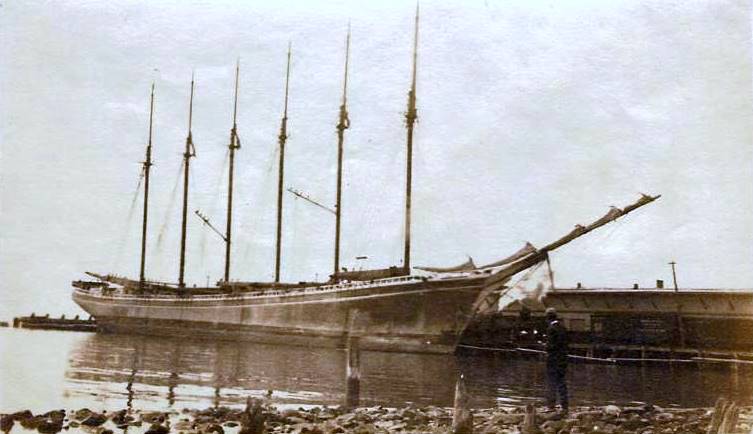
Likewise,
the images most representative of New England are
those of the sea or commerce, like the schooner or the factory:
When
the War of Northern Aggression began (the so-called Civil War of 1861-5), it
should likewise be no surprise that the North featured a great navy and
state-of-the-art artillery, and the South an excellent cavalry and infantry
under the leadership of men like Generals J. E. B. Stuart and Thomas ‘Stonewall’
Jackson.
Howsobeit,
the South was bested in that War and forced to remain in the union, and from
thenceforward the sea element predominated in America, though Southerners
continue to be a voice of protest against it.
Here
again, we see that it is not primarily the Anglo-Saxon or English people at the
root of the militarism of the modern American Empire, but the
Viking/Scandinavian folk. As they had done
with the French earlier, their intermingling with a people they had invaded and
settled amongst (the southeastern English), gave birth to a restless people
(New Englanders) bent on conquest.
Southerners were among the first to encounter their rising battle lust
but nowhere near the last.
III.
The South and Land
Now
that these forewords are finished, let us say a few things about the South as a
‘land’ people, and what this means for her.
The
knowledge of a difference between the land and sea types has been persistent in
the South, though its expression has changed at times. Oftentimes, one will find the ‘sea’ equated
with fiat money, industrialism, and other such terms.
The
Revered Robert Lewis Dabney, who served under Gen Jackson during the War, wrote
in 1866,
The Northern were maritime States; the Southern
were, by population, climate, habits, and geographical position, inclined to
agricultural pursuits (Life and Campaigns,
p. 137).
Miss
Flannery O’Connor, Georgia’s
great novelist and short story writer, put the distinction this way in her
story ‘The Life You Save May Be Your Own’ (p. 1875):
“A body and a spirit,” he repeated. “The body, lady, is like a house: it don’t go anywhere; but the spirit, lady,
is like a automobile; always on the move, always . . .”
Nearer
to our own time, Wendell Berry, the Kentucky
writer and farmer, wrote in 2002,
The fundamental difference between industrialism
and agrarianism is this: whereas
industrialism is a way of thought based on monetary capital and technology,
agrarianism is a way of thought based on land.
Agrarianism, furthermore, is a culture at the same
time that it is an economy.
Industrialism is an economy before it is a culture. Industrial culture is an accidental
by-product of the ubiquitous effort to sell unnecessary products for more than
they are worth (‘The Whole Horse’, pgs. 238-9).
The
self-sufficient house is always central to Southern thought. Again from Mr Berry:
An agrarian economy is always a subsistence economy
before it is a market economy. The
center of the agrarian farm is the household (ibid., p. 239).
This
market economy
. . .
substitutes for the real economy, by which we build and maintain (or do not
maintain) our household, a symbolic economy of money, which in the long run, .
. . cannot symbolize or account for anything but itself (‘The Idea of a Local
Economy’, p. 252).
. . . the
global economy is based upon cheap long-distance transportation . . . . Whatever may be said for the “efficiency” of
such a system, its result (and I assume, its purpose) is to destroy local
production capacities, local diversity, and local economic independence (ibid.,
pgs. 254-5).
Thomas
Jefferson wrote some two centuries earlier about the land economy vs the paper
economy of the sea civilization:
“We are now taught to believe that legerdemain
tricks upon paper can produce as solid wealth as hard labor in the earth. It is
vain for common sense to urge that nothing can produce but nothing; that it is
an idle dream to believe in a philosopher’s stone which is to turn everything
into gold, and to redeem man from the original sentence of his Maker, ‘in the
sweat of his brow shall he eat his bread” (Kimball, ‘Thomas Jefferson vs. Paul
Krugman, Alan Greenspan, et. al.’)
With
this emphasis upon the homeplace and the real products of the earth, technology
is not looked upon as a savior. Mr Berry again gives a good
example of the Southern temperament when discussing his experiences with a hand
scythe and a gasoline-powered scythe:
. . . I
never took the least pleasure in using the power scythe, whereas in using the
Marugg scythe, whatever the weather and however difficult the cutting, I always
work with the pleasure that one invariably gets from using a good tool. . . .
The power scythe—and it is far from being an
isolated or unusual example—is not a
labor saver or a shortcut. It is a labor
maker (you have to work to pay for it as well as to use it) and a long
cut. Apologists for such expensive
technological solutions love to say that “you can’t turn back the clock.” But when it makes perfect sense to do so—as
when the clock is wrong—of course you
can (‘A Good Scythe’, pgs. 174-5)!
It
is plain that in the South there is still a strong current of the sentiment
voiced by the North Carolina
statesman Nathaniel Macon in the early 19th hundredyear:
Why depart from the good old way which has kept us
in quiet, peace, and harmony—everyone living under his own vine and fig tree,
and none to make him afraid? Why leave
the road of experience, which has satisfied us all and made us all happy, to
take this new way . . . of which we have no experience (Evangelicals and Conservatives, p. 169)?
This
sentiment may be seen in two other areas, hierarchy and religion.
Hierarchy
was present in the South from the start:
. . . the
feudal concept of aristocracy was expressed in the development of slavery and
great estates, and in the growing belief that the slavemasters were the
descendants of the Cavaliers (Simkins, A
History of the South, p. 58).
It
reached its highest development as the War approached, when public calls began
to be heard for the crowning of a king in the South. For example:
In Georgia,
the unionist Augusta Chronicle and
Sentinel . . . proposed a constitutional monarchy for the new southern
Confederacy (Fox-Genovese and Genovese, Mind
of the Master Class, p. 705).
This
progress before the War in politics was matched by a similar advancement in
religious thought:
Protestant Southerners increasingly wondered
aloud: Did the Reformation bear
responsibility for the individualism that was now careening out of hand (ibid.,
p. 652)?
This
movement away from an atomistic individualism in politics, religion, and
economics was stopped abruptly by the War, Reconstruction, and so forth.
Eliza Frances Andrews of Georgia cried [after the
South had been defeated in the War--W.G.], “In another generation or two, this
beautiful country of ours will have lost its distinctive civilization and
become no better than a nation of Yankee shopkeepers (Genovese, Consuming Fire, p. 104).”
It
has not quite gotten that bad. Something
more than dull democratic equality and uniformity and the truncated, deformed
Christianity of Fundamentalism (both New England imports into the South) has
survived in Dixie, especially as one gets away
from the big cities and finds himself in the midst of an extended family with a
patriarch or matriarch at its head. Or
as he reads the fiction and non-fiction of Flannery O’Connor, Richard Weaver,
Walker Percy, M. E. Bradford, Eudora Welty, William Faulkner, and others. To speak more specifically of religion,
however -
The
Uncreated may be known through the created:
Many Southerners still believe this to be true at some level. For them the creation still has a sacred
quality to it. Why else would the image
of Eden appear
so often in Southern literature? To
illustrate, Alexander Meek in 1857 opened one of his poems, ‘Come to the
South’, thusly:
Oh, come to the South, sweet, beautiful one,
'Tis the clime of the heart, 'tis the shrine of the sun;
Where the sky ever shines with a passionate glow,
And flowers spread their treasures of crimson and snow;
Where the breeze, o'er bright waters, wafts incense along,
And gay birds are glancing in beauty and song;
Where summer smiles ever o'er mountain and plain,
And the best gifts of Eden, unshadowed, remain
(Songs and Poems of the South, p. 1).
This
may also explain in part the appearance of the half-Christian, half-heathen
abomination - the sportsman fleur-de-lis - on so many Southern pick-up
trucks: The Southern soul is looking for
a more satisfying belief about the relationship between God and His creation
than His absolute absence from it that has been offered to her by Protestant
and Roman Catholic theology.
Whatever
the real cause, this mixing of the Holy Trinity with animal idolatry is a
dangerous road for Southerners to be going down. The ascetical writings of Orthodox monks like
The Philokalia are a safer place to
look for insights into the relation between God, man, and the creation than the
latest marketing gimmicks.
IV.
The South and Rome
The
South follows the Roman pattern of land civilization described above fairly
closely, but there is one other important tie between the two: The South sees herself as having relived in a
way the ancient Roman experience itself.
Professor M. E. Bradford wrote about this in the following way. Alluding to a poem on Southern origins he
quoted from earlier in his essay, he said,
Drayton envisions no attempt to improve upon the
dominant culture of Britannia. The
plantation of Virginia will be new in the
sense of extension or re-creation—as Rome was a
fresh but minimally different Troy,
made out of the residue from a particular stream of history and for the sake of
its perpetuation, with the possibility of felt discontinuity reduced to
whatever comes from the experience of setting as opportunity sans impiety. . . .
The allusion to Aeneas, looking both back and
forward, is therefore an expected commonplace in the serious literature of the
South (‘First Fathers’, p. 172).
How
natural, then, should it be for the South, who identifies herself so closely
with Old Rome, to seek an alliance with Moscow, the Third Rome (New Rome or
Constantinople being the second, which fell to the Turkish Muslims in 1453),
the leader of the ‘land’ civilizations in the world today, as she seeks to free
herself from ‘Carthage’ - from the yoke of the ‘sea’ civilization of
Washington, D. C.-New England? To quote
Mr Dugin again,
In modern
history, the epitome of “land” power was the Russian Empire along with the
Central European Austro-Hungarian and German empires. Russia, Germany, and Austro-Hungary are
essential symbols of “geopolitical land” in the period of modern history (‘The
Great War of Continents’).
Elsewhere
he elaborated,
The “Rich mondialist North” [the ‘First World’,
i.e., USA and Western Europe--W.G.]
globalizes its domination over the planet through partition and destruction of
the “Second world” [Russia
and other former Soviet satellites--W.G.]. In modern geopolitics this is also
called as the “new world order”. The active forces of antitradition consolidate
their victory over the passive recalcitrance of southern regions, preserving
their economic backwardness and defending Tradition in its residual forms. The
internal geopolitical energies of the “Second world ” are put before a choice —
either to be incorporated in the system of the “civilized northern belt” and
definitively to tear off any connection with a sacred history (project of
leftist mondialism), or to turn into an occupied territory being allowed a
partial restoration of some aspects of tradition (project of the rightist
mondialism). In this direction the events today are developing and will develop
in the near future.
As the alternative project it is possible
theoretically to formulate a different path of geopolitical transformation
based on rejecting the North – South mondialist logics and on returning to the
spirit of genuine sacred geography — as far as it possible at the end of dark
era. It is the project of the “Great Return” or, in different terminology, of
the “Great War of Continents”.
In its most general features, the essence of this
project is as follows.
1) The “Rich North is opposed not to the “poor
South” [the ‘Third World’--W.G.], but to the
“poor North”. The “Poor North ” is an ideal, the sacred ideal of returning to
the nordic sources of civilization. Such North is “Poor” because it is based on
total ascetism, on radical devotion to the highest values of Tradition, on the
complete despise of the material for the sake of the spiritual. “Poor North”
geographically exists only on the territories of Russia, which, being in effect, “
by the Second world ”, socio-politically resisted until the last moment to the
final adoption of a mondialist civilization in its most “progressive” forms.
Northern eurasian lands of Russia
are the only territories on earth which have been not completely mastered by
the “rich North”, inhabited by traditional peoples and being a terra incognita
of the modern world. The path of “Poor North ” for Russia means the refusal of
incorporating in the mondialist belt, of achaicizing its own traditions and of
reducing them to the folkloric level of an ethno-religious reserve. “Poor
North” should be spiritual, intellectual, active and aggressive. In other
regions of the “rich North” a potential opposition of the “poor North” is also possible
too – which can be shown in a radical sabotage on part of the intellectual
western élite to the establishied course of the “mercantilistic civilization”,
in the rebellion against the world of finance for the ancient and eternal
values of Spirit, equity, self-sacrifice. “Poor North” starts a geopolitical
and ideological fight with the “rich North”, rejecting its projects, blasting
from the inside and from the outside its plans, bating its stainless
efficiency, crashing its social and political manipulations.
2) The “Poor South”, unable to counter itself the
“rich North”, engages a radical alliance with the “poor (eurasian) North” and
starts a liberation struggle against “northern” dictatorship. It is especially
important to strike the representants of the ideology of the “rich South ”,
i.e. those forces which, working in the “rich North”, stand up for
“development”, “progress” and “modernization” of traditional countries, which
practically will mean only an increasing withdrawal from the remains of sacred
Tradition.
3) The “Poor North” of the eurasian East, together
with the “poor South”, extending on a circle around the whole planet,
concentrate the forces struggling against the “rich North” of the atlantist
West. Thus an end is forever put to the ideologically vulgar versions of
Anglo-Saxon racism, hailing the “technical civilization of the white peoples”
and echoing the mondialist propaganda. (Alain de Benoist expressed this idea in
the title of his famous book “The Third world and Europe: the same fight”
[L’Europe, Tiersmonde — même combat]; its argument is, of course, “spiritual
Europe”, the “Europe of the peoples and
traditions”, instead of the “Maastricht Europe of goods”.) Intellectuality,
activity and the spiritual profile of the genuine sacred North make the
traditions of the revert to a nordic Source [‘nordic’ in a metaphysical sense,
not a biological sense, as Mr Dugin says in this same essay--W.G.], and raise
the “South” to a planetary revolt against the only geopolitical enemy. The
passive recalcitrance of the “South” acquires thus a fulcrum in the planetary
messianism of the “nordics”, radically rejecting the degenerated and antisacred
branch of those white peoples which followed the path of technical progress and
material development. Flares the planetary supra-racial and supra-national
Geopolitical Revolution based on the fundamental solidarity of the “Third
world” with that part of the “Second world” which rejects the project of the
“rich North” (‘Sacred Geography to Geopolitics’).
It
was not so long ago that Southerners described New Englanders in these kinds of
words:
This reflected the widely held opinion that
Northerners were temperamentally unstable, incapable of distinguishing between
the superficial and the fundamental, and consequently always victimized by fads
and notions (Weaver, Southern Tradition
at Bay, p. 139).
. . .
In broad outline the victory of the Yankee was
viewed by the South as a triumph of the forces of materialism, equalitarianism,
and irreligion. Richard Taylor, who
spent much of his time after the war in the North interceding for Confederates
in distress, was appalled by the saturnalia he witnessed there. It appeared to him that the masses had “lost
all power of discrimination.” The new
men of influence were those who had just acquired fortunes, and who showed
themselves ‘destitute of manners, taste, or principles.” The great moral crusade had ended in a
mockery:
The vulgar insolence of wealth held complete
possession of public places and carried by storm the citadels of society. Indeed, society disappeared. As in the middle ages, to escape pollution, honorable
men and refined women (and there are many such in the North) fled to sanctuary
and desert, or, like the early Christians in the Catacombs, met secretly and in
fear (ibid., pgs. 205-6).
But
after decades of brainwashing by America’s public schools and
popular culture (all dominated by New Englanders), many Southerners have
proudly taken on some of these same traits that they used to bemoan in New Englanders. But if the Yankeefication of the South is not
yet complete, if there is a flicker of a memory of the better ways of the Old
South still living in the hearts of Southern men and women, they need to
disengage from Washington, D. C., stop trying to reform and change it (for the
principles its government are founded upon are at odds with what they hold
dear), turn their gaze to Orthodox Christian Russia, and begin a long dialogue
with her on how to revive what remains of their downtrodden culture.
Works Cited
Berry, Wendell.
‘A Good Scythe’. The Gift of Good Land:
Further Essays Cultural and Agricultural.
Berkeley, Cal.: Counterpoint, 1981.
--. ‘The
Idea of a Local Economy’. The Art of the Commonplace: The Agrarian
Essays of Wendell Berry. Ed. Wirzba,
Norman. Berkeley,
Cal.: Counterpoint, 2002.
--. ‘The
Whole Horse’. The Art of the Commonplace: The Agrarian Essays of Wendell Berry. Ed. Wirzba, Norman.
Berkeley, Cal.: Counterpoint, 2002.
Bradford, M.E. ‘First Fathers: The Colonial Origins of the
Southern Tradition’. A Better Guide than
Reason: Federalists and Anti-Federalists. New Brunswick, Nj.: Transaction, 1994.
Calhoon, Robert.
Evangelicals and Conservatives in
the Early South, 1740-1861. Columbia,
S. Car.: U of SC Press, 1988.
Dabney, Rev Robert Lewis. Life and Campaigns of Lieut. Gen. T.J. (Stonewall) Jackson. Harrisonburg, Va.:
Sprinkle Publications, 1983.
Fischer, David Hackett. Albion’s Seed: Four British Folkways in America. New York, Ny.: Oxford UP, 1989.
Fox-Genovese, Elizabeth,
and Eugene D. Genovese. The Mind of the Master Class: History and
Faith in the Southern Slaveholders’ Worldview. New York: Cambridge
UP, 2005.
Genovese, Eugene D.
A Consuming Fire: The Fall of the
Confederacy in the Mind of the White Christian South. Athens,
Ga.: U of Georgia Press, 1998.
Higgens, Deborah.
Anglo-Saxon Community in J.R.R.
Tolkien’s The Lord of the Rings.
Oloris Publishing, 2014.
O’Connor, Flannery.
‘The Life You Save May Be Your Own’.
The American Tradition in
Literature. Eds. Bradley, Beatty,
Long. 3rd ed. New
York: W. W.
Norton & Co., 1967.
Simkins, Francis Butler. The History of the South. 3rd ed. New
York: Alfred
A. Knopf, 1965.
Tolkien, J.R.R.
The Hobbit, or There and Back
Again. Boston, Mass.: Houghton Mifflin Co., 2001.
Tolkien, J.R.R.
‘Prologue’. The Lord of the Rings. Boston, Mass.: Houghton Mifflin Co., 2004.
Weaver, Richard M. The Southern Tradition at Bay: A History of
Postbellum Thought. Eds. Core, George and M. E. Bradford. 1st
ed. Washington, D.C.: Regnery Gateway, 1989.




#/media/File:General_R._E._Lee_and_Traveler.jpg)
#/media/File:Schooner_Wyoming,_1917.JPG)
